Contents
The lesser purple emperor, Apatura ilia, is a butterfly native to most of Europe and east across the Palearctic, and it is named for its similarity to the purple emperor. It belongs to the Apaturinae, a subfamily spread mainly in tropical countries2, which counts medium and large butterflies among its members. Denis and Schiffermüller described it in 1775, and Lepidoptera Mundi gives Vienna in Austria3 as its type locality. Its name comes from the Classical tradition: Ilia was the mother of Romulus and Remus in Roman mythology. In March 19871 North Korea issued a postage stamp showing the species.
Identification
The wingspan is 55–60 mm in the female and 60–70 mm in the male. The upperside is dark brown, with metallic blue-violet shades in the male, and it has a clear post-discal band on the hindwing and several bright spots on the forewing. These light areas come in two forms: they are white in form ilia and light fawn in form clytie. In both forms the forewing carries an orange eyespot that separates the species from the purple emperor2, Apatura iris. A similar eyespot sits on the hindwing in both species. On the underside the forewing is brown, and the hindwing is dull brown with an orange eyespot centred in black, as in the purple emperor. An older account by Seitz describes the male with violet gloss and the female dull black-brown or grey-brown, and the forewing’s outer margin as obtusely angled below the tip. The same account calls the species very variable in colour and pattern, the male sometimes shot with pure blue instead of violet1.
Range and habitat
It is present in most of Europe and across the Palearctic to Japan1. It is absent from the European Mediterranean islands and the southernmost regions, from most of Spain and Portugal, from Greece, and from Denmark, Sweden, Norway, Poland, northern Germany and the British Isles. In Italy it is absent only from the islands2.
The species favours forest habitats with poplars and willows. It occurs from the basal to the mountain level2 in broad-leaved woods, wooded countryside and undergrowth. Lepidoptera Mundi lists its habitats as deciduous and mixed forests, forest edges and forest paths3.
It is one of 35 European butterflies1 with enough data for ecologists to assess how their ranges in Europe have moved. Of these 35, it is the only species whose northern limit has moved slightly south while its southern limit stayed stable.
Life cycle and host plants
The eggs are laid singly on leaves, and the caterpillars feed on willows and poplars, in particular Populus tremula and Populus nigra. Lepidoptera Mundi adds white poplar and western balsam poplar3 as primary host plants and lists willow as a secondary one. The caterpillar is green or brown with yellow and brown bands2, with two horns on its head. A full-grown larva measures 4–5 cm and is dirty green, similar to that of the purple emperor in shape and markings, with reddish, black-striped horns on its head and two red-edged yellow lines on the front of the body. The species either pupates in the same year or winters as a young caterpillar, turning brown while stuck to a twig, and the greyish green chrysalis hangs from a leaf or twig. Seitz describes the pupa as greenish and keeled along the back1, with the back, the wing-cases and the head processes edged with yellow.
Behaviour and flight period
Adults fly from May to September in one or two generations. One account describes the species as bivoltine, with adults in June–July and August–September2. Adults feed on tree honeydew and fly near the treetops1, and they come down only to find moisture, honeydew on shrubs or excrement.
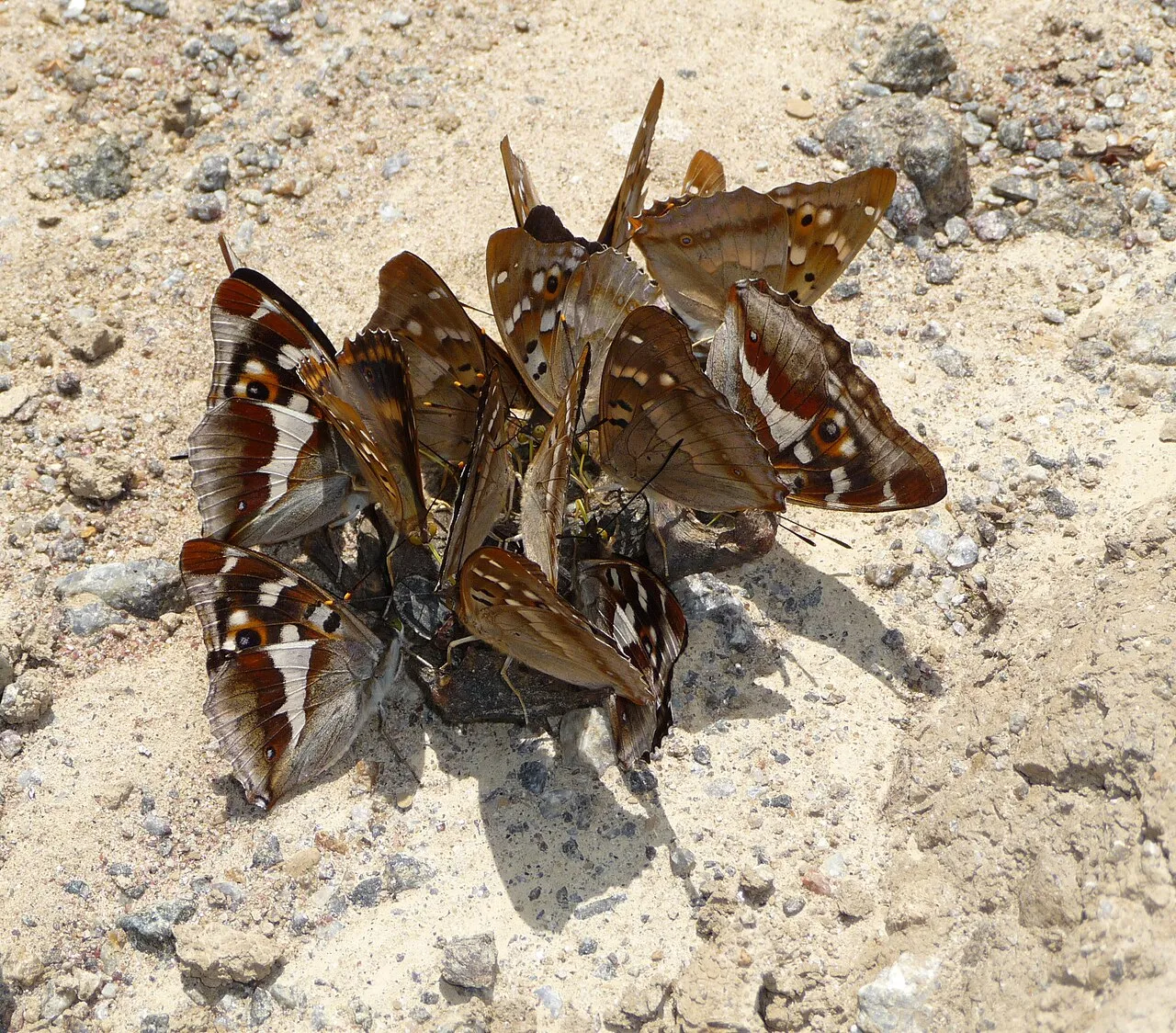
The flight is quick, often gliding several metres above the ground, and on the ground the butterfly sucks fluids from rotting fruit and moist soil. It also sometimes sucks sap from wounds in trees. It is a territorial species that defends its area2 against any other butterfly, including those of other species.
Similar species
Lepidoptera Mundi names Apatura iris and Apatura metis3 as similar species.
- Purple emperor (Apatura iris): the lesser purple emperor has an orange eyespot on the forewing2 in both its forms, which tells the two apart.
- Freyer’s purple emperor (Apatura metis): it resembles the lesser purple emperor but has a stepped protrusion on the hindwing’s postdiscal band4, in the middle of its outer edge.
_-_Blue_Pansy_(Female_DSF)_(5)_WLB_1XtyjN.webp)
_female_Dobruja_26TKKb.webp)
_female_Macedonia_Z3684v.webp)