Contents
The pearl-bordered fritillary, Boloria euphrosyne, is a small orange-and-black fritillary of sunny woodland clearings, and one of the earliest fritillaries to emerge each year. It belongs to the family Nymphalidae, in the genus Boloria, and eight subspecies are recognised across its range, from western Europe to Transbaikalia and the Caucasus. The species ranges across Europe from Scandinavia to northern Spain and Ireland, and east through the Palearctic to Russia and northern Kazakhstan. In the British Isles it survives in scattered colonies in England, Wales and Scotland, with a few remaining sites in western Ireland.
Identification
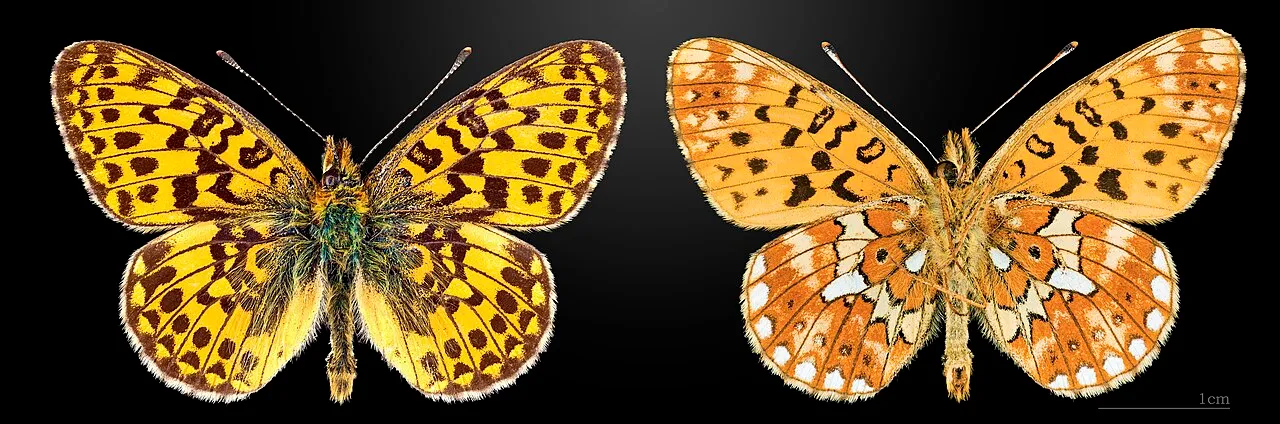
It is a small butterfly, with a wingspan of 38 to 47 mm; males run from about 38 to 46 mm and females from about 43 to 47 mm. The upperside is orange with black spots, and females show darker markings and rounder wings than males. Like its close relative the small pearl-bordered fritillary, it takes its name from the row of silver-pearly markings along the edge of the hindwing underside, set against a reddish-brown ground colour that gives excellent camouflage against dead bracken at breeding sites. A triangular marking along the pearl border and a single silver spot set among yellow markings are the surest check against the small pearl-bordered fritillary, described further under Similar species below; timing helps too, since this species emerges earlier and looks paler than the small pearl-bordered fritillary, which flies from about two weeks later. The caterpillar is black, with white or yellow spines along its back.
Range and habitat
The pearl-bordered fritillary favours woodland clearings, recently coppiced or clear-felled areas, and mosaics of bracken and grass on woodland edges, with the best sites carrying roughly one-third grass to two-thirds bracken. Such ground is usually most suitable two to four years after cutting, once violets and nectar sources have had time to become abundant but before scrub closes the canopy again. In Britain it is now confined to scattered, isolated colonies, chiefly southwest of a line from Denbighshire to East Kent, with outlying populations in Westmorland and West Lancashire and a scatter of sites in central Scotland; in Ireland it survives on the limestone pavements of the Burren, in Clare and south-east Galway.
This dependence on a particular stage of woodland management, rather than on woodland as such, explains why the butterfly can disappear quickly from a site once coppicing or felling stops: in England and Wales, along with ten other European countries, it has declined rapidly in number and is now a highly threatened species, a fall that monitoring schemes attribute chiefly to the end of traditional woodland coppicing.
Life cycle and host plants
Caterpillars feed on violets, chiefly common dog-violet (Viola riviniana), with heath dog-violet (Viola canina) and marsh violet (Viola palustris) also used. Females lay their pale yellow eggs singly on dead bracken or leaf litter close to the violets, from mid-May to the end of June, and the eggs hatch after 10 to 14 days. The young caterpillars feed at once and moult three times over five to six weeks before moving to a hibernation site, usually at the end of July, losing around half their body weight in the process. The species overwinters as a part-grown caterpillar, sheltering in a curled dead leaf at the base of the foodplant, before resuming feeding in March and completing its growth after a final moult. Pupation follows among the leaf litter, and the chrysalis stage lasts only 10 to 14 days.
Behaviour and flight period
Adults are on the wing from late April to June across most of the range, with a partial second brood flying in August where conditions allow. Males patrol low over breeding sites in search of females, investigating any reddish-brown object that might be a mate, while a female ready to mate flies up to an elevated perch, and a pairing may stay together for thirty to sixty minutes. When laying, females fly low and slowly over the ground, searching deliberately for suitable patches of foodplant rather than settling directly on the violets themselves. Adults feed at bugle, bluebell, buttercups, bird’s-foot trefoil, dandelions, hawkweeds, ragged-robin, selfheal, thistles and tormentil. The species keeps close to the warm, sheltered conditions that newly opened woodland provides, and rarely strays far from such ground even where it is locally common.
Similar species
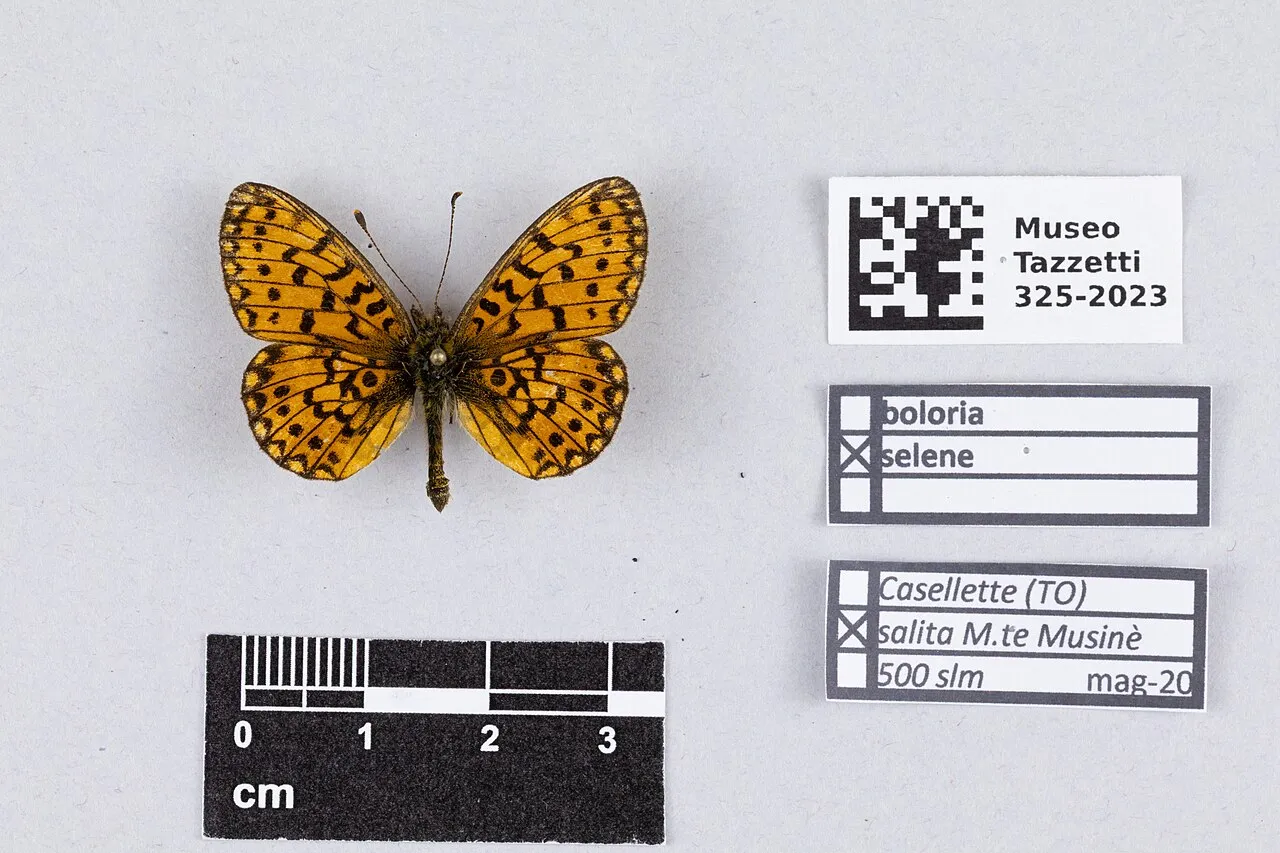
- Small pearl-bordered fritillary (Boloria selene): the closest look-alike, told apart chiefly by the underside hindwing pattern, where the pearl-bordered fritillary shows a single large silver-centred spot near the middle of the wing that selene lacks, and by timing, since selene typically flies around two weeks later in the season.
- Marsh fritillary (Euphydryas aurinia): a similarly small, orange-patterned fritillary of damp grassland and woodland margins, distinguished by its more checkered, less streaked upperside pattern.
_dia-001_Z2riDe4.webp)
_kkJaX.webp)
_2r3CXC.webp)