Contents
The marbled fritillary, Brenthis daphne, is a mid-sized orange butterfly of warm woodland edges across the Palearctic, described by Bergsträsser in 1780 and named in the classical tradition after Daphne, a naiad of Greek mythology associated with fountains, wells, springs, streams and brooks. It belongs to the family Nymphalidae, in the tribe Argynnini. Its genus, Brenthis, erected by Jacob Hübner in 1819, is small, holding only four species: Brenthis daphne; the lesser marbled fritillary Brenthis ino; the twin-spot fritillary Brenthis hecate, found from south-western Europe through the Balkans and Asia Minor to Central Asia; and Brenthis mofidii, known only from Iran. Seven subspecies of Brenthis daphne are recognised across its range: the nominate B. d. daphne in Europe, B. d. ochroleuca in the Caucasus and western Siberia, B. d. fumidia in Korea, B. d. rabdia in Japan, and the more narrowly distributed B. d. nikator, B. d. japygia and B. d. iwatensis. The species ranges from southern and central continental Europe — northern Spain, southern France, Germany, Italy, east to Slovakia and Greece — through the Caucasus and western Siberia to Korea and Japan, a span that carries the species from the edge of western Europe to the Pacific coast of East Asia.
Identification
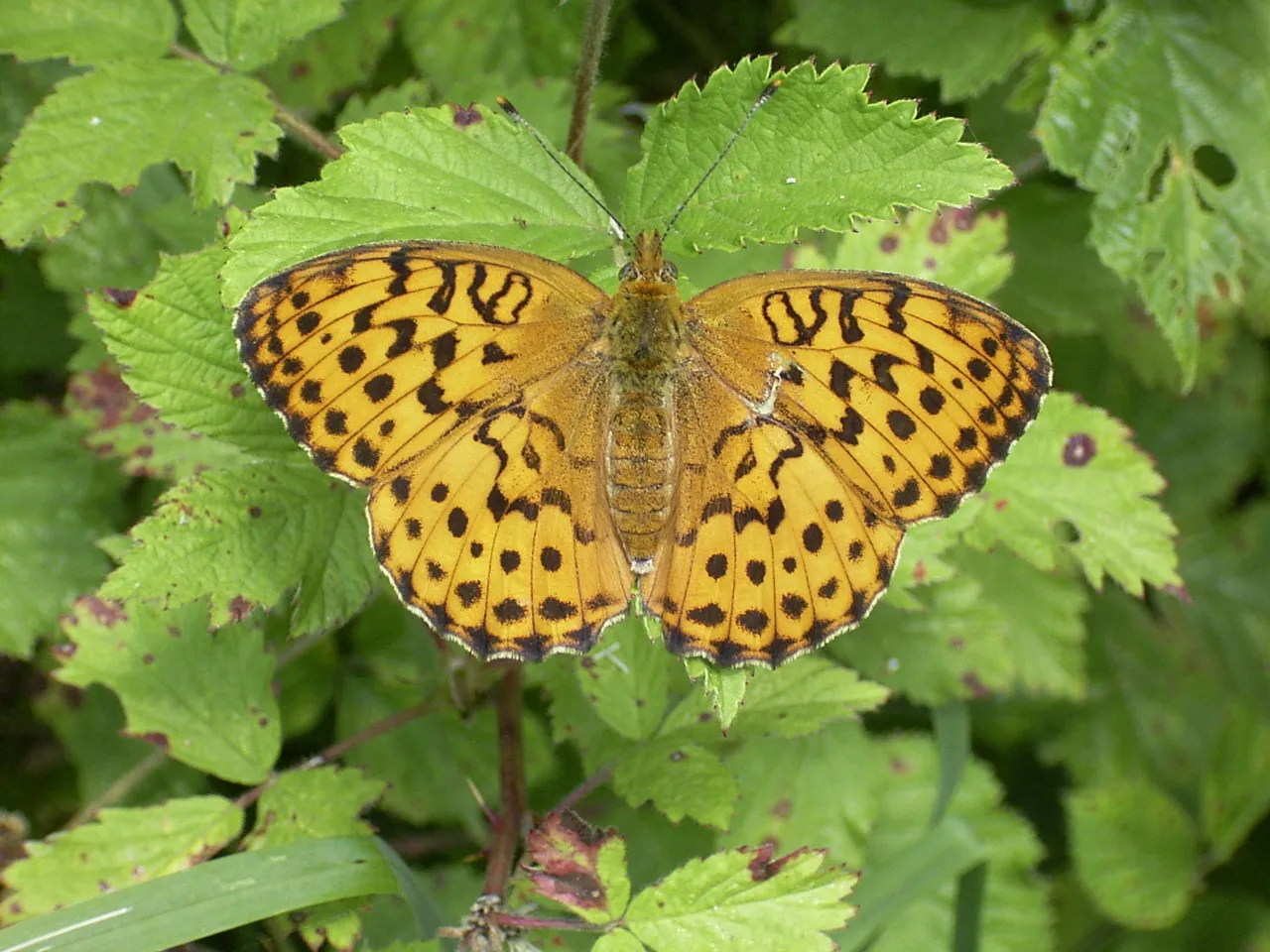
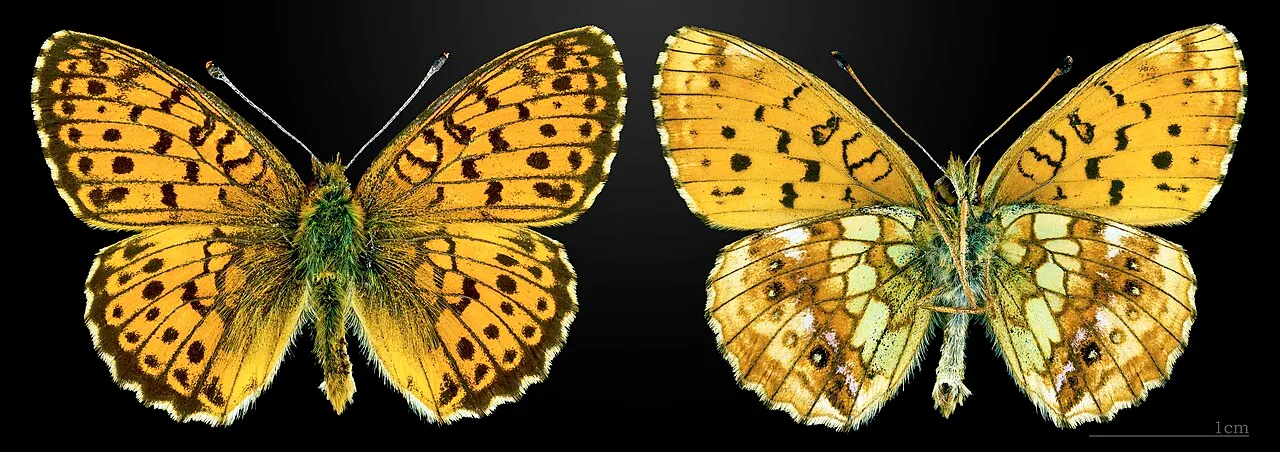
It is a mid-sized butterfly, with a wingspan of 30 to 44 millimetres. The wings are rounded, and the upperside is bright orange with a black marginal band. The underside is where the species earns its name: the hindwing carries a yellowish postdiscal band overlaid with a purple marginal suffusion, which together give the wing a marbled effect. That purple-shaded patch is the quickest way to tell it apart from its closest relative, the lesser marbled fritillary, since in that species the equivalent patch is slightly smaller and coloured entirely yellow, without any purple shading. Before it reaches that adult form, the chrysalis carries two dorsal rows of thorns with bright spots and a metallic shine.
Range and habitat
The marbled fritillary prefers warm, sunny forest edges, woodland clearings and bushy areas, the kind of ground where its bramble host plants thrive along a sunlit margin. It is found at elevations from about 75 to 1,750 metres, tracking the availability of food plants rather than any one altitude band. Across its wide Palearctic range the habitat stays consistent: a warm, bushy edge rather than deep closed-canopy forest or open treeless ground. Adults feed on nectar from brambles, thistles and other flowers growing along those same sunlit margins, so a single patch of scrub can supply both the caterpillars’ foliage and the adults’ nectar.
Life cycle and host plants
Caterpillars feed on brambles (Rubus fruticosus), raspberry (Rubus idaeus), Rubus caesius, Rubus sachalinensis, Sanguisorba officinalis and Filipendula species, a mix of rose-family shrubs and herbaceous meadow plants that explains why the butterfly favours bushy, bramble-tangled edges. Females lay their eggs separately in July, scattering them rather than laying in clusters. The species overwinters as a caterpillar still inside the egg shell, hatching only the following spring to begin feeding on the fresh growth of its host plants. It completes a single generation each year, univoltine like most fritillaries of temperate latitudes.
Behaviour and flight period
Adults are on the wing from late May to early August, a flight window that spans the whole of the European and Siberian summer. With only one generation a year, that long window reflects the spread of emergence across the species’ broad range rather than repeated broods: populations at the southern and lower-altitude edge of the range emerge earlier than those in cooler, higher or more northerly woodland.
Similar species
- Lesser marbled fritillary (Brenthis ino): its closest relative and the easiest confusion, told apart by the underside hindwing patch — purple-shaded and slightly larger in Brenthis daphne, plain yellow and slightly smaller in Brenthis ino.
- Twin-spot fritillary (Brenthis hecate): the third member of the genus, found from south-western Europe through the Balkans and Asia Minor to Central Asia, well south and east of most marbled fritillary populations.
_kkJaX.webp)
_2r3CXC.webp)