Contents
The lesser marbled fritillary, Brenthis ino, is a small orange-brown fritillary of damp meadows across Eurasia, described by Rottemburg in 1775. It belongs to the family Nymphalidae, and within it to the subfamily Heliconiinae and the tribe Argynnini — the “greater fritillaries”, a tribe of orange, dark-marked butterflies that also holds the much larger genera Argynnis, Boloria and Issoria. The genus Brenthis, erected by Jacob Hübner in 1819, is small, holding only four species: Brenthis ino, the marbled fritillary Brenthis daphne (Europe east to Japan), the twin-spot fritillary Brenthis hecate (south-western Europe through the Balkans and Asia Minor to Central Asia), and Brenthis mofidii, the most narrowly distributed of the four, known only from Iran. Early naturalists described Brenthis ino more than once before the name settled: alongside Rottemburg’s Papilio ino, Schiffermüller called it Papilio dictynna and Bergsträsser named it Papilio parthenie, both now treated as synonyms. The species occurs in Spain, France, Italy, central and northern Europe, Siberia, temperate Asia, northern China and Japan, and entomologists recognise twelve subspecies across that range — the nominate B. i. ino in Europe, and eleven further named forms across the rest of the range: achasis, acrita, adalberti, amurensis, maxima, paidicus, parvimarginalis, schmitzi, siopelus, tigroides and trachalus.
Identification
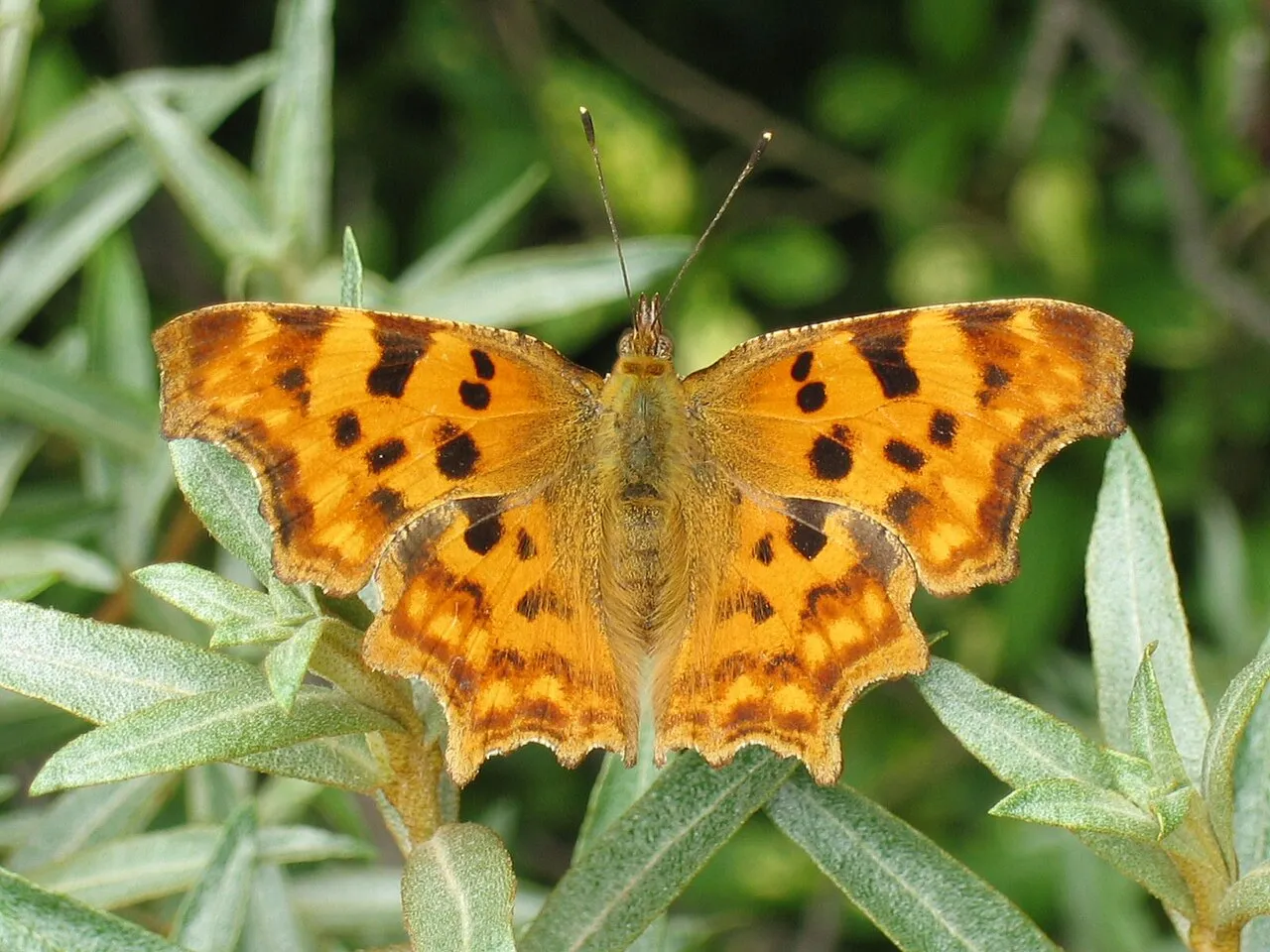
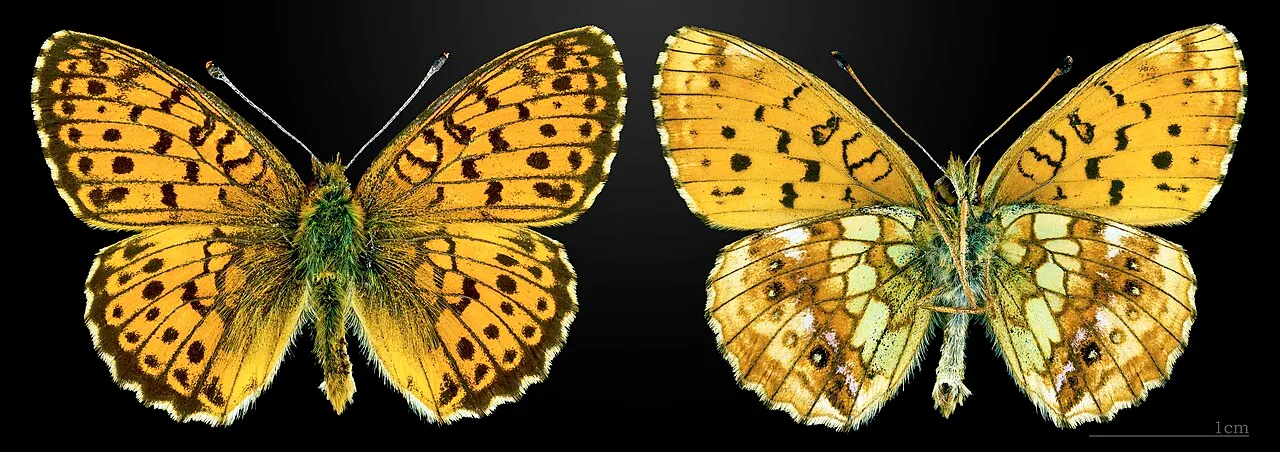
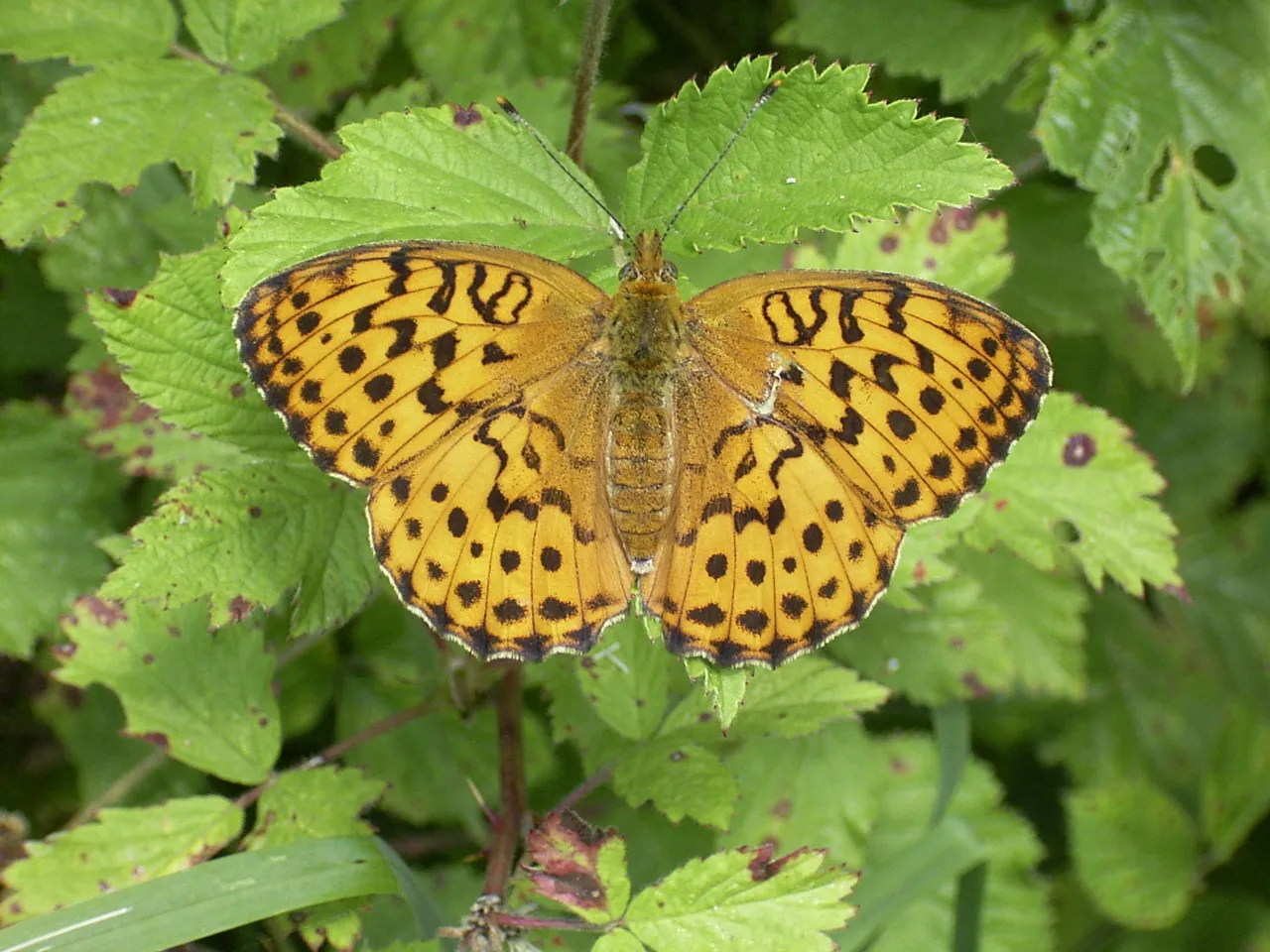
It is a small butterfly, with a wingspan of 34 to 42 mm. The upperside is orange with several dark brown blotches and brown-edged wings carrying a discontinuous row of small blotches. The underside is creamy orange with an indented edge and dark brown blotches on the forewings, while the hindwings show brown-edged beige blotches and some ringed dark brown and violet shading spots. Unlike many related fritillaries, the wings carry no silver blotches at all, which is the quickest way to rule out a look-alike, since several of its relatives in the same tribe carry bright silver spotting on the hindwing underside. The antennae are club-shaped, as in other fritillaries, and females run larger and usually darker than males, a difference that can be seen in the field once a pair is together on the same flower head.
Range and habitat
The species lives in damp meadows and bogs, from sea level up to about 1,500 m. That preference for wet, unimproved grassland, rather than the drier ground many other fritillaries use, is a useful clue alongside the wing pattern when placing a sighting. Across its wide Eurasian range, from Spain in the west to Japan in the east, the species tracks this one habitat type rather than a particular climate, turning up in alpine meadows in the south of its range and in lowland bogs further north.
Life cycle and host plants
Caterpillars feed on meadowsweet (Filipendula ulmaria), dropwort (Filipendula vulgaris), stone bramble (Rubus saxatilis), raspberry (Rubus idaeus), Aruncus species, Spiraea species and salad burnet (Sanguisorba minor), a wider spread of food plants than many fritillaries that depend on violets alone; all of these are plants of damp or shaded ground, matching the species’ habitat preference. The species overwinters as a caterpillar, resuming feeding on these plants once the weather turns in spring, before pupating and emerging as an adult in early summer.
Behaviour and flight period
Adults are on the wing from June to August, depending on location, a single flight period rather than the strung-out, multi-brood flight season seen in some of its more mobile relatives. Combined with its single overwintering stage as a caterpillar, this points to one generation a year across most of the range, with the exact timing shifting later with latitude and altitude.
Similar species
- Small pearl-bordered fritillary (Boloria selene): a fritillary of similarly damp, grassy ground, but it carries the silvery “pearl” spots along the hindwing underside that Brenthis ino entirely lacks.
- Queen of Spain fritillary (Issoria lathonia): told apart at a glance by the large, mirror-like silver patches on its hindwing underside, again absent in Brenthis ino.
- Marbled fritillary (Brenthis daphne): its closest relative, with a similar wingspan of 30 to 44 mm and no silver markings either, but the quadrangular patch on the underside hindwing is partly shaded orange-pink in Brenthis daphne, against a patch that is completely yellow in Brenthis ino, which is also the slightly smaller of the two.
_kkJaX.webp)
_2r3CXC.webp)