Contents
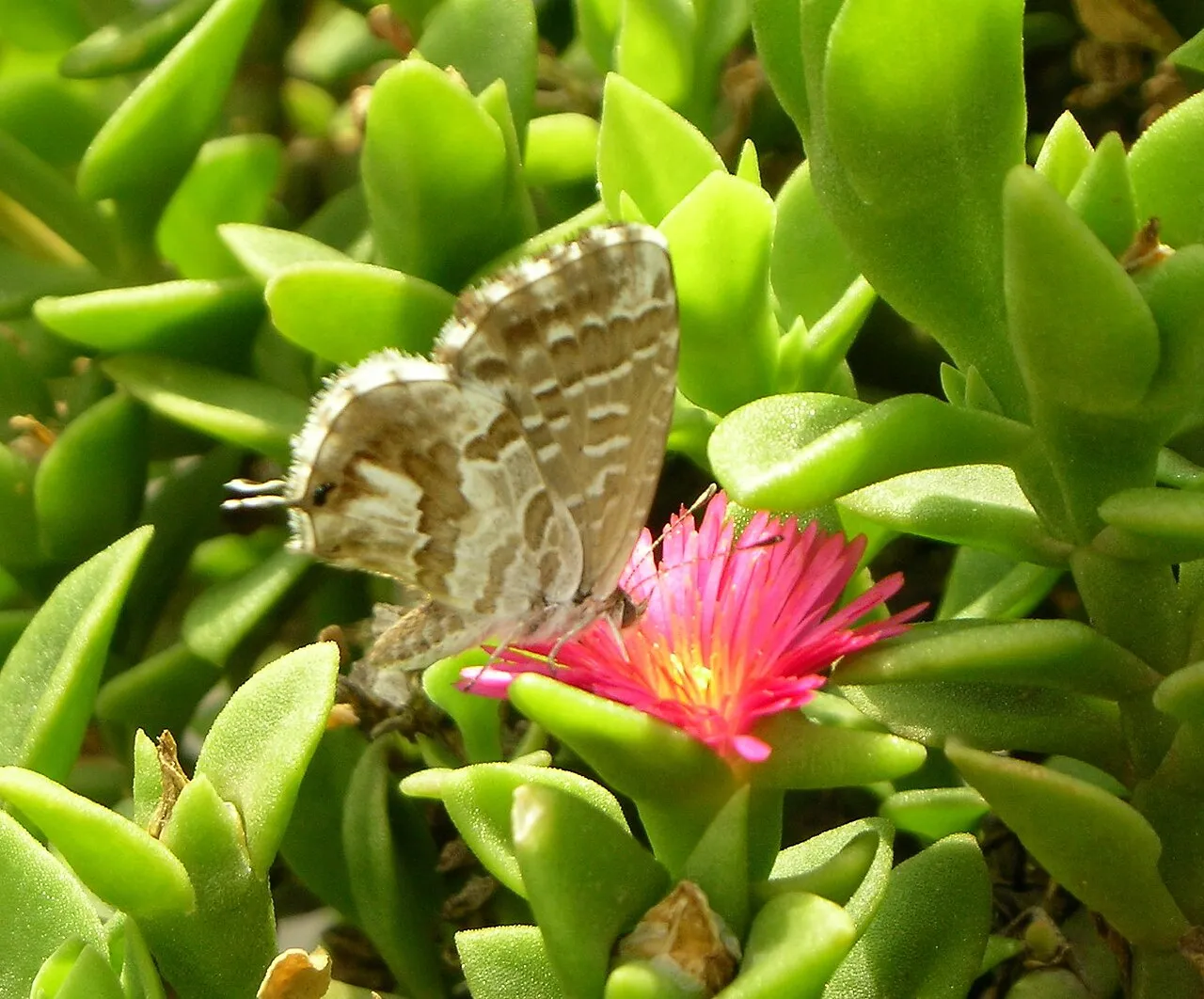
The geranium bronze, Cacyreus marshalli, is a small brown Lycaenidae butterfly native to southern Africa that has become one of Europe’s most familiar garden pests since hitching a ride to the continent in a shipment of pelargoniums. It belongs to the family Lycaenidae, and its caterpillars bore into the stems and flower buds of geraniums and pelargoniums rather than simply grazing on leaves. The species is native to South Africa, including KwaZulu-Natal and the Cape provinces, and was accidentally brought to Europe in 1978. From that first foothold it spread quickly, reaching Mallorca by 1990 and Rome by 1996, and is now established across much of southern and eastern Europe, including Spain, Italy, France and Greece.
Identification
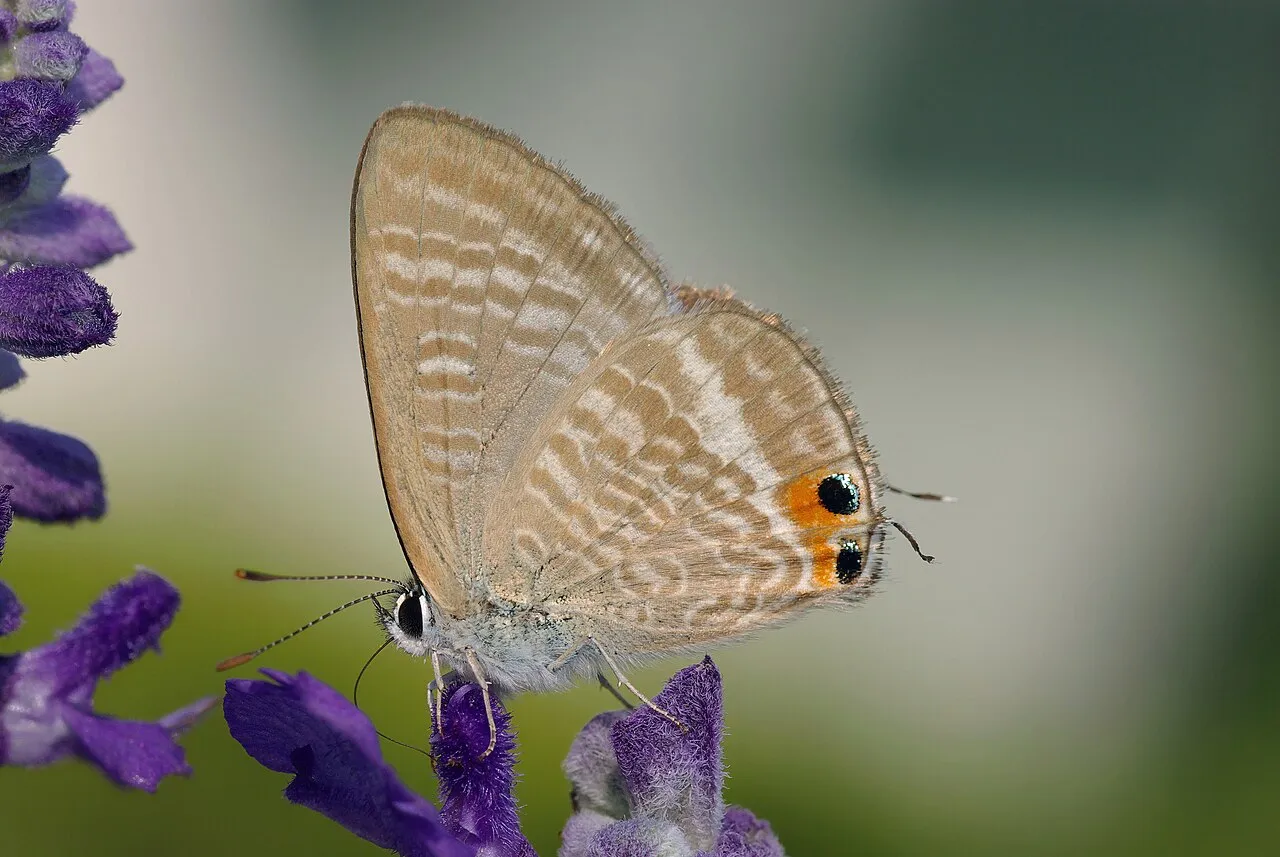
This is a small butterfly: males span 15 to 23 mm and females 18 to 23 mm. The upperside of the wings is brown with a bronze sheen and a white border outlining the margin, while the underside is grey-brown with darker bands interlaced with white, forming an intricate pattern, and the hindwing carries an eyespot that helps divert predators from the butterfly’s more vulnerable body. The hindwings also end in short tail-like projections, a feature that first confused the observer who recorded the species’ discovery in Britain, who briefly took it for a brown argus and then for a Lang’s short-tailed blue before noticing the tails on the hind wings. The male and female are similar in overall appearance, though one early British record described a specimen as smaller, darker and more distinctly marked, which may point to a male.
Range and habitat
Beyond its native South African range, the species now occurs across much of southern and eastern Europe. It lives wherever its host plants are grown, favouring gardens, parks and other cultivated areas with geranium and pelargonium plants, both ornamental and wild Geraniaceae. This close tie to a widely planted garden flower, rather than to any particular climate or terrain, is what has let it ride potted plants from one country to the next.
Life cycle and host plants
Caterpillars feed on Pelargonium and Geranium species, including cultivated garden geraniums; European populations also use Geranium sanguineum, G. sylvaticum and G. pratense. Females lay eggs mostly on top of and underneath leaves, less often on stems, favouring flower buds; the eggs are tiny, about 0.5 mm across and 0.3 mm high, changing from pale green to white and then to brown or yellow before hatching. Rather than grazing openly, newly hatched larvae drill into the stems and flower buds, and the stem typically turns black where it has been invaded — the clearest sign of an infestation on a garden pelargonium. Through four instars the caterpillar grows from about 1 mm to around 13 mm, each later stage taking some 8 to 9 days, and most caterpillars are yellow or green, sometimes with pink markings. The species is multivoltine, producing two or more broods per year, and overwinters as either a caterpillar or a pupa, though which of the two is not firmly established.
Behaviour and flight period
Where winters are mild, adults fly for most of the year, and in South Africa the flight period typically runs from August to May. Because the larvae feed hidden inside stems and buds rather than on exposed leaf surfaces, contact pesticides generally fail against them; growers have had more success with the bacterium Bacillus thuringiensis, and with insecticides such as diflubenzuron, flufenoxuron, hexaflumuron, lambda-cyhalothrin, alphamethrin and benfuracarb. The butterfly is now classed as an A2 quarantine pest for Europe and an A1 quarantine pest for Turkey, a reflection of the real economic damage it does to the ornamental geranium trade.
Conservation
The species is listed by the IUCN under the category shown in the facts box, taken from its Wikidata record. Its conservation status in the wild is not a concern: unlike most butterflies on this site, the geranium bronze is a successful invader whose spread is managed as a pest problem rather than protected as a vulnerable population.
Similar species
- Brown argus (Aricia agestis): a native European lookalike at first glance, and the species a British observer initially mistook the geranium bronze for before noticing the tails on the hind wings.
- Lang’s short-tailed blue (Leptotes pirithous): another small, pale-marked, tailed Lycaenidae that has caused field confusion with the geranium bronze, again resolved only once the tails and underside pattern were compared closely.
_male_Turna_Ewa2f.webp)
_07-05-2006_1_ZJyP4Y.webp)
_Lycaena_virgaureae_-_Radawa_Poland_-_male_Z25L2d2.webp)