Contents
Lang’s short-tailed blue, Leptotes pirithous, is a small butterfly of the family Lycaenidae, a member of the genus Leptotes alongside other short-tailed blues of the Old World tropics and subtropics. It is a strong migrant, and its core range runs from southern Europe and the Mediterranean coast across Asia Minor east to the Himalayas, through most of Africa and Madagascar, with wanderers occasionally turning up far north of this range.
Identification
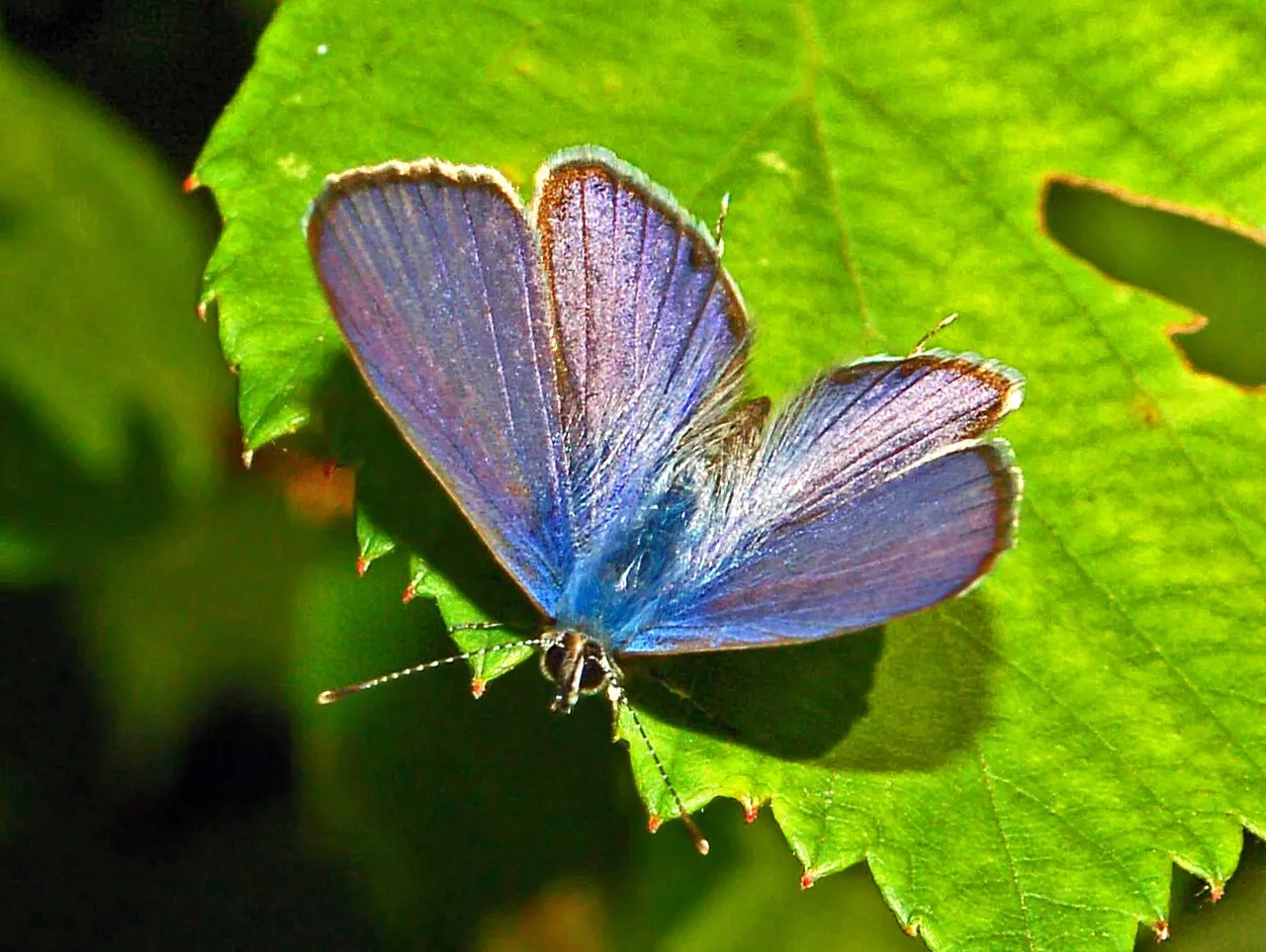
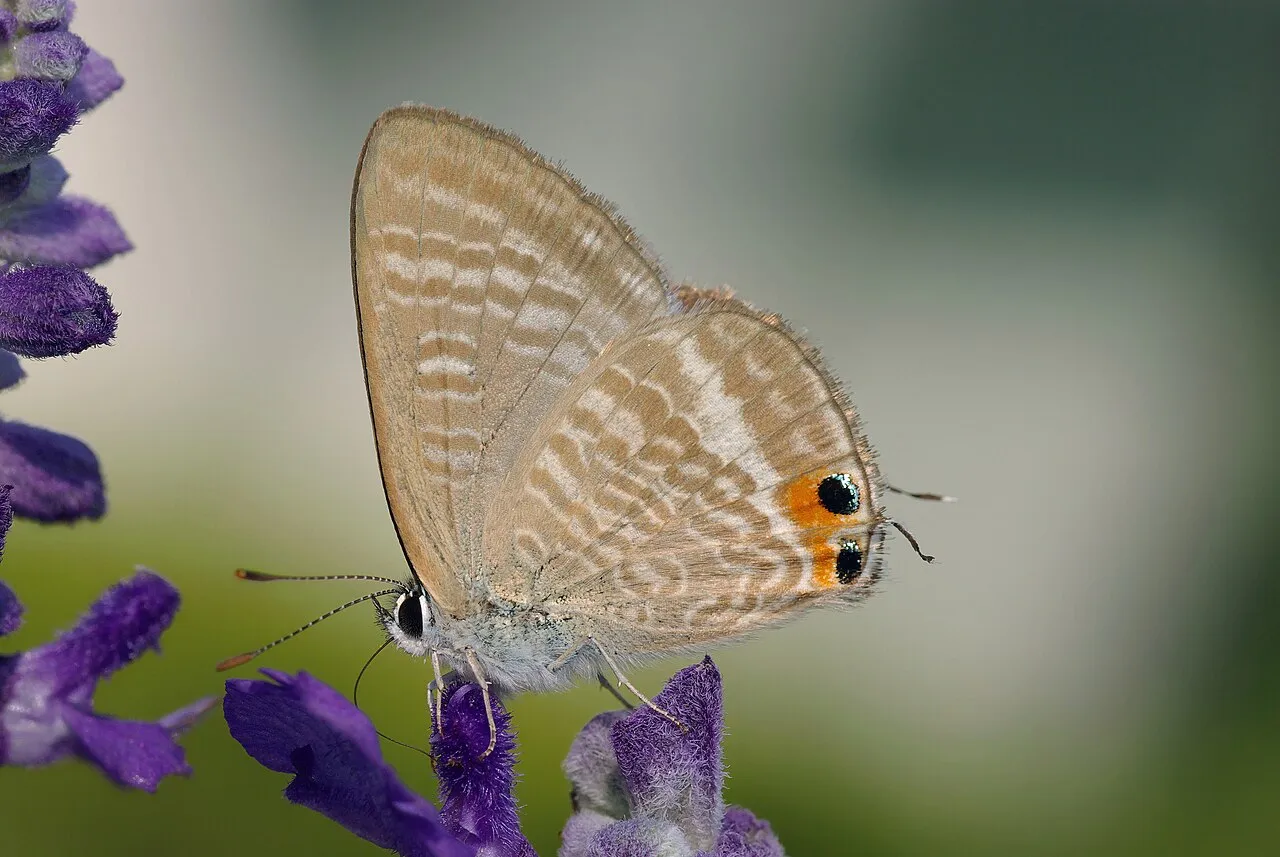
This is a tiny butterfly, with a wingspan of 21 to 30 mm. The sexes differ in both size and colour: males have purple-blue uppersides and a wingspan of about 21–29 mm, while females run slightly larger, at 24–30 mm, with bluish-brown uppersides. Both sexes share the same underside pattern, dark beige with fine white striations and marginal orange and black spots on the hindwing, with intense blue rings around the anal spots. As in other members of its genus, both sexes also carry a short, thin tail on each hindwing, the feature that gives the species its common name. This underside design is close enough to that of Lampides boeticus and Cacyreus marshalli that all three are easily confused in the field, and the tails and anal-spot rings are the most reliable field marks for telling Lang’s short-tailed blue apart.
Range and habitat
Lang’s short-tailed blue is not a fussy butterfly. It lives in varied natural habitats as well as cultivated land and gardens, which helps explain how it keeps turning up well beyond its main breeding range. Its strongholds are the warm south: the Mediterranean basin, Asia Minor, the Himalayan foothills, most of Africa and Madagascar, but as a regular migrant that appears to migrate in certain years, it is capable of reaching cooler regions far to the north in some years. Its tolerance of gardens and farmland, and not only wild habitat, is part of what makes those northward movements possible: a wandering adult has a reasonable chance of finding a plant it can use for egg-laying even well outside the species’ usual haunts.
Life cycle and host plants
Caterpillars feed mainly on legumes (family Fabaceae), but also take plants from two other families entirely. Recorded host plants include melilots (Melilotus), alfalfa (Medicago sativa), Egyptian clover (Trifolium alexandrinum), indigo (Indigofera), cowpea (Vigna) and gorse (Ulex) among the legumes, hawthorn (Crataegus), a member of the rose family, Rosaceae, and, further from the typical blue-butterfly diet, leadwort (Plumbago capensis) of the family Plumbaginaceae, along with broom (Genista), heather (Calluna vulgaris) and purple loosestrife (Lythrum salicaria). That spread across unrelated plant families, from legumes to leadworts, is unusually broad for a Lycaenid caterpillar and likely helps the species establish itself wherever it wanders. The species runs through multiple generations a year, with a life cycle of about four to eight weeks depending on temperature, producing distinct spring and autumn broods.
Behaviour and flight period
Adults are on the wing for most of the warmer part of the year, flying from February to November depending on location. That long season, combined with the short generation time, lets the species push outward from its core range in most years, only to be beaten back by winter where it cannot survive the cold. The species is described as a regular migrant that appears to migrate in certain years rather than every year, so the scale of any given year’s push north varies: in some seasons wanderers are scarce, while in others they turn up well beyond the Mediterranean core range described above.
Conservation
The IUCN category in the facts box comes from the species’ Wikidata record. Given its wide range, strong migratory habit and tolerance of gardens and farmland, Lang’s short-tailed blue is not thought to be at risk.
Similar species
- Short-tailed blue (Cupido argiades): a similarly small, tailed Lycaenid, but one of the Palearctic rather than the Afrotropical and Oriental regions; the two overlap only at the edges of their ranges, in southern Europe.
- Long-tailed blue (Lampides boeticus): another wide-ranging migrant blue that shares much of Lang’s short-tailed blue’s range across Africa and Asia, but is larger and carries longer, more conspicuous tails with a false-head pattern on the underside.
_male_Turna_Ewa2f.webp)
_07-05-2006_1_ZJyP4Y.webp)
_Lycaena_virgaureae_-_Radawa_Poland_-_male_Z25L2d2.webp)