Contents
The long-tailed blue, Lampides boeticus, is a small, fast-flying butterfly of the family Lycaenidae, easily told apart from other blues by the thin tails on its hindwings. It is one of the most widely distributed butterflies in the world: the species is widespread across Europe, Africa, South and Southeast Asia, Australia, the Hawaiian Islands and the Maldives, and self-introduced to New Zealand, where it was first recorded in 1965.
Identification
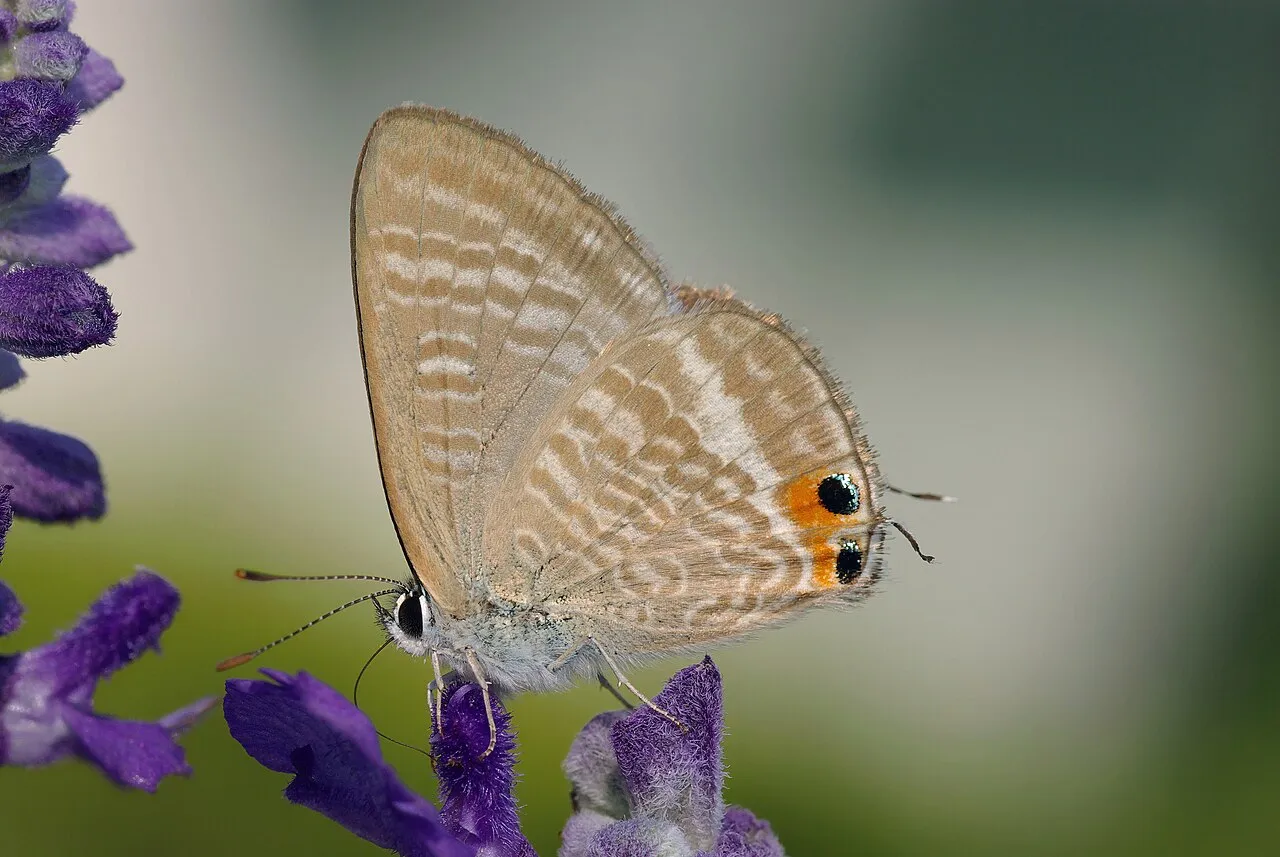
This is a small butterfly, with a wingspan of 24 to 34 mm. The sexes differ above. The male has a mainly blue-violet upperside with brown edges, while the female shows only a small amount of blue in the centre of the wings and more extensive brown. The underside is the more distinctive side: it is ochreous with white markings and a prominent white submarginal streak. Both sexes carry the species’ signature feature, a thin, long tail on each hindwing and two black spots near the anal angle. Those spots do double duty as a decoy: the underside of each hindwing shows a pair of small black eyespots beside the tails, together with an orange marginal spot at the anal angle, a pattern that mimics a false head and is thought to misdirect predators away from the real head.
Range and habitat
Few butterflies cover as much ground. Beyond its core range across Europe, Africa and Asia to Australia and the Pacific, the long-tailed blue also turns up in the Hawaiian Islands and the Maldives. It favours forest edges, mountain meadows and other hot, flowery places, from the lowlands up to about 2,700 m elevation.
Life cycle and host plants
Caterpillars feed on a broad range of legumes. Host plants recorded for the species span various Fabaceae genera, including Medicago, Crotalaria, Polygala, Sutherlandia, Dolichos, Cytisus, Spartium and Lathyrus. With such a wide choice of food plants across such a wide range, the species can turn up wherever its host legumes grow, including gardens and farmland where peas and other pulses are cultivated.
Behaviour and flight period
The long-tailed blue is a strong flier and a persistent colonist. Adults are on the wing from February to early November, with multiple generations overlapping through the season, and the species can produce up to three generations a year. That combination of strong flight and a long breeding season helps explain its unusually wide, and still expanding, distribution.
Conservation
The species is assessed as shown in the facts box, taken from its Wikidata record. A butterfly this widespread and adaptable, breeding on common legumes across six continents’ worth of range, faces no particular threat as a species, even where individual populations fluctuate with the weather and the availability of host plants.
Similar species
- Lang’s short-tailed blue (Leptotes pirithous): a close look-alike that shares the tailed hindwings and false-head pattern, but the long-tailed blue is noticeably larger than both this species and the next.
- Geranium bronze (Cacyreus marshalli): another small tailed blue it can be confused with, again distinguished mainly by its larger size.
_male_Turna_Ewa2f.webp)
_07-05-2006_1_ZJyP4Y.webp)
_Lycaena_virgaureae_-_Radawa_Poland_-_male_Z25L2d2.webp)