Contents
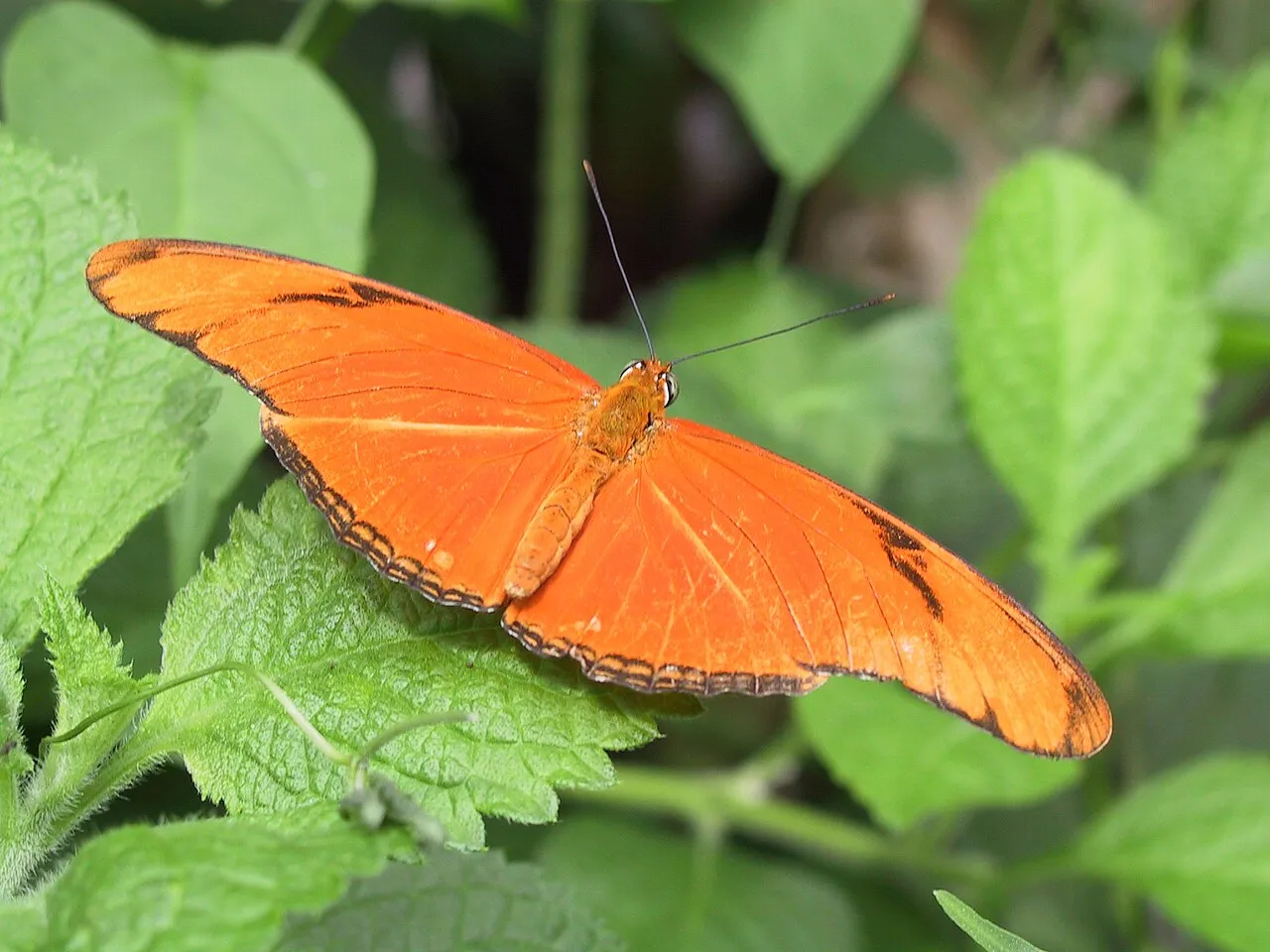
The Julia butterfly, Dryas iulia, is a long-winged orange butterfly of the family Nymphalidae, named for the passionflower vines its caterpillars eat. Fabricius first described it in 1775 as Papilio iulia, and its name is often misspelled “julia” rather than the correct “iulia”. It ranges across the Americas, from Brazil through the Caribbean and Central America to southern Texas and Florida, and strays as far north as Nebraska in summer. Over 15 subspecies have been described, and black markings, which vary by subspecies, sit mainly near the wing tips.
Identification
The Julia is a medium-to-large butterfly with elongated orange wings, a wingspan of 82 to 92 mm, and black markings that vary by subspecies. The sexes differ in shade rather than pattern: the male is a brighter orange than the female, whose orange is duller, and in both sexes the black markings sit mainly near the wing tips. The narrow, elongated wing shape is itself a useful field mark among the orange butterflies that share its range.
Range and habitat
The Julia is a butterfly of open, sunny breaks in subtropical and tropical forest, and it is common in gardens, cattle-grazing land and forest clearings rather than deep forest interior. Within its broad range from Brazil to the southern United States, Florida and southern Texas hold resident populations, while records further north, up to Nebraska, are summer strays.
Life cycle and host plants
Caterpillars feed on passionflowers, including the species Passiflora affinis and the yellow passionflower P. lutea, drawn from host plants in the subgenera Astrophea, Polyanthea, Tryphostemmatoides and Plectostemma. Females lay their eggs separately on the new leaf tendrils of the host vine; each egg is about 1.2 mm high and 1.0 mm across, pale yellow when laid and turning darker orange or brown before it hatches. The caterpillar that emerges is pink, grey and black, covered in long, branched black spines, with a cream-coloured mark shaped like an inverted Y on its head. It pupates in a greyish-white chrysalis that resembles a dead leaf, an effective disguise against the forest-edge predators that hunt by sight. The passionflower diet gives the Julia its chemical defence: like other Heliconians, it stores cyanide-based compounds from its host plant that make it unpalatable to predators, placing it in the “orange” Müllerian mimicry complex of distasteful butterflies sharing a similar warning colour. That same yellow fluid, oozing from the tips of the caterpillar’s spines, can raise a skin rash on a person who handles it.
The relationship between the Julia and its host plant is itself an arms race: some Passiflora vines defend their leaves by growing them tough and thick, or shedding small leaves that would otherwise look like good egg-laying sites within days of sprouting, and some species even grow stipules that mimic the butterfly’s own eggs to make a female fly on rather than lay.
Behaviour and flight period
Adults are short-lived, surviving less than a month, and they roost close to the ground, alone or in small groups. Its flight can be fast or slow, and it is usually seen patrolling the middle story of its forest habitat rather than the canopy or the ground. In southern Florida and southern Texas, the Julia flies year-round and is most abundant in the fall, with strays reaching further north in summer.
Both sexes take nectar, females visiting flowers such as Lantana and Eupatorium, but males show two further, more striking feeding habits. They gather at damp ground to drink dissolved minerals, a habit called mud-puddling, and some go further still, agitating the eyes of caimans and turtles to drink the tears this produces, a source of salts and nutrients scarce in nectar.
Courtship follows a set sequence of three phases, aerial, then air-ground, then ground, in which the male positions himself so the female can scent his scent scales. Females can mate up to four times in a lifetime, unusually often for a Heliconius-type butterfly, most of which mate only once. The Julia’s long adult life and constant daytime activity also make it a popular species in butterfly houses.
Similar species
- Gulf fritillary (Agraulis vanillae): another orange, passionflower-feeding Heliconian found through much of the same range, though its wings are more rounded than the Julia’s elongated shape and its underside carries large silver spots.
- Zebra longwing (Heliconius charithonia): a fellow member of the orange-and-black Heliconian mimicry complex sharing Florida and the Caribbean with the Julia, readily told apart by its black wings crossed with yellow-white stripes rather than solid orange.
_kkJaX.webp)
_2r3CXC.webp)
_2_rmr34.webp)