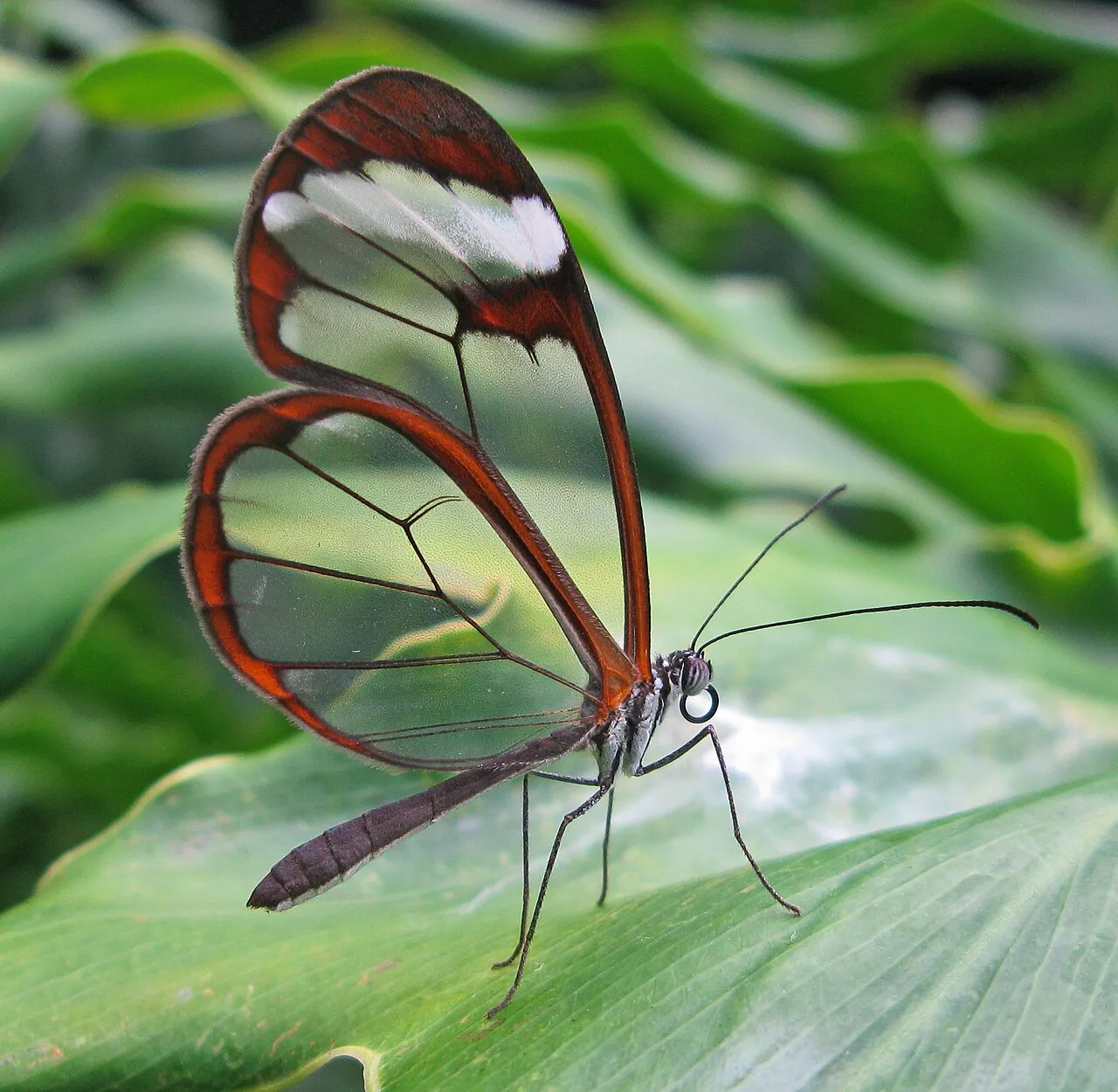
The glasswing butterfly, Greta oto, is a member of the tribe Ithomiini1 whose wings are naturally transparent. It was described by Hewitson in 1854 and is placed in the family Nymphalidae, subfamily Danainae2. In Spanish-speaking regions it may also be called espejitos, “little mirrors”, because of those wings. The butterfly is mainly found in Central America and northern South America, with sightings as far north as Texas and as far south as Chile. Its wings appear delicate, yet it can carry up to 40 times its own weight3.
Identification
The adult has a wingspan of 5.6 to 6.1 cm and a body 2.8 to 3.0 cm long3. Its wings are transparent with opaque, dark-brown borders tinted with red or orange, and its body is dark brown.
The clear panels show remarkably low haze and reflectance over the whole visible range, even at view angles as large as 80°. This anti-reflection effect is caused by small nanopillars covering the transparent regions of the wing. Unlike other anti-reflection coatings found in nature, these pillars are irregularly arranged, with a random height and width. Simulations by researchers at the Karlsruhe Institute of Technology4 showed that the random height of the pillars significantly reduces reflection, both for light striking the wing head-on and at high view angles.
Another study, which used electron and scanning probe microscopy on both the transparent parts and the brown “veins”, described the protuberances differently: as nanosized protuberances in a highly ordered array, similar to the “corneal nipple array” that other insects use against reflection. The same study notes that natural transparency is rare1 among the Lepidoptera.
Range and habitat
The glasswing is most commonly found from Central to South America3 as far south as Chile, with appearances as far north as Mexico and Texas. It thrives in the tropical conditions of the rainforests in the Central and South American countries.
The Butterflies and Moths of North America database holds one verified sighting, observed in Costa Rica in July 20172.
Life cycle and host plants
Eggs are typically laid on plants of the genus Cestrum, a member of the nightshade family, which serves as food for the later stages. Cestrum gives the caterpillar its best nutrition; when larvae use other host plants, they often die in the first instar3 or develop more slowly.
The caterpillar has a green body, with yellow stripes in later stages3. It is cylindrical, with smooth dorsal projections that carry filaments, and these make the larva extremely reflective, which essentially makes it invisible to predators. The caterpillar’s chemical extracts are unpalatable to Paraponera clavata ants.
The pupa is initially green with black specks, later becoming silver. During the fifth instar it produces a silk pad on the lower surface of a leaf through four spinning movements3, and attaches to it. The cremaster, a hooked, bristle-like structure on the pupa, grips the pad through a series of sideways movements of the hind abdomen. The attachment has high tensile strength and toughness, which keeps predators from pulling the pupa off and the wind from breaking it loose; it fails when the silk pad breaks.
Behaviour
The adult feeds mainly on the nectar of Lantana, a genus of 150 species3 of perennial flowering plants. It also eats flowers of the Asteraceae and Boraginaceae and the droppings of insectivorous birds, absorbing amino acids that are later converted to proteins.
The glasswing is migratory and travels up to 19 km a day at up to 13 km/h3. It migrates to change elevations, which causes differences in population density between areas.
The species mates polygynously3, with males trying to obtain one or more females per breeding season. To attract females, males form leks, or large gatherings, in shaded areas of the rainforest, where they compete and display themselves. During lekking they release pheromones derived from pyrrolizidine alkaloids taken from Asteraceae plants; the alkaloids are converted through the formation of a pyrrole ring, followed by ester cleavage and oxidation. Because the pheromone derives from plants, it is unlikely to be used to distinguish between species.
Birds are common predators of this butterfly3. Plant compounds from Cestrum and the Asteraceae, taken in by both the caterpillar and the butterfly, give it a foul taste that discourages predation. In flight it uses its transparency to hide by blending into the background. Transparency is rare among the Lepidoptera, which more commonly use mimicry to ward off predators.
Similar species
- Greta morgane, the thick-tipped greta: a clearwing with wings 56 to 58 mm long5, common in Mexico, Middle America and the Caribbean. It sits in the same subfamily, Danainae6, and the glasswing has been listed as Greta morgane oto2.
- Greta andromica, the Andromica clearwing7: the glasswing closely resembles3 this congener, whose subspecies range from Guatemala to Panama and into Venezuela, Colombia, Ecuador, Peru and Trinidad.
- Cithaerias pireta, the blushing phantom or pink-tipped glasswing satyr: found from Mexico south to South America8, but placed in a different subfamily, Satyrinae9.