Contents
The large chequered skipper, Heteropterus morpheus, is a small, dark skipper best known for the row of pale, mirror-like spots on its hindwing underside and a low, bouncing flight that is unlike most other skippers. It belongs to the family Hesperiidae and is the only species in its genus, Heteropterus. The butterfly ranges across continental Europe (the type locality is Samara, Russia) and east across the Palearctic to Central Asia and Korea, and maintains a small colony on Jersey in the Channel Islands, extinct there from 1996 until its rediscovery in 2020.
Identification
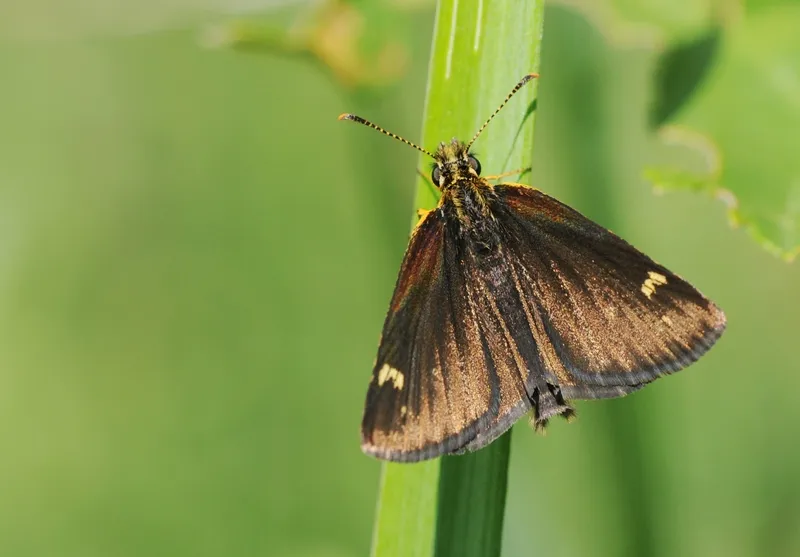
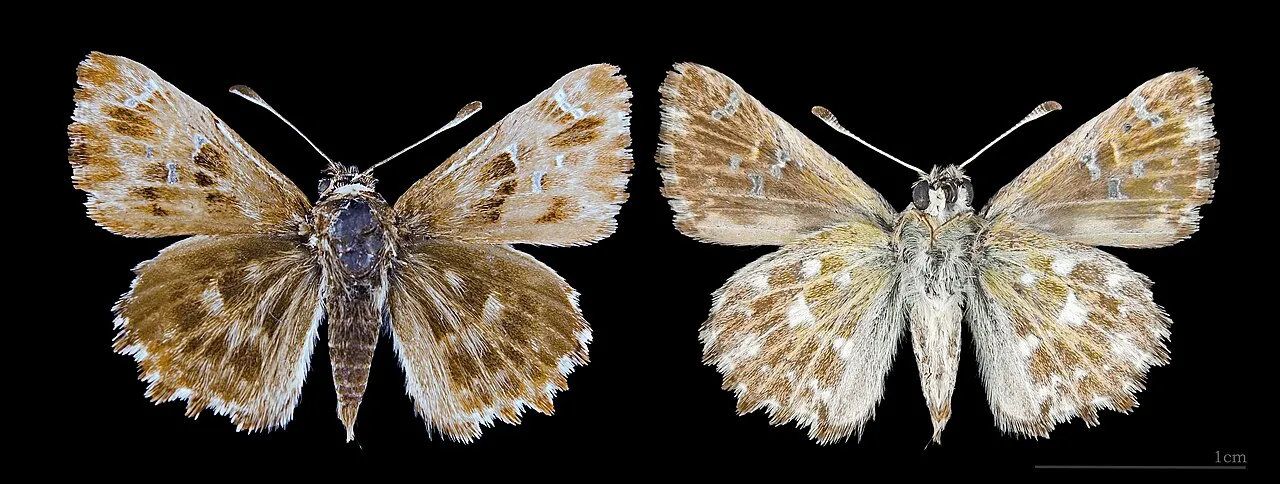
This is a small butterfly, with a wingspan of about 15 to 18 mm. The upperside is quite dark brown and rarely seen, since the butterfly usually settles with its wings closed. The underside is the distinctive side: the forewing is brown with three lines of white, oval spots edged in black and a white border cut with black, on an ochre ground, while the hindwing carries three rows of oval, mother-of-pearl spots ringed with small yellow spots, with a narrow yellow band near the margin. Those pale, glossy spots look like beads of water on glass, which is why the French call it “Le Miroir”, the mirror.
Range and habitat
The large chequered skipper favours damp, rough grassy places with damp soils: grasslands, road verges, stream edges, raised-bog margins and woodland clearings. In Jersey, the only British Isles site it has occupied, it lived in sheltered damp grassland dominated by Purple Moor-grass, on the edge of a bog.
Life cycle and host plants
Caterpillars feed on grasses, mainly Purple Moor-grass (Molinia caerulea) and Purple Small-reed (Calamagrostis canescens), with records also on Eriophorum, Poa annua and Brachypodium species. The caterpillar feeds until it is half-grown, around early October, before building a tube in which it hibernates, then emerges the following spring to resume feeding, overwintering as a caterpillar. The species is single-brooded throughout its range, producing one generation a year.
Behaviour and flight period
Adults are on the wing from June to August, depending on location; on Jersey, adults fly from mid-July to mid-August. The flight itself sets the species apart from most skippers: it moves in a series of low ‘hops’ or ‘bounces’ just above the ground rather than the fast, darting flight typical of the family.
Conservation
The species is listed by the IUCN under the category shown in the facts box, taken from its Wikidata record. Its history in the British Isles reflects that fragility: the Jersey colony, established after the butterfly was accidentally introduced around 1940–1945 in hay imported from France, died out in 1996 but was rediscovered in the north of the island in 2020.
Similar species
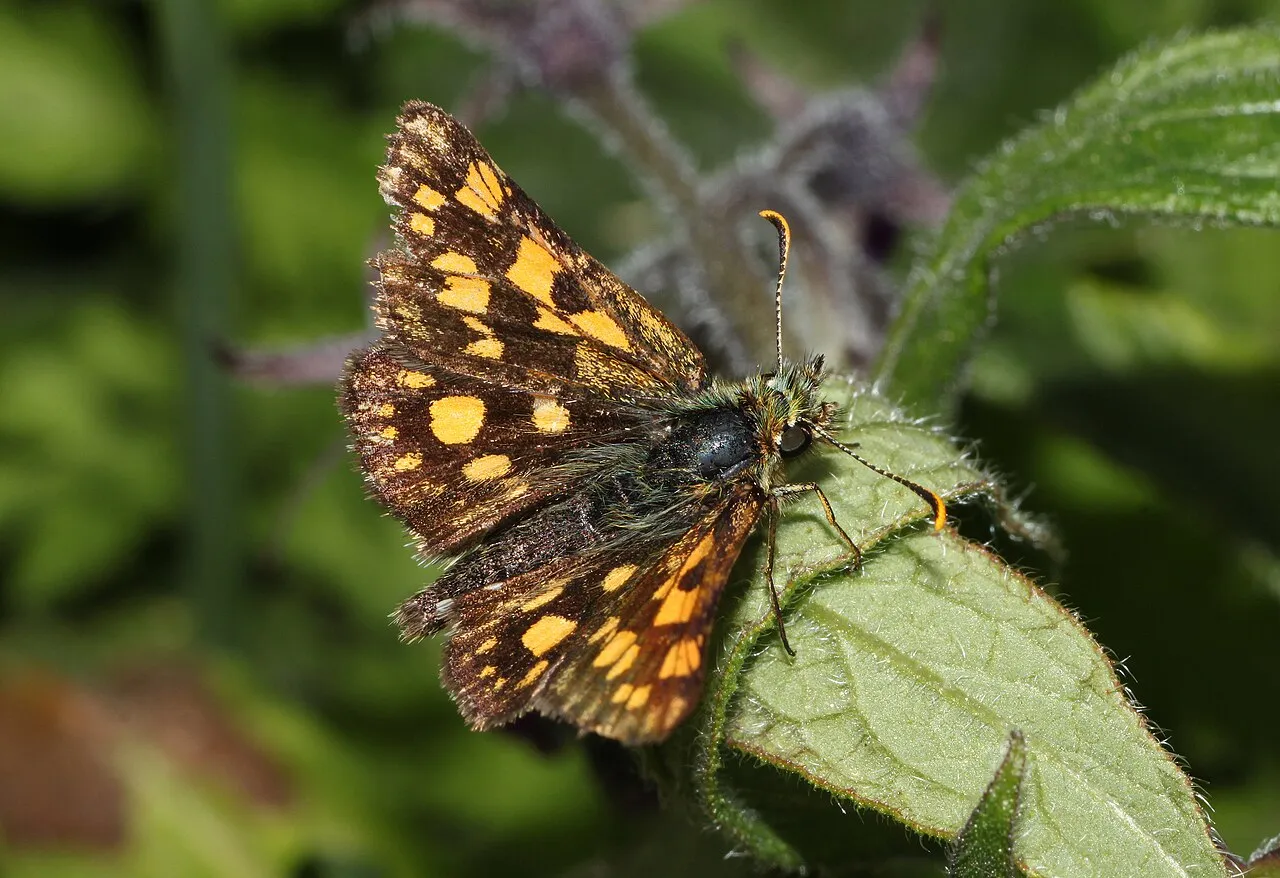
- Chequered skipper (Carterocephalus palaemon): another small, dark skipper with pale spotting, but its spots are golden-orange rather than mirror-white, and it flies earlier in spring. See its page.
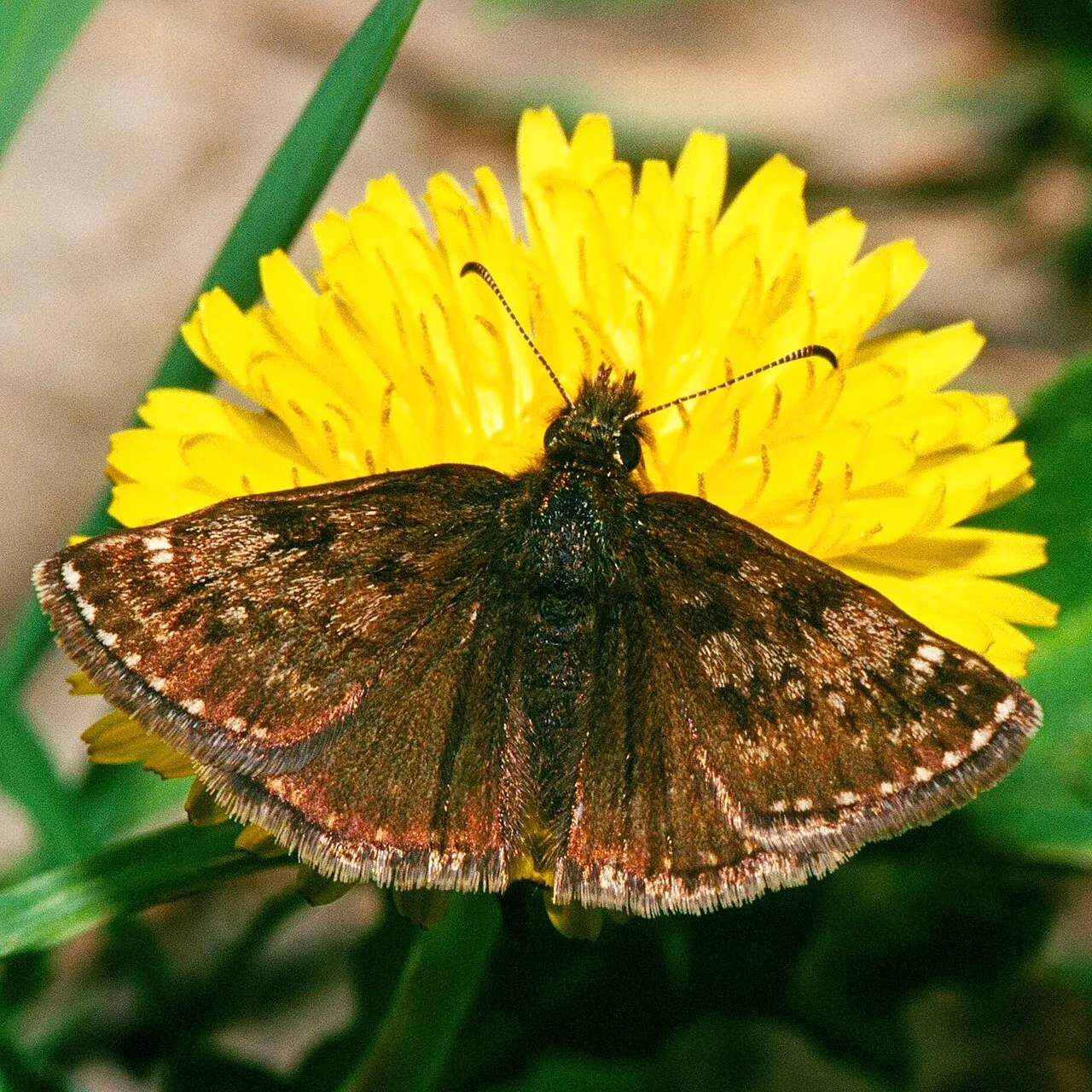
- Large skipper (Ochlodes sylvanus): larger and more orange-brown overall, lacking the large chequered skipper’s rows of pale, pearly underside spots. See its page.
_Z1PwpAL.webp)
_Thymelicus_lineola_-_St_Foy_d'Aigrefeuille_-_France_-_male_ZAC1oH.webp)
_Ochlodes_sylvanus_-_Foret_de_Bouconne__France_-_male_73F1g.webp)
_Thymelicus_sylvestris_-_Foret_de_Bouconne__France_-_male_Z1dCd98.webp)