Contents
The grizzled skipper, Pyrgus malvae, is a small, fast-flying butterfly of the family Hesperiidae, easy to overlook but easy to tell apart once seen well: its wings are chequered black and white rather than the orange-brown of most other skippers. It ranges across most of Europe, reaching north into Scandinavia and middle Finland, south into parts of Greece and some Mediterranean islands, and east into temperate Asia, though within the British Isles it is absent from Scotland, Ireland, the Isle of Man and the Channel Islands.
Identification
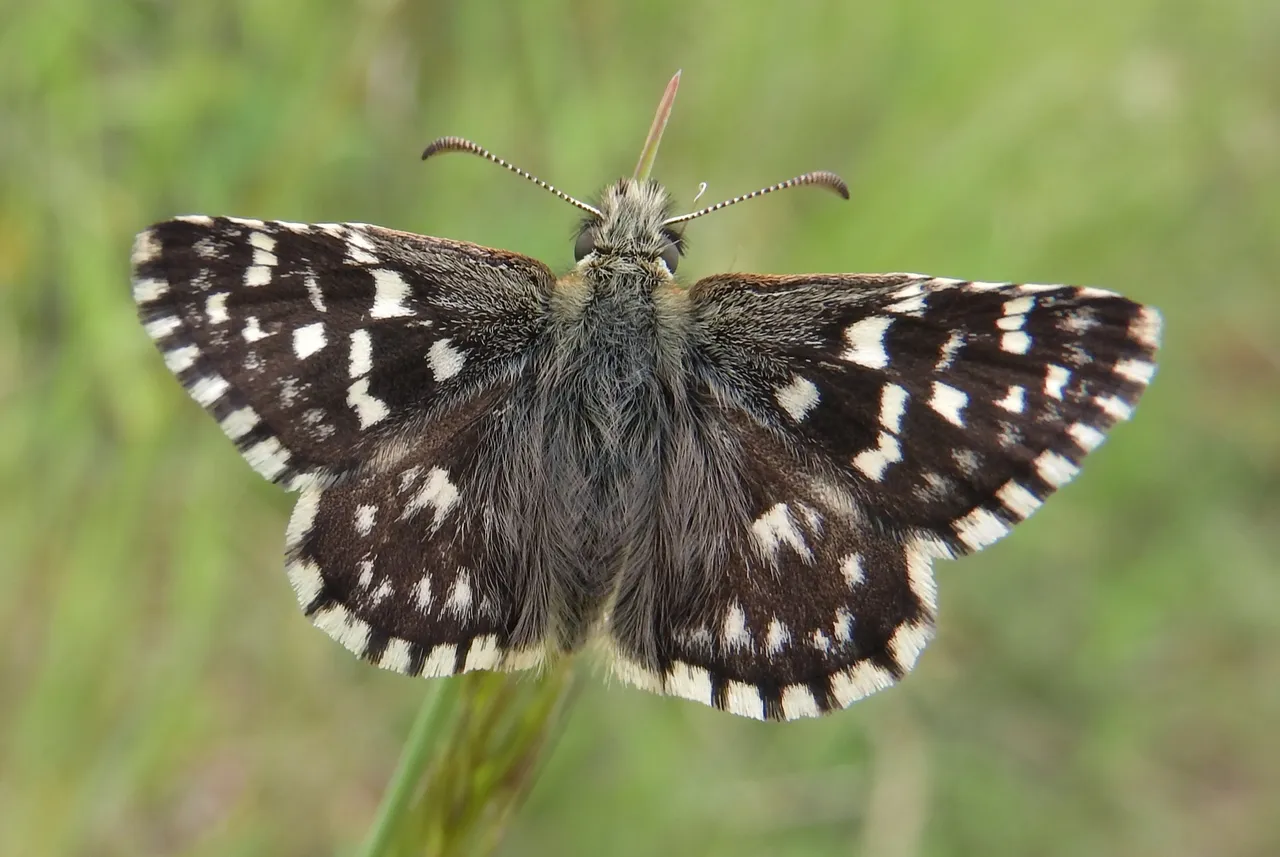
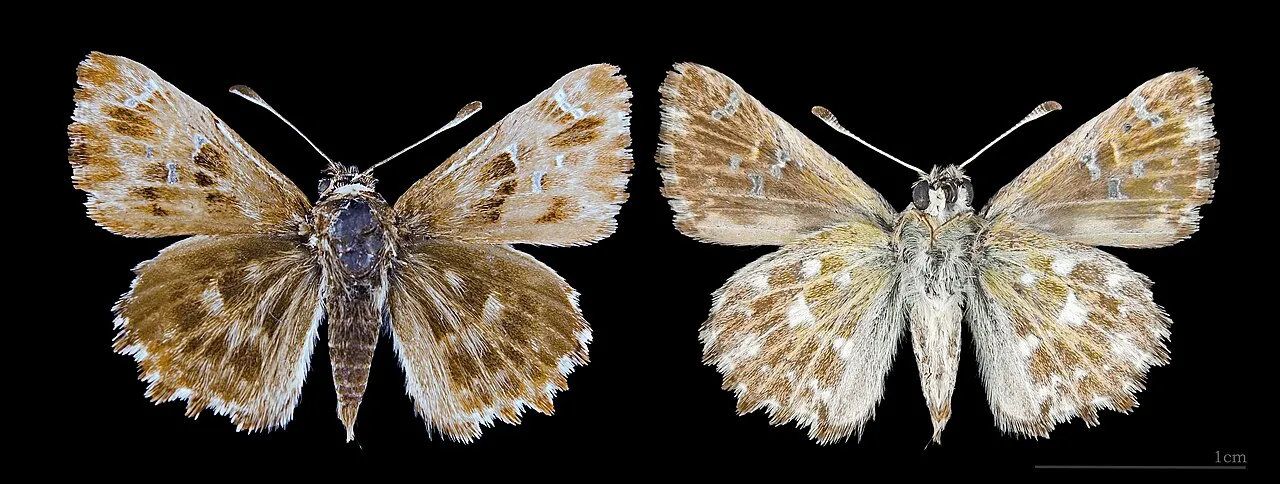
The grizzled skipper is one of the smallest butterflies on the wing in spring, with a wingspan of 23–29 mm and an average forewing length of around 12 mm. Both the upperside and the underside show the same strong chequered pattern of dark brown or black squares on a white ground, which gives the species its common name and separates it at a glance from the plain brown dingy skipper that flies alongside it. The sexes are similar, though males have slightly more angular forewings than the rounder-winged females, and the chequered pattern itself is variable enough that individual butterflies can often be told apart by their markings. The wing scales are also mildly adhesive, rough and strongly hydrophobic, a structure that sheds water and resists fouling without the wings losing their grip on a perch.
Range and habitat
Within its European range the grizzled skipper favours warm, sheltered sites with sparse vegetation: chalk downland, woodland edges and clearings, unimproved grassland, hillsides and valleys, and occasionally heathland or disturbed industrial ground. Wikipedia’s account of its habitat adds acidic or marshy grassland, shingle and sand dunes to that list, underlining how wide a range of open, sun-warmed ground the species can use. In England, where the butterfly was once found much more widely, colonies now lie mostly south of a line running from West Gloucestershire in the west to North Lincolnshire in the east, with scattered colonies further north and in Wales. Bare or lightly vegetated ground matters as much as the plants it feeds on, since the caterpillar’s foodplants need open conditions to grow and the adults need bare patches to bask. The same preference for broken, flower-rich turf runs through its range, from chalk hills in southern England to grassy clearings further east.
Life cycle and host plants
Caterpillars feed mainly on low-growing Rosaceae: agrimony (Agrimonia eupatoria), creeping cinquefoil, wild strawberry and tormentil (Potentilla species), as well as barren strawberry, salad burnet, bramble, dog-rose, raspberry, silverweed and wood avens. This broad diet within one plant family lets the species persist on sites where any single foodplant is scarce, so long as the ground stays open and sunny. Females lay their eggs singly on the underside of a foodplant leaf growing in a warm spot near bare ground, and the egg stage lasts about ten days before the caterpillar hatches. The caterpillar then passes through five instars over roughly two months, at first spinning silk across the leaf’s midrib for shelter and later drawing leaves together with silk, feeding mostly in the early morning and evening and resting for long stretches in between.
The species overwinters as a chrysalis, formed within a loose cocoon spun low among the foodplant’s stems, where it stays for around nine months before the adult emerges the following spring. Most populations fly as a single generation a year, though a partial second generation can appear in favourable conditions.
Behaviour and flight period
Adults are on the wing from mid-March to mid-July across most of the range, with English colonies typically flying from April to the end of June and an occasional small second brood appearing in favourable years. Despite their small size the butterflies fly fast and low over the ground, darting between flowers and settling to bask with wings spread flat on bare soil or short turf, a habit that helps them warm up quickly between short, rapid flights. Males defend a patch of ground and chase off other butterflies that enter it, courting any female that does so, while in food-poor habitats males instead perch on taller plants to wait for a mate rather than patrolling for one; scent-producing organs on the wings and legs let a male direct pheromones toward a female during this brief courtship. Adults favour blue and violet flowers for nectar and show little interest in white, yellow or red blooms, feeding on plants such as bugle, buttercups, common bird’s-foot-trefoil, daisy, dandelion, ground-ivy, ragged-robin, wild strawberry and wild thyme; in cool weather and at night they roost on flower heads and grass stems instead.
Conservation
The species is assessed as of Least Concern globally. That global picture hides losses in parts of its range: in Britain, where chalk grassland and other open, flower-rich habitats have shrunk and become more fragmented, the grizzled skipper has declined and disappeared from many former sites, and its occurrence fell by about 48% and its abundance by about 49% between 1976 and 2019, making it a regular target of habitat management on the reserves where it survives. The decline is not only a British one: over the past 25 years Britain, Croatia, Belgium, European Turkey and the Netherlands have all recorded falls of roughly 25–50% in grizzled skipper numbers, with several English counties losing the species entirely, though a handful of sites saw it return in the mid-1990s. The species appears to do well in warm, dry summers, so the main long-term threat is less the climate itself than the loss and fragmentation of the open, sparsely vegetated ground it depends on.
Similar species
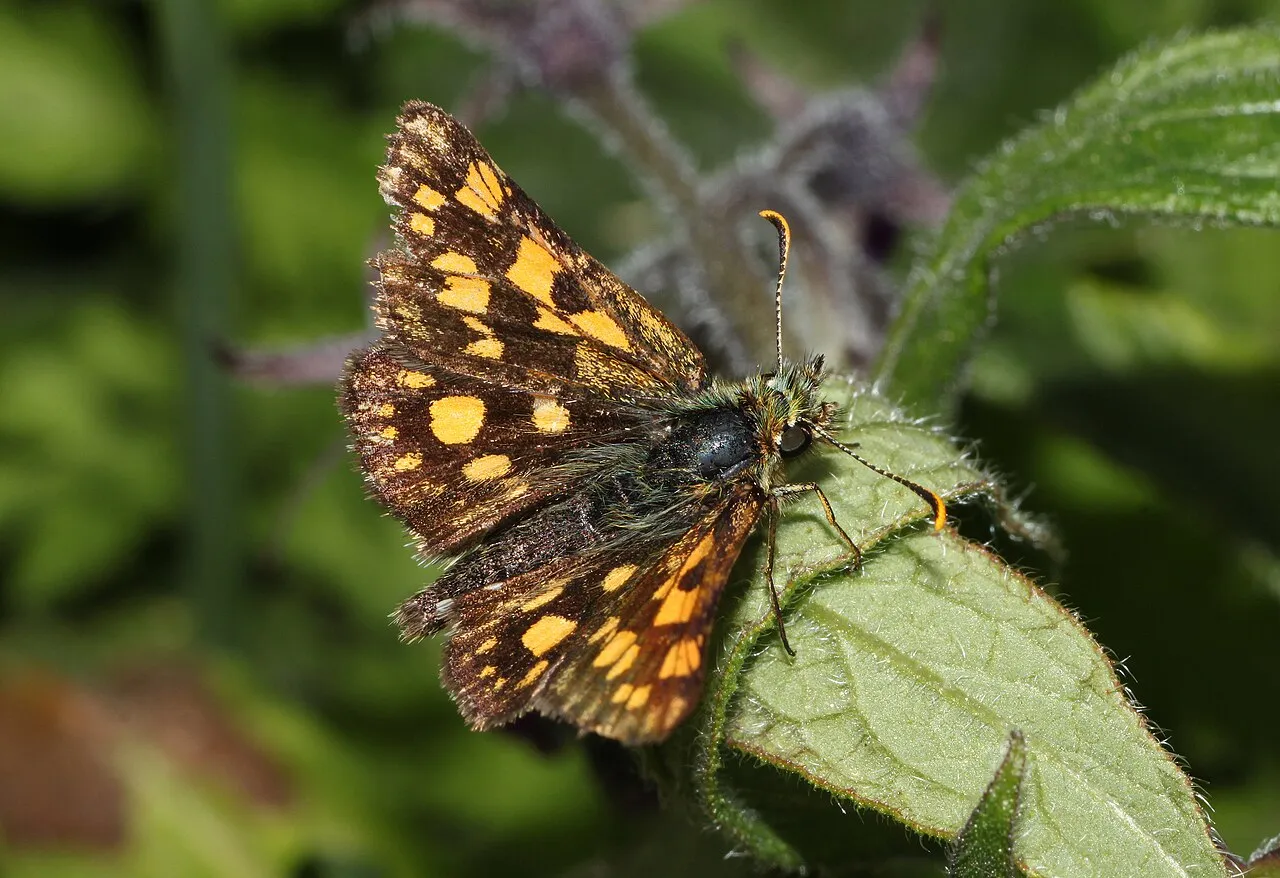
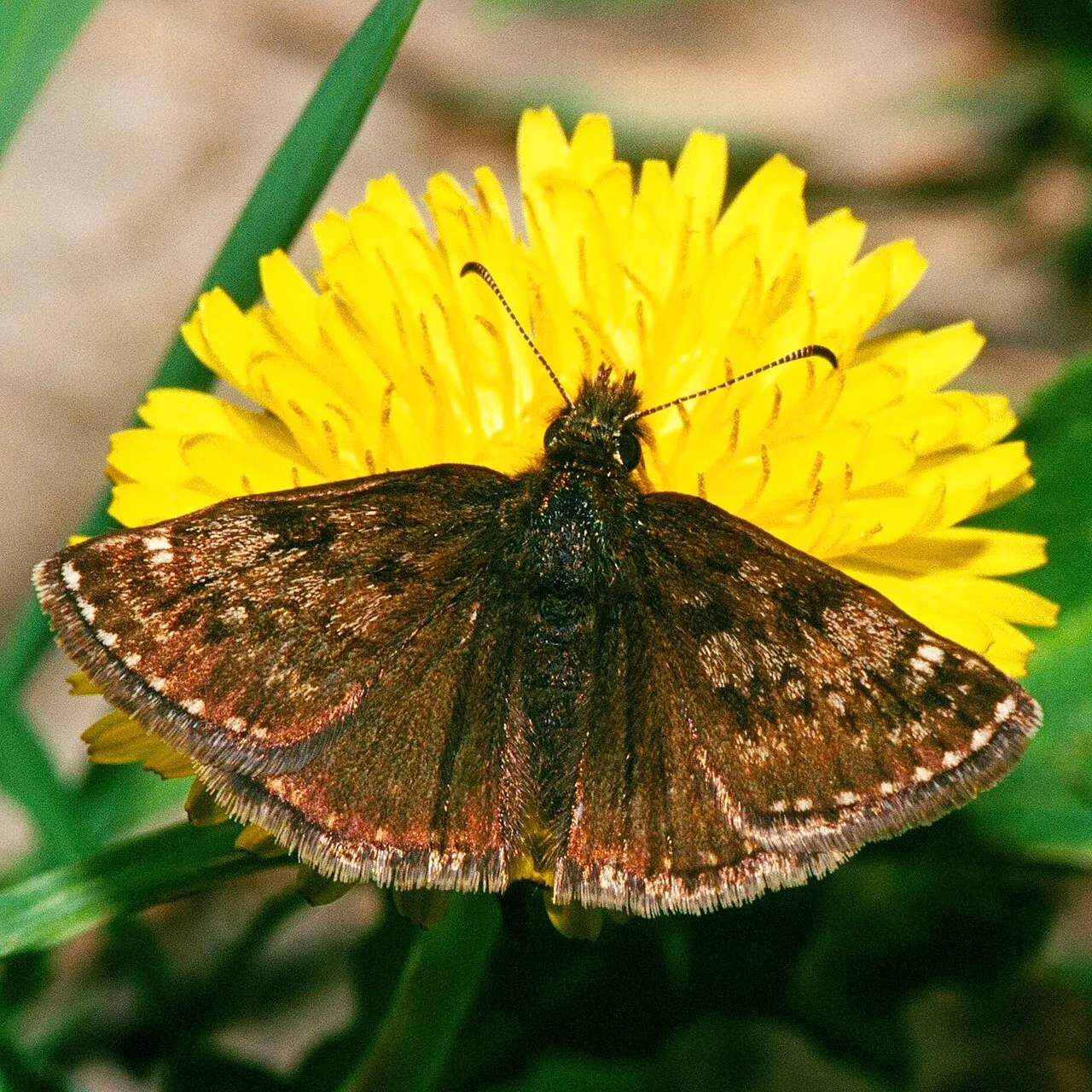
- Dingy skipper (Erynnis tages): flies in the same habitats at the same time of year but lacks the chequered pattern, showing instead mottled grey-brown wings.
- Essex skipper (Thymelicus lineola): a later-flying, orange-brown skipper with none of the grizzled skipper’s black-and-white chequering, easily told apart once the two are compared side by side.
_Z1PwpAL.webp)
_Thymelicus_lineola_-_St_Foy_d'Aigrefeuille_-_France_-_male_ZAC1oH.webp)
_Ochlodes_sylvanus_-_Foret_de_Bouconne__France_-_male_73F1g.webp)
_Thymelicus_sylvestris_-_Foret_de_Bouconne__France_-_male_Z1dCd98.webp)