_Ochlodes_sylvanus_-_Foret_de_Bouconne__France_-_male_73F1g.webp)
Contents
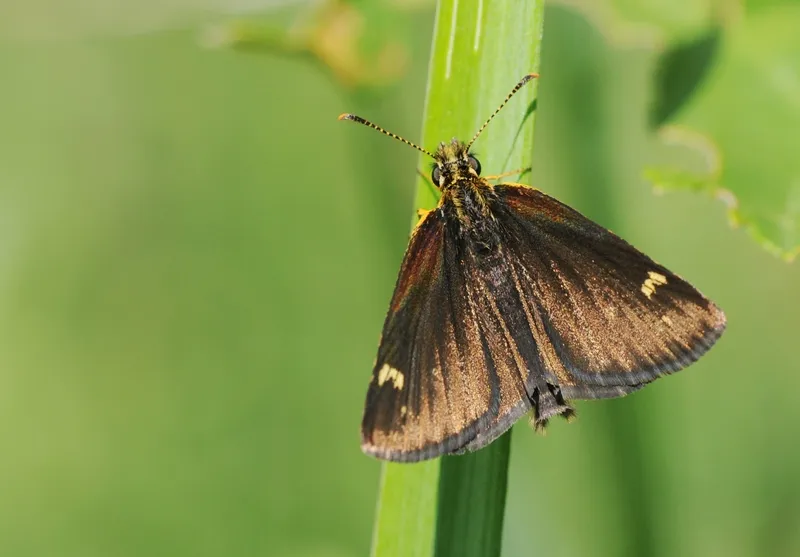
The large skipper, Ochlodes sylvanus, is a stocky, orange-brown butterfly of the family Hesperiidae, usually seen basking with its wings held in the half-open, moth-like posture typical of the group. It ranges across Europe east through the Palearctic, including northern Asia, China and Japan, and in Britain is found across England, Wales and south-western and south-eastern Scotland.
Identification
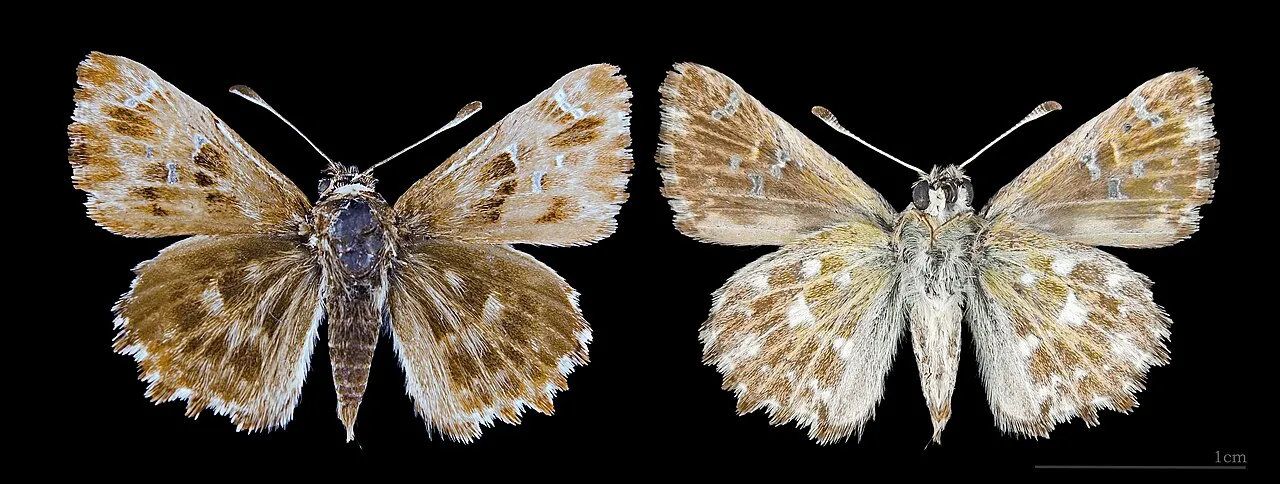
The large skipper has a wingspan of 29–36 mm, with males running 29–34 mm and the somewhat larger females 31–36 mm. As its name suggests, it is one of the largest of Britain’s “golden” skippers. The wings are a warm orange-brown above, broken up by darker patches and faint paler spots, with a mottled, chequered look that separates it from the plainer small and Essex skippers it flies alongside. Males carry a dark diagonal line of scent scales across the centre of the forewing, a feature females lack; otherwise the sexes share the same pattern, and the triangular, delta-winged resting posture is shared across the skipper family.
Range and habitat
The large skipper favours sheltered grassland where grasses grow tall: meadows, hedgerows, roadside verges, woodland rides and clearings, parks and churchyards. Rank, uncut grass is the common thread running through all of these settings, since it both feeds the caterpillars and gives the adults shelter and basking spots. Within its broad Eurasian range it reaches from Western Europe to the Pacific coast of Asia, and in Britain it is widespread over most of England and Wales, thinning out towards the northern and western edges of its range in Scotland.
Life cycle and host plants
Caterpillars feed mainly on Cock’s-foot (Dactylis glomerata), and also take False Brome (Brachypodium sylvaticum), Purple Moor-grass (Molinia caerulea), Tor-grass (Brachypodium rupestre) and Wood Small-reed (Calamagrostis epigejos). The species passes the winter as a caterpillar, resuming feeding on its grass host the following spring before pupating and emerging as an adult in early summer. Britain sees a single brood a year, with no second generation even in warm seasons.
Behaviour and flight period
Adults are on the wing in Britain mainly in June and July, with some individuals lingering into August. Males are markedly territorial, taking up a perch on a prominent leaf or grass stem from which they dart out at passing insects, including other butterflies, before returning to the same spot. The flight itself is fast, low and whirring, carrying the butterfly in short bursts between perches and nectar sources rather than the long glides of larger species. Adults nectar readily at bramble, thistles and other grassland flowers, often basking open-winged in the half-open posture characteristic of skippers to warm up between flights.
Conservation
The species is listed by the IUCN under the category shown in the facts box, taken from its Wikidata record. It remains widespread and often common across its grassland range in Britain and the wider Palearctic, with no equivalent of the sharp declines reported for some of its scarcer grassland relatives, though it depends, like other grass-feeding skippers, on the survival of unmown, tussocky grassland in the wider countryside.
Similar species
- Essex skipper (Thymelicus lineola): a smaller, plainer golden-orange skipper that shares the same grassy habitats; it lacks the large skipper’s mottled wing pattern and is best told apart by the black-tipped underside of its antennal club.
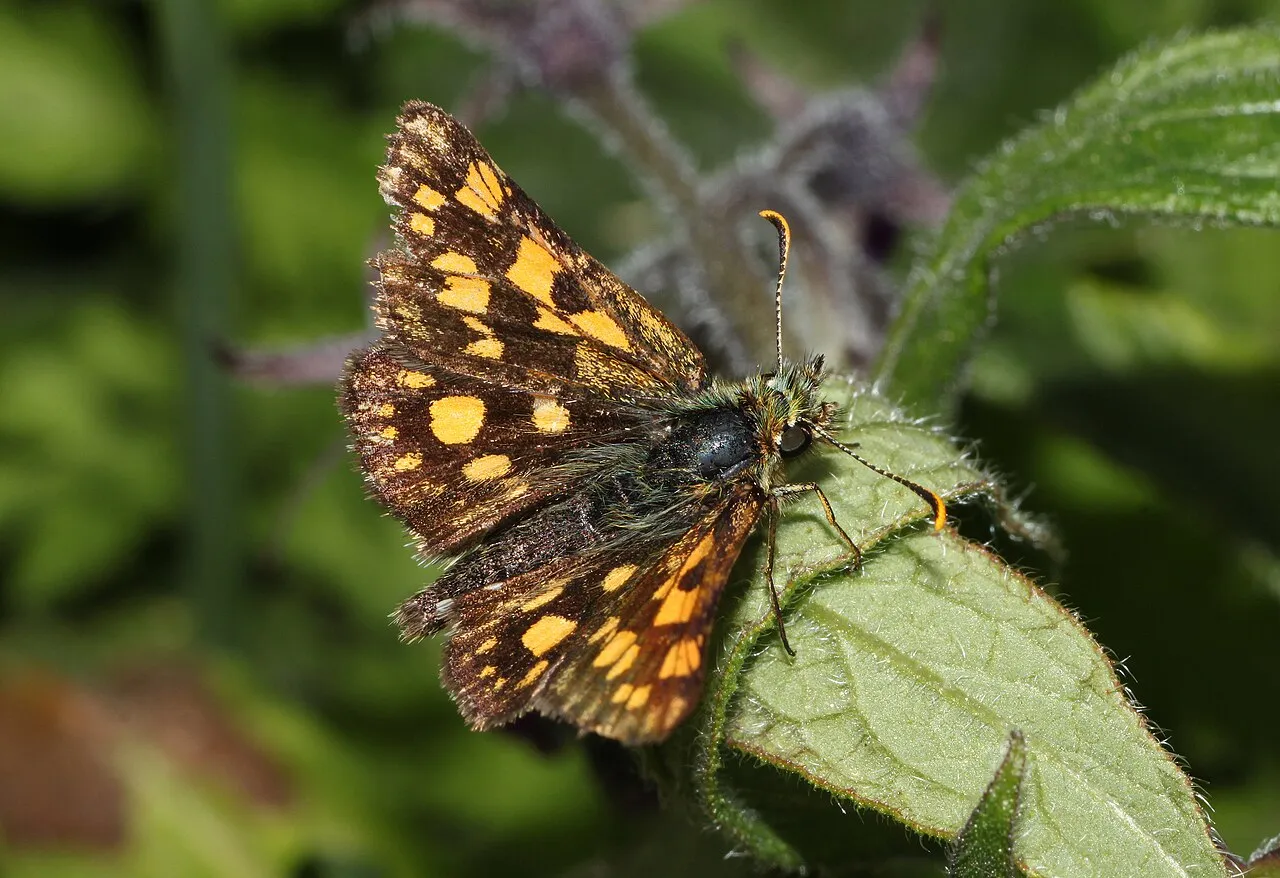
- Chequered skipper (Carterocephalus palaemon): a smaller, darker skipper with a chequerboard pattern of pale spots, found in Britain only in western Scotland, far from most of the large skipper’s English and Welsh range.
_Z1PwpAL.webp)
_Thymelicus_lineola_-_St_Foy_d'Aigrefeuille_-_France_-_male_ZAC1oH.webp)
_Thymelicus_sylvestris_-_Foret_de_Bouconne__France_-_male_Z1dCd98.webp)