Contents
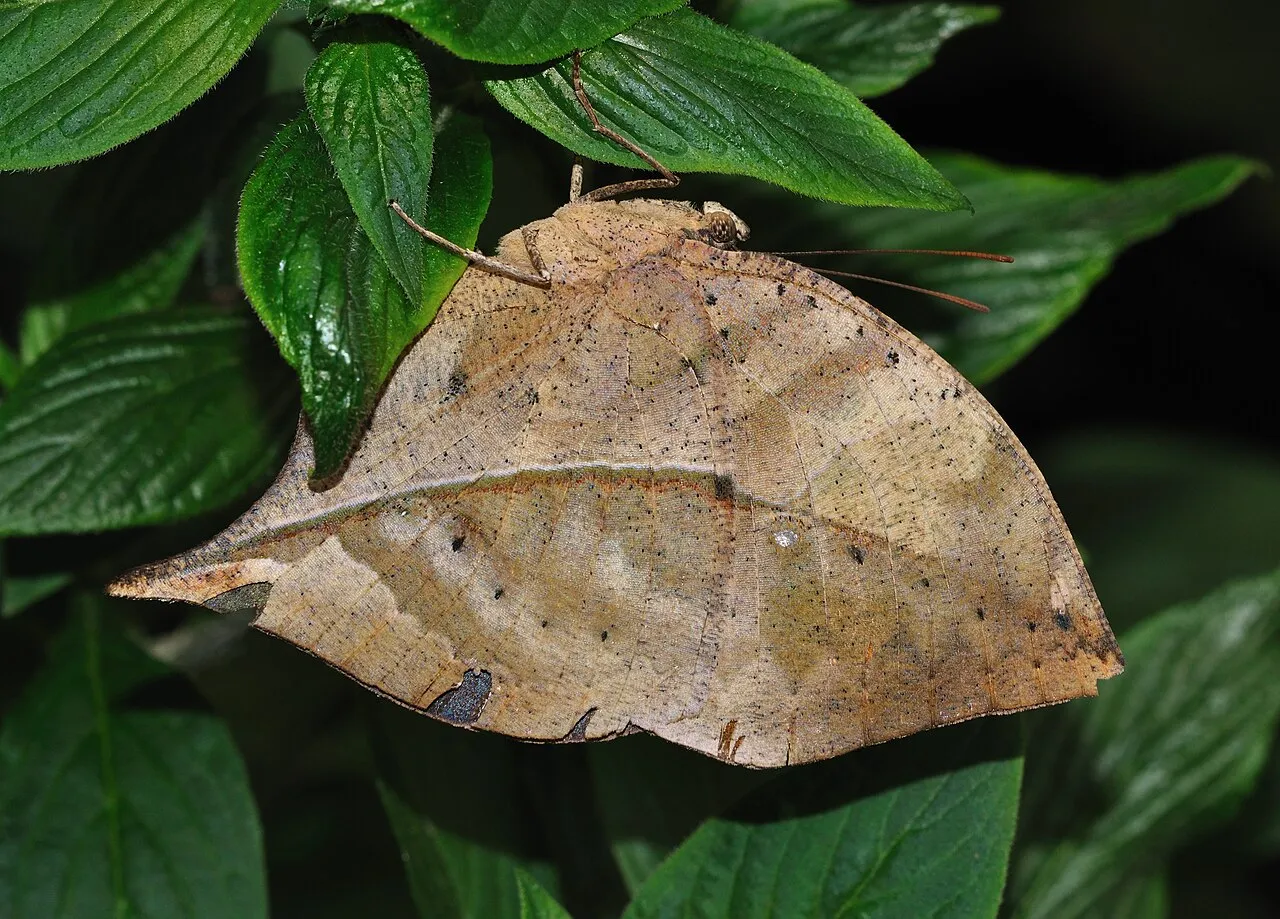
The orange oakleaf, Kallima inachus, is a forest butterfly of tropical Asia best known for an underside that passes for a dead leaf down to the midrib and veins. It belongs to the family Nymphalidae, the brush-footed butterflies, in the genus Kallima, the oakleaf butterflies. It is found from India, Pakistan, Nepal, Bhutan, Bangladesh and Myanmar south to the Tenasserim Hills, and on through southern China, Thailand, Laos, Taiwan and Vietnam.
Identification
With wings spread 85 to 110 mm across, the upperside carries the colours that give the species its name: the forewing shows a black tip, an orange band across the middle and deep blue at the base, with a white eyespot near the black tip and a second one where the orange meets the blue; the hindwing is mostly blue with brown patches spreading in from the edges. None of this shows in rest. Closed, the butterfly turns over an underside in rusty, grey or yellowish brown, scattered with dark flecks that read as patches of fungus or lichen, and crossed by a dark line running from the forewing tip to the hindwing’s trailing edge like a leaf’s midrib, with slanting lines beside it standing in for side veins. Sexes differ slightly: females run larger, with a more drawn-out point at the forewing tip and a redder, paler-mottled underside than the male. The pattern also shifts with the season: the wet-season form is smaller and darker than the dry-season form, with its orange band more broadly bordered in black on the inner side.
Range and habitat
The orange oakleaf keeps to dense tropical deciduous and subtropical evergreen forest with good rainfall, moving through the undergrowth and along stream beds. Across its range it is mostly a lowland and mid-altitude butterfly of moist broadleaf forest, from roughly 400 to 1,800 metres, though it has been recorded considerably higher in heavily forested country. It is common enough in India, while in China, nearer the edge of its range, it is scarce enough to have drawn captive-breeding studies aimed at its conservation.
Life cycle and host plants
Caterpillars feed across an unusually wide spread of plant families: Urticaceae, Polygonaceae, Rosaceae and Acanthaceae, taking in Girardinia diversifolia, Polygonum orientale, peach (Prunus persica) and several Strobilanthes species. The fully grown caterpillar is velvety black with long yellowish hair and rows of reddish spines, eleven to a segment. Reared at 20, 25 and 30 degrees Celsius, the caterpillar stage shortens from roughly 32-36 days to about 21 days as temperature rises, though fewer caterpillars survive the heat, and a full generation from egg to adult has been timed at around 50 days in Chongqing, China. Adults are strong fliers that feed at tree sap and over-ripe fruit rather than at flowers. The species overwinters as an adult in diapause, with three generations a year recorded in the Emei mountains of Sichuan, the second brood’s adults entering diapause in early July to sit out the winter before breeding again. Adults are on the wing from April to October in the Himalayas, and from April to December elsewhere in India.
Behaviour and flight period
The disguise is a defence used on the wing as much as at rest. Startled, the butterfly flies erratically for a moment before dropping into the foliage and settling with its wings shut, where the leaf-like underside takes over; birds, ants, spiders, wasps and certain bacteria are named among its natural enemies. Between these moments of alarm it is a confident, powerful flier through the forest understorey, drawn to sap runs and fallen, rotting fruit, and to mud for puddling, rather than to flowers in the open.
Similar species
- Blue oakleaf (Kallima paralekta): the closest relative in look and habit, a Southeast Asian oakleaf butterfly with the same dead-leaf underside and a similar blue-based upperside.
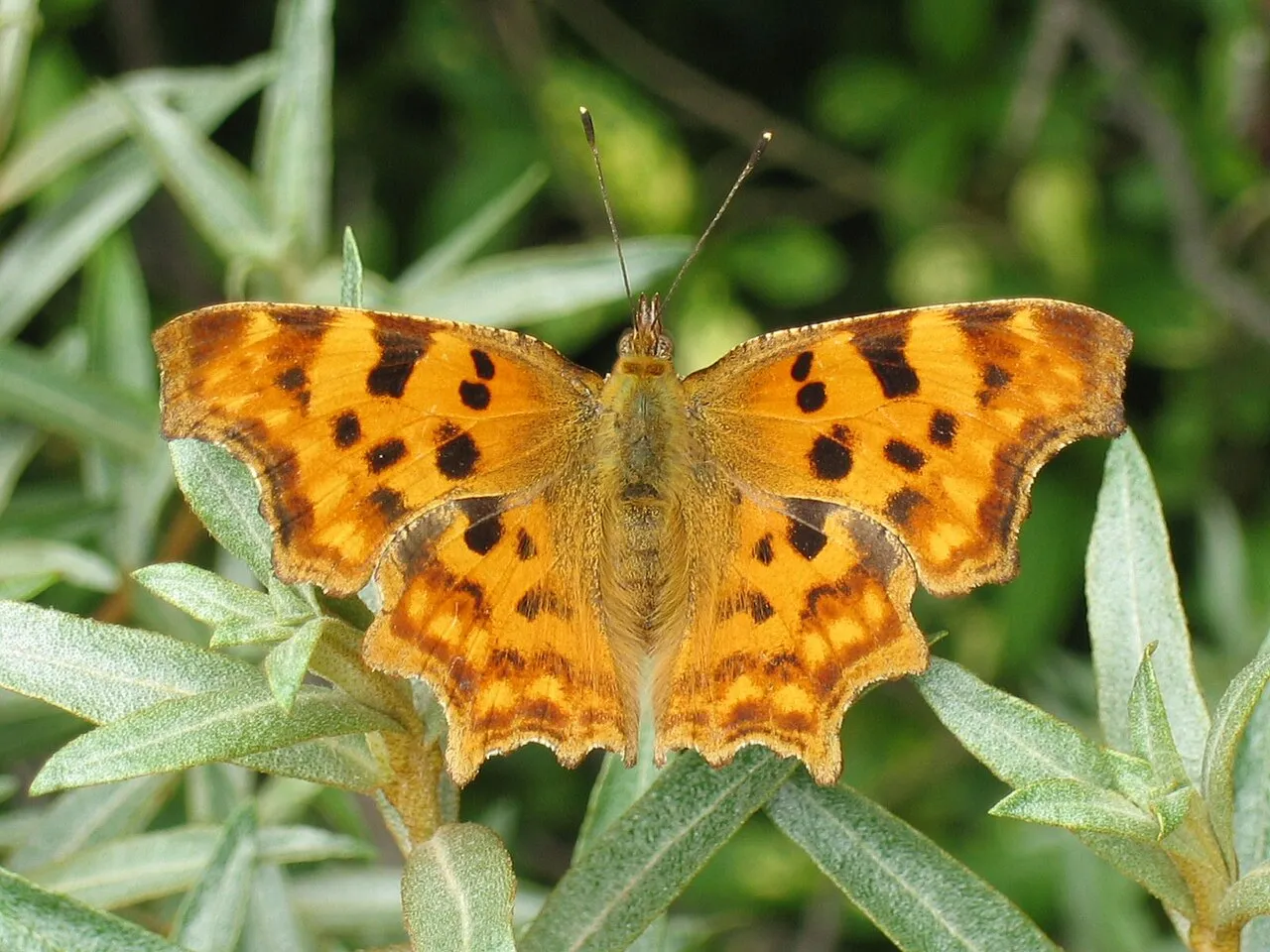
- Comma (Polygonia c-album): an unrelated species that converges on the same trick, closing its ragged-edged wings to show a mottled brown underside that passes for a dry leaf at rest.
_kkJaX.webp)
_2r3CXC.webp)
_2_rmr34.webp)