Contents
The wood white, Leptidea sinapis, is a small, pure white butterfly of the family Pieridae, named for its fondness for woodland clearings and shrubby edges. It ranges across Europe eastwards through the Caucasus, Asia Minor and the Middle East into Middle Asia, Kazakhstan and south Siberia, and in Britain it is confined mainly to central and southern England and Ireland. It is one of the gentlest fliers on the wing, drifting low over vegetation rather than dashing between flowers.
Identification
The wood white has a wingspan of 36–44 mm, making it one of the smaller whites. Its wings are white, sometimes carrying small grey or yellowish markings towards the middle or edge of the wing, and the forewing tips are distinctly rounded rather than pointed. Adults always rest with their wings closed, so the underside is the view most often seen in the field.
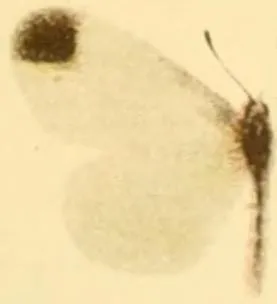
The sexes differ in several small ways. Males carry white-tipped antennae, while females have brown-tipped antennae, a useful check when the butterfly is at rest. On the upperside, males show a black spot at the forewing tip that is greatly reduced in the female; the spot is greyer on spring-brood males and darker on summer-brood males, and summer-brood females are slightly smaller than spring-brood females.
Identification by eye only goes so far. The wood white belongs to a complex of near-identical cryptic species, and it can only be told apart from its relatives by examining the genitalia, not by wing pattern.
Range and habitat
Beyond its broad continental range, the wood white’s European distribution is patchy: it occurs unevenly across the Midlands and southern England, Ireland, and parts of northern Europe, with populations also in Slovakia, the Czech Republic, Sweden, France and Spain.
It favours woodland rides, clearings and margins in warm, sheltered conditions, as well as disused railway cuttings, sea cliffs, meadows and sparse forest up to 2,500 m. Shelter matters more than open sun: the species needs sites with plenty of vegetation and shrubbery, but is very particular about the amount of shade it gets, and rides that become too heavily shaded through tree planting or neglect tend to lose their wood whites.
Life cycle and host plants
Caterpillars feed on low-growing legumes, chiefly bird’s-foot-trefoils (Lotus corniculatus, Lotus pedunculatus), meadow vetchling (Lathyrus pratensis), bitter-vetch (Lathyrus linifolius) and tufted vetch (Vicia cracca). Females choose their plants carefully, flying low and slowly over the shrubbery and testing several plants by landing on them and using their chemoreceptors before laying; eggs are laid singly on the underside of leaves, and taller plants tend to receive more eggs.
Eggs hatch after 10 to 20 days, and the caterpillar stage lasts 35 to 60 days over roughly four instars, depending on temperature, with the green, well-camouflaged larvae staying on their host plant to feed. Before pupating, a caterpillar wanders for anywhere from an hour to a few days before settling, often on a grass stem, to form a pale green or brown chrysalis. The species overwinters as a chrysalis and is bivoltine, producing two generations a year: on the continent broods fly in May–June and again in July–August, while in England the main spring brood runs from early May to the end of June, with a partial second brood at some southern sites in summer.
Behaviour and flight period
True to its soft colouring, the wood white has one of the slowest and most delicate flights of any British butterfly. Males spend most of their day patrolling low over shrubbery in search of females, rarely stopping to rest or feed, especially in sunny weather, and when a male finds a female he courts her by wagging his head from side to side and extending his proboscis towards her. Females are choosy, accepting only males of their own species despite males courting females of related species indiscriminately, and while a female mates only once in her life, a male may mate several times.
Similar species
- Green-veined white (Pieris napi): a similarly pale butterfly sharing woodland-edge habitat, but larger, with grey-green veining on the underside rather than the wood white’s plain, rounder wings.
- Cryptic wood white (Leptidea juvernica): externally indistinguishable from the wood white and only recently separated from it; the two are reliably told apart only by differences in their genitalia, not by appearance, and L. juvernica replaces L. sinapis in parts of Ireland and northern Europe.
_Anthocharis_cardamines_-_Foret_de_Bouconne__France_-_male_2lyp2N.webp)
_Aporia_crataegi-_Foret_de_Soreze_Tarn_France_-_male_25HPdB.webp)
_Gonepteryx_rhamni_-_Pr%C3%A9serville_France_-_male_KFu9N.webp)
_Pieris_napi_napi_-_Foret_de_Bouconne__France_-_male_Z19U1qT.webp)
_Colias_croceus_-_Durfort_Tarn_France_-_male_ZvAIWE.webp)