Contents
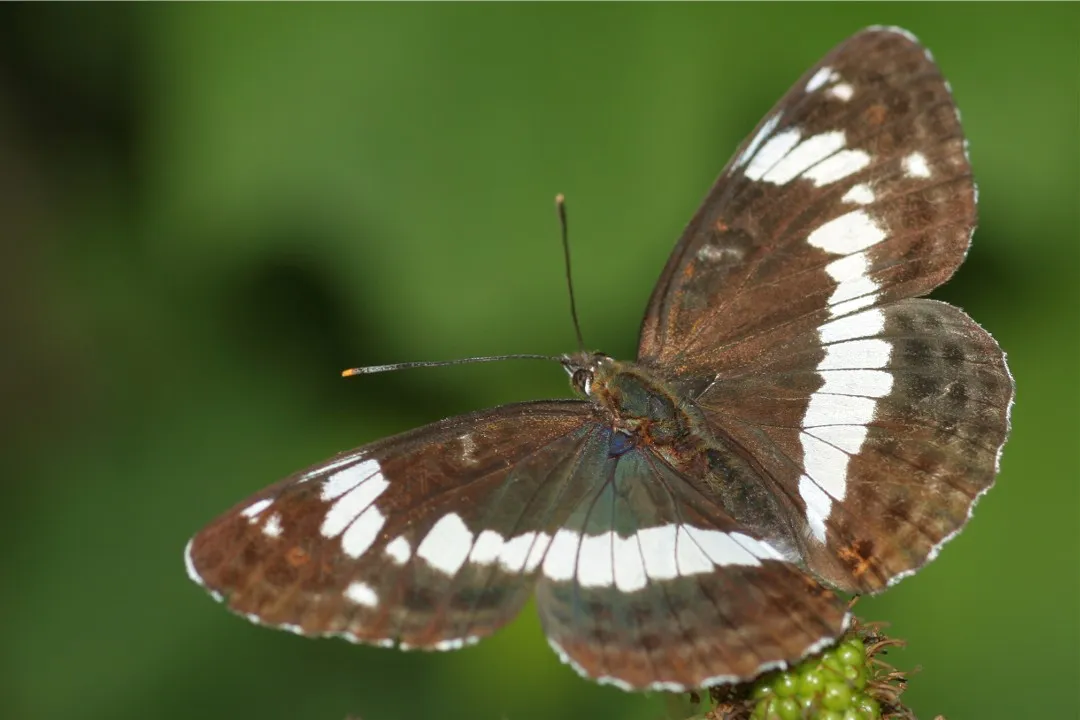
The white admiral, Limenitis camilla, is a woodland butterfly of black wings crossed by bold white bands, found from southern Britain through much of temperate Europe and the Palearctic, east as far as Japan. It belongs to the family Nymphalidae, and its caterpillars feed almost entirely on honeysuckle.
Identification
Settled adults are hard to mistake for anything else: the upperside is black with prominent white bars crossing both wings, a pattern that also breaks up the wing’s outline against the dappled light of woodland rides. The underside carries a quieter, more intricate version of the same bands. The wingspan runs 56–66 mm.
The sexes are close in pattern but not identical. Females are slightly browner and larger than males, with more rounded wings; seen closer up, females also show more prominent whitish spots near the margin of the hindwing and distinct light and reddish patches in the forewing cell, where males look plainer.
Range and habitat
The white admiral is a butterfly of shady deciduous woodland, including conifer plantations where honeysuckle grows in the understorey. In Britain it is confined to central and southern England, south of a line running roughly from South Devon to North Lincolnshire, with a scatter of colonies in Wales; it is absent from Scotland, Ireland and the Isle of Man. Beyond Britain its range stretches across most of temperate Europe and on through the Palearctic to Japan.
Life cycle and host plants
Caterpillars feed on honeysuckle, chiefly Lonicera periclymenum and other Lonicera species, with snowberry (Symphoricarpos) also taken. Females lay their eggs singly on honeysuckle growing in dense, shady woodland, and the resulting caterpillars are green with red-brown hairs, their outline further hidden by their own droppings and silk.
The species overwinters as a caterpillar, sheltering in a hibernaculum it builds by folding a leaf, a tent-like structure of leaf tissue bound with silk. In spring the caterpillar resumes feeding and moults into a spinier green skin before pupating into a green-and-gold chrysalis, with the adult emerging after about two weeks. There is normally one generation a year, with an occasional partial second brood in late summer, and the main flight period runs from late June to early July in Britain.
Behaviour and flight period
The white admiral’s flight is as distinctive as its markings: it moves along woodland rides with an elegant, gliding style, alternating short bursts of wingbeats with long glides from treetop to forest floor and back up again, a habit that has earned related continental species the nickname “gliders.” Adults feed on bramble blossom and honeydew in the canopy rather than on open flowers at ground level, which keeps much of their activity high among the trees.
Similar species
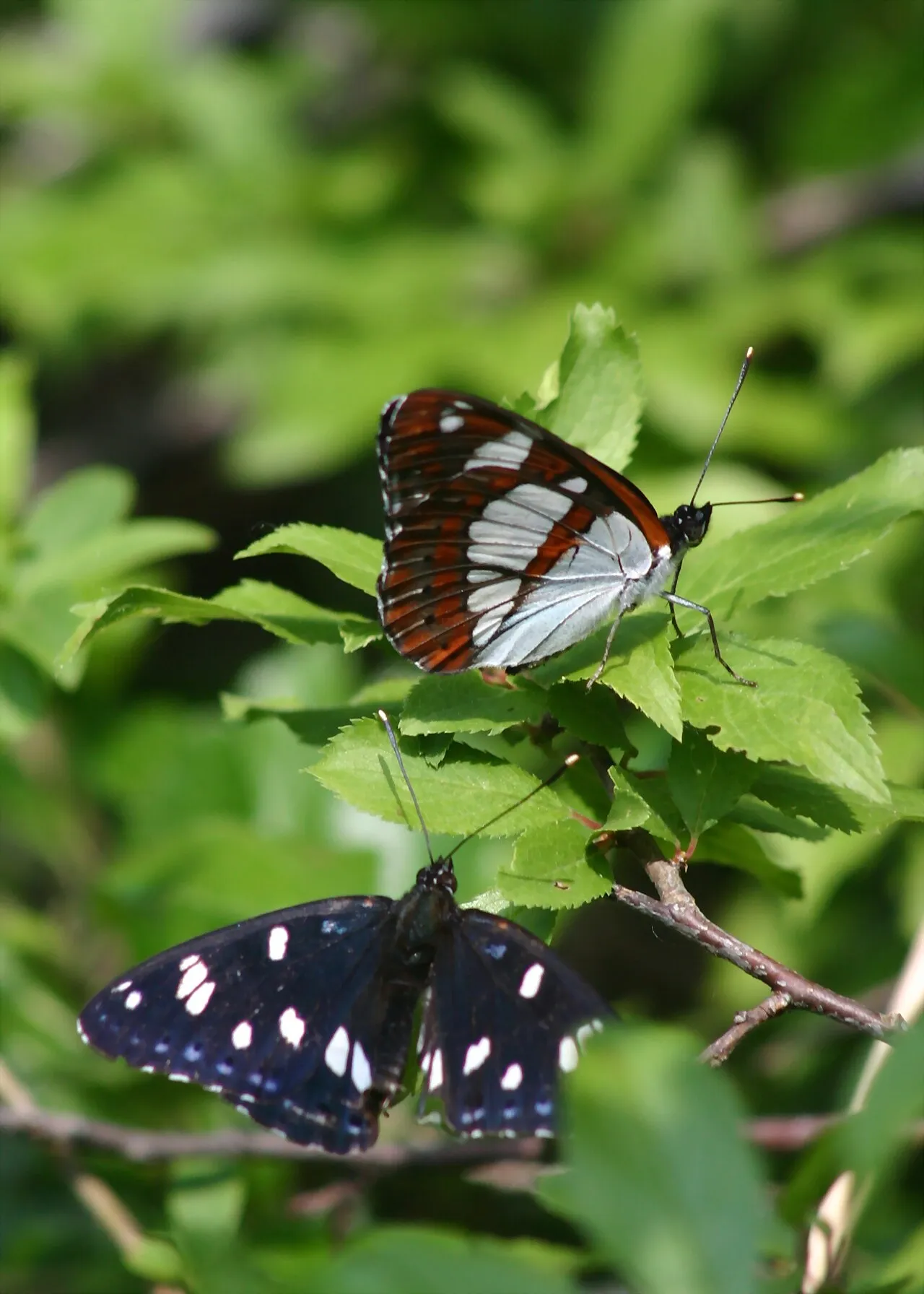
- Southern white admiral (Limenitis reducta): a close relative of central and southern Europe, Western Asia and the Caucasus, smaller at 46–54 mm against the white admiral’s 56–66 mm, with an underside hindwing that shows a red ground colour rather than the white admiral’s white bands.
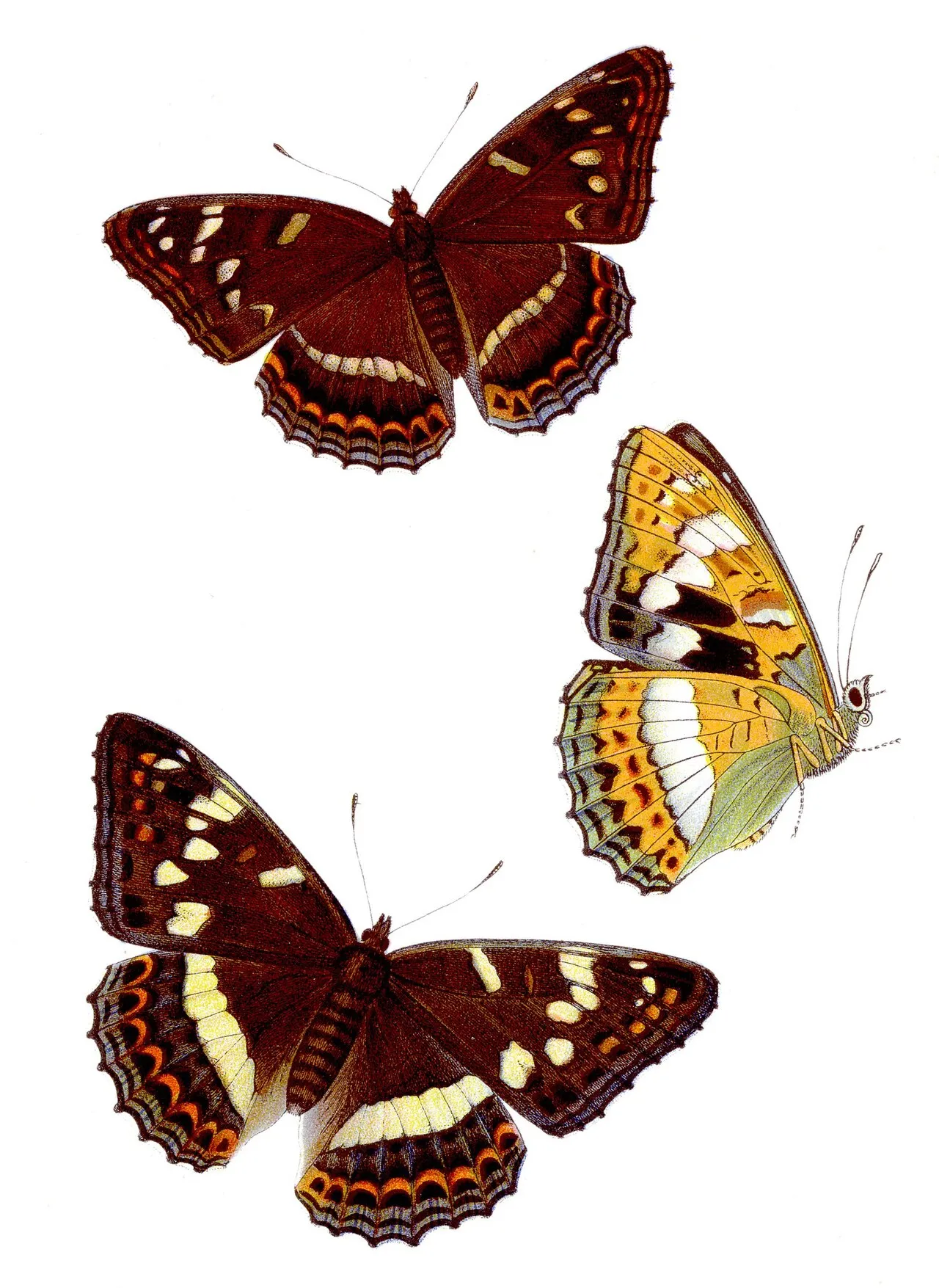
- Poplar admiral (Limenitis populi): a much larger relative of continental Europe and across the Palearctic to Japan, with a wingspan of 66–85 mm, whose caterpillars feed only on aspen and black poplar and whose adults stay mostly in the tree canopy rather than the honeysuckle-rich understorey the white admiral favours.
_kkJaX.webp)
_2r3CXC.webp)