Contents
The viceroy, Limenitis archippus, also called the false monarch butterfly, is a North American butterfly of the family Nymphalidae2. It ranges through most of the contiguous United States and parts of Canada and Mexico. It was long thought to be a Batesian mimic of the monarch, but because the viceroy is also distasteful to predators, it is instead considered a Müllerian mimic. The viceroy was named the state butterfly of Kentucky in 19901.
Identification
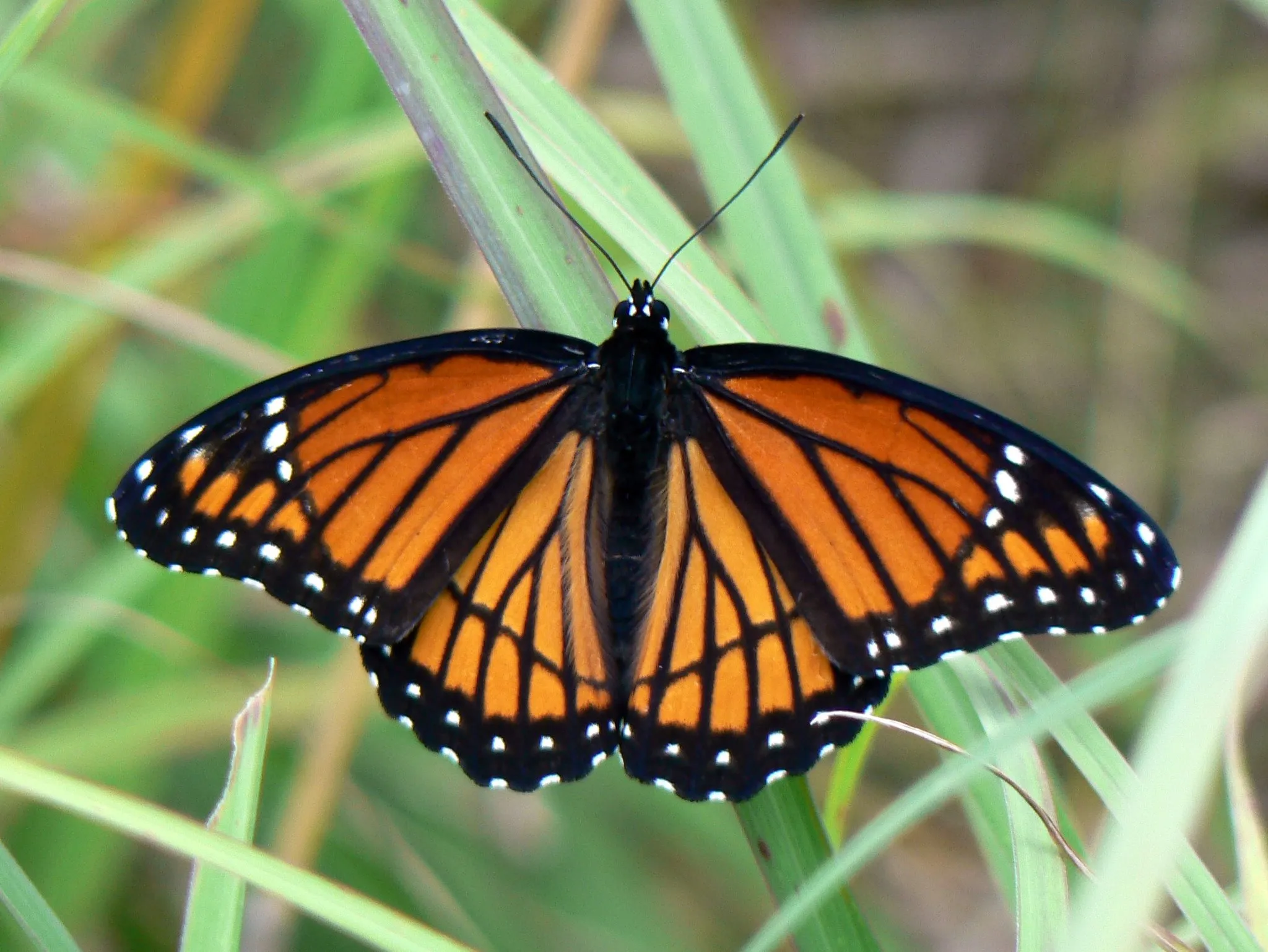
The wingspan is 6.3–8.6 cm, or 63–86 mm. The upperside is orange and black, resembling the monarch, except that the viceroy has a black line across the hindwing and a single row of white dots in the black marginal band2. It can also be told from the monarch by its smaller size1.
Where monarchs are rare, in Florida, Georgia and the Southwest, viceroys are brown instead of orange2 and mimic the queen, Danaus gilippus. In areas inhabited by the queen, the white spotting becomes less noticeable and the orange is replaced by a deep mahogany brown3. In Mexico, viceroys share the pattern of the soldier, Danaus eresimus. The two colour forms differ only in the colour of the wings and the line through the hindwings1; other features, such as body size and wing-pattern elements, are identical.
The caterpillars, as well as the chrysalis, resemble bird droppings1.
Range and habitat
In the west, the range runs from the Northwest Territories south along the eastern edges of the Cascade and Sierra Nevada mountains to central Mexico, and it extends east through all the eastern United States2. In the east, it reaches along the Atlantic and Gulf coasts from Nova Scotia into Texas1.
The viceroy lives in moist open or shrubby areas2 such as lake and swamp edges, willow thickets, valley bottoms, wet meadows and roadsides. It prefers open or slightly shrubby areas that are wet or near water, a list that also includes marshes, ponds and railroad tracks3.
Life cycle and host plants
Caterpillars feed on trees in the willow family (Salicaceae)2, including willows (Salix) and poplars and cottonwoods (Populus). They sequester the salicylic acid1 in their bodies, which makes them bitter and upsets predators’ stomachs.
Mating occurs in the afternoon. Females lay eggs at the tip of host plant leaves, depositing only two or three eggs on a plant2 before moving to another, and choose only leaves that have not been eaten by other insects3.
After hatching, caterpillars eat their eggshells, then feed at night on catkins and leaves. Young caterpillars make a ball of leaf bits, dung and silk that hangs off the leaf on which they are feeding; the dangling mass may distract predators. Third-stage caterpillars2 make a shelter from a rolled leaf tip in which they spend the winter.
Behaviour and flight period
There are two to three broods from May to September in most of the range, and adults fly all year in Florida2. Adults are strictly diurnal1, flying preferentially in the late morning and early afternoon.
The flight is a slow flap and glide. During most of the day, males perch on vegetation or patrol around the host plants2 to find females. In this perch-patrol behaviour a male perches on the ground or low vegetation for a short time, then patrols a 20 m distance to another perch, back and forth through the same area. If two males meet, they abruptly soar 50 m or more3 into the air.
Early in the season, when few flowers are available, adults feed on aphid honeydew, carrion, dung and decaying fungi. Later generations feed more often at flowers, favouring composites such as aster, goldenrod, joe-pye weed, shepherd’s needle and Canada thistle2.
The viceroy is a Müllerian mimic of the monarch2, and it is also distasteful. In an experiment with the wings of both species removed, birds found the viceroy just as unpalatable as the monarch. When palatability was measured from birds’ responses to butterfly abdomens, the viceroy was significantly more unpalatable than the queen1.
Conservation
The viceroy is listed as Least Concern on the IUCN Red List 2022.24. Its NatureServe rank is G5, demonstrably secure globally, though it may be quite rare in parts of its range, especially at the periphery. One subspecies, the obsolete viceroy (obsoleta), has lost much of its habitat to development, water impoundment and the exotic, aggressive saltcedar. The management needs listed for the species are to restore riparian habitats in the Southwest2 and conserve the habitats that remain.
Similar species
- Monarch (Danaus plexippus): a similar orange and black upperside, but the viceroy has a black line across the hindwing2 and the monarch does not.
- Queen (Danaus gilippus): chestnut brown, like the southern viceroys it resembles, but the queen’s black forewing borders carry two rows of white spots5, with white spots scattered at the forewing apex; the viceroy has a single row of white dots2 in its black marginal band.