_(cropped)_ZsqovX.webp)
Contents
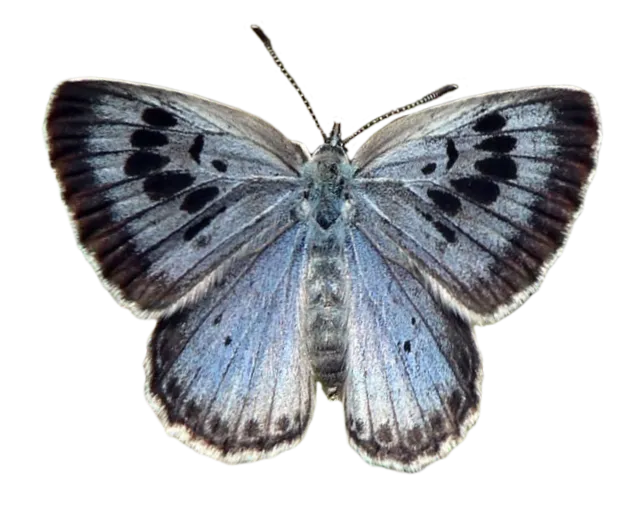
The Purple-shot Copper, Lycaena alciphron, is a small butterfly of the family Lycaenidae, named for the violet sheen that flashes across the male’s gold-red upperside in flight. The species ranges across the Western Palaearctic, from Morocco’s Atlas Mountains and Iberia in the south-west across Central and Southern Europe to Central Siberia in the east and the Baltic countries in the north, present in all three Mediterranean peninsulas and reaching as far as northern Iran. It is absent from Great Britain and Fennoscandia.
Identification
The forewing measures 14–21 mm in length, giving the species a modest overall wingspan among the coppers. The sexes differ sharply above. The male’s upperside is red-gold marked with black spots and flushed with a purple sheen that gives the species its common name, while the female’s upperside is brown, likewise marked with black spots. Both sexes carry a row of submarginal spots on the hindwing, though these vary considerably between individuals. The underside is quieter and more uniform in tone than the upperside in both sexes, with the forewing disc a brighter reddish yellow marked with numerous large, rounded dark spots strongly ringed in white. The species breaks into several subspecies that differ in size and colour. The southern mountain race gordius is markedly larger than the typical form, bright yellow-red above with heavier black spots, and shows a yellow hindwing underside where the typical form’s is blue-grey; granadensis of Spain is as small as the typical form or smaller but carries even larger upperside spots than gordius, with the same bright yellowish-red ground colour; and melibaeus of Greece, Asia Minor and northern Iran is intermediate in size and colour between the typical form and gordius.
Range and habitat
Within that broad distribution, from the Atlas Mountains to Central Siberia, the Purple-shot Copper is a butterfly of colder habitats such as piedmont and montane flowery meadows, pastures, heathlands, sandy soils and shrublands, generally drier ground than many of its relatives favour. Egg-laying depends on bare ground: females need bare soil and sparse acidophilous vegetation to lay their eggs, so the species favours lightly grazed or disturbed ground within these habitats rather than closed, dense vegetation. Elevation varies sharply with subspecies: the typical form is found at heights between 500 and 900 metres, while the southern mountain subspecies gordius climbs much higher in the Alps, up to about 10,000 feet.
Life cycle and host plants
The life cycle begins with a flattened, green-yellow egg with a finely reticulate surface, laid on or near the bare ground the species needs for egg-laying. Caterpillars feed on sorrels, Rumex acetosella and R. acetosa, and are green and largely of a single colour, feeding mostly by night. The species overwinters as a caterpillar at the base of the host plant’s stem, resuming development the following spring. There is a single generation a year, and before pupating the caterpillar develops from around August through to early May, a long larval period that spans the whole autumn and winter. The pupa is olive-green with darker, shadowy stripes and is fastened close to the ground.
Behaviour and flight period
Adults fly for a single generation in June and July. On the wing they are busy visiting flowers, especially brambles, at sunny roadsides and waysides, and also take nectar from wild thyme and ground-elder. Compared with the purple-edged copper, adults are less tied to fixed flight areas and tend to occur singly across their habitat rather than in dense colonies.
Conservation
The species is assessed as shown in the facts box, a category drawn from its Wikidata record.
Similar species
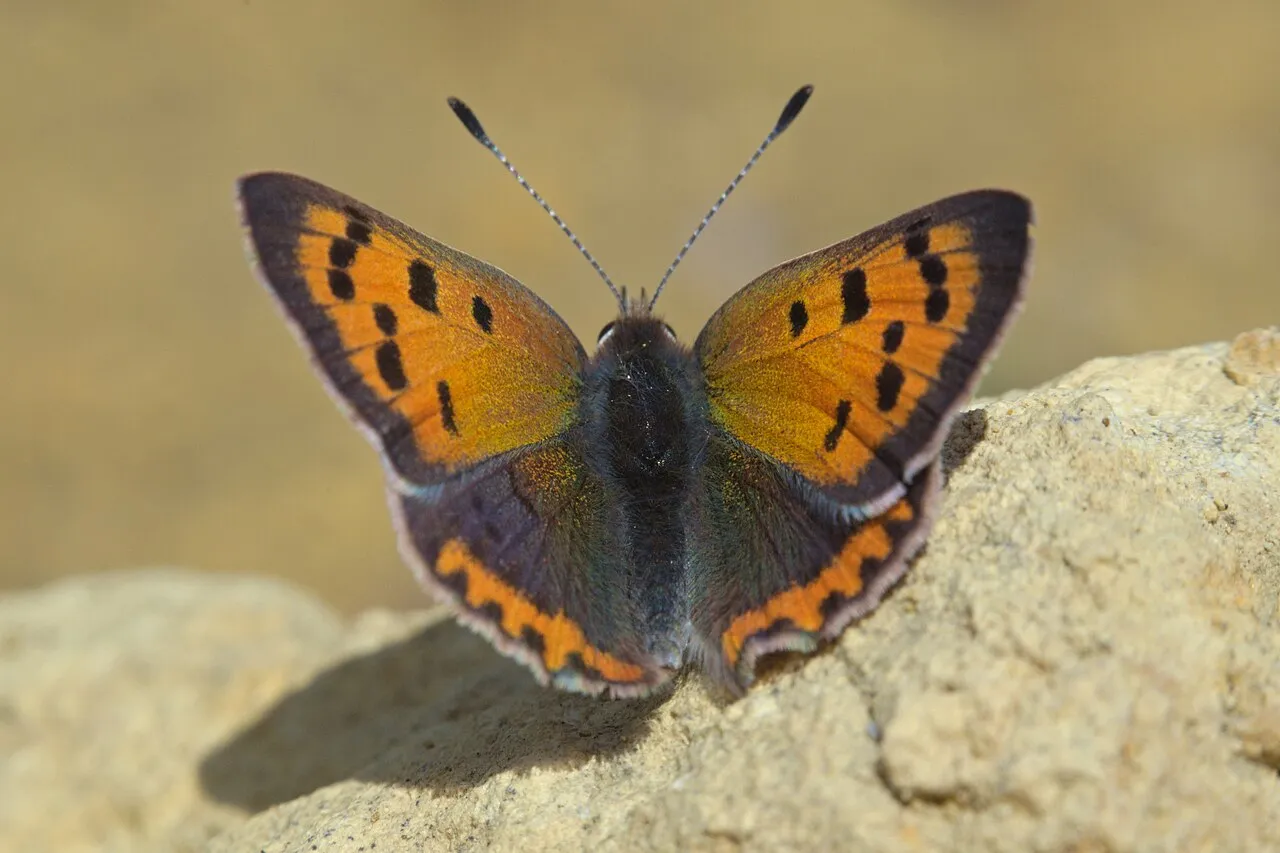
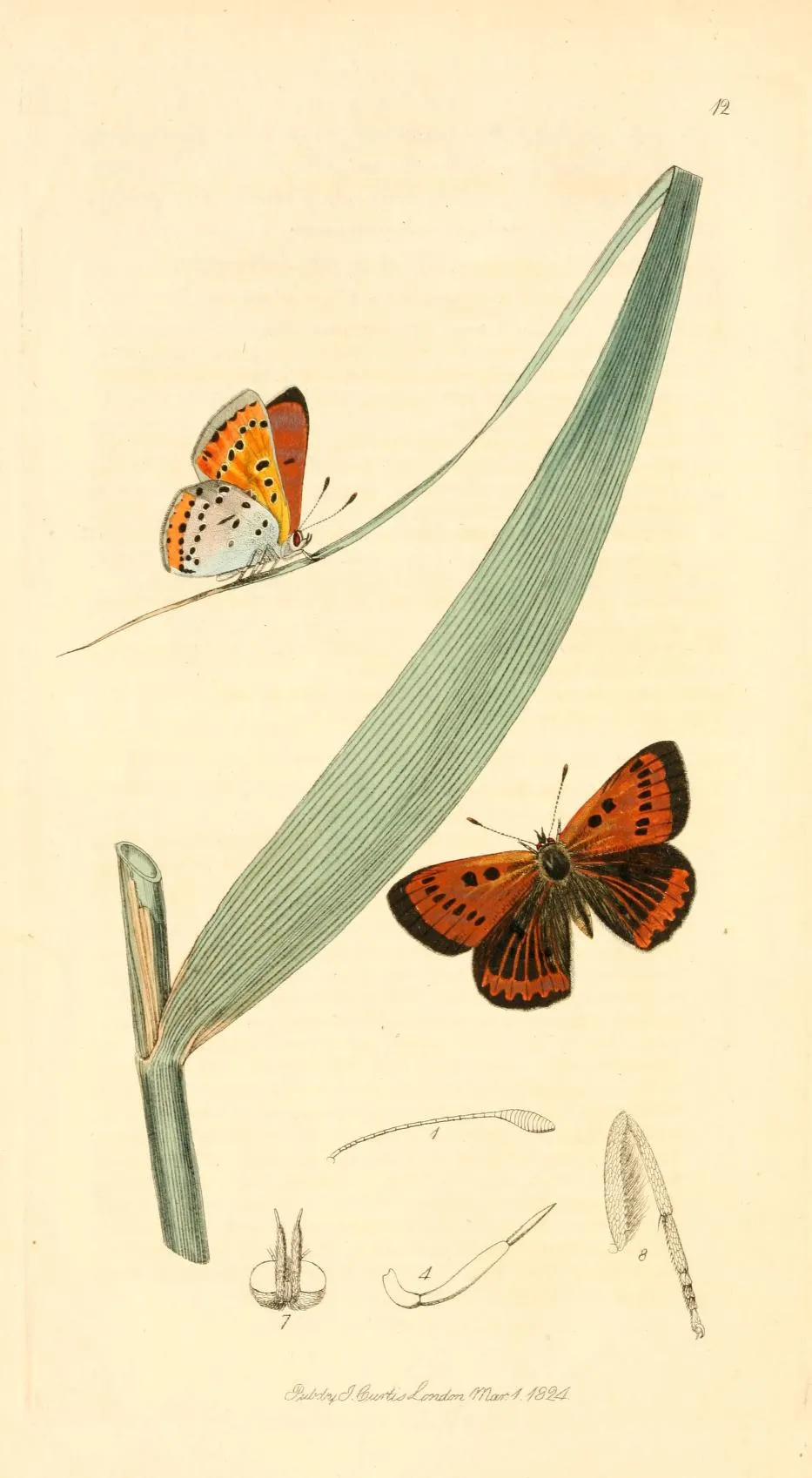
- Sooty copper (Lycaena tityrus): the male also shows a dark upperside rather than the bright copper typical of the genus, but it lacks the purple-shot copper’s violet sheen and has a thin reddish marginal line on the hindwing instead.
- Purple-edged copper (Lycaena hippothoe): another violet-flushed male, but the sheen sits only along the wing’s edge rather than washing across the whole upperside, and the female is very dark brown rather than the purple-shot copper’s plainer brown.
- Scarce copper (Lycaena virgaureae): a similarly bright, iridescent-orange-male copper of overlapping Eurasian range, but without any purple sheen on the upperside.
_Lycaena_virgaureae_-_Radawa_Poland_-_male_Z25L2d2.webp)
_2_XOluD.webp)
_Lycaena_hippothoe_-_Ja%C5%9Bliska__Poland_-_male_Z2dknjB.webp)
_%E2%99%82__Holzwarchetal_bei_M%C3%BCrringen__Ostbelgien_-_Flickr_-_Frank.Vassen_Z2eXhn5.webp)
_male_Turna_Ewa2f.webp)