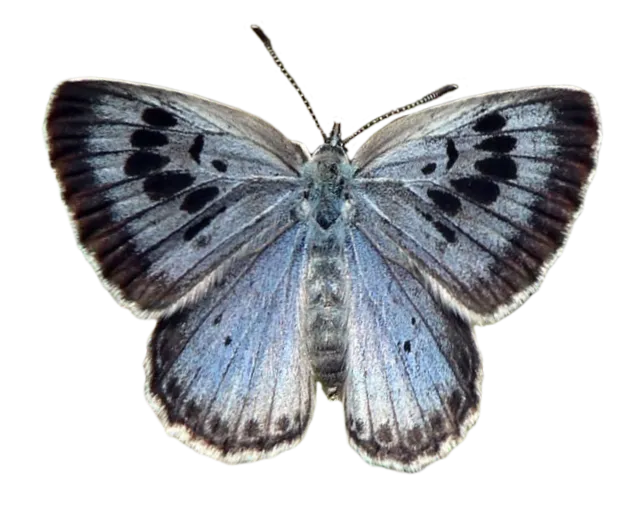
_Lycaena_hippothoe_-_Ja%C5%9Bliska__Poland_-_male_Z2dknjB.webp)
Contents
The purple-edged copper, Lycaena hippothoe, is a small butterfly of the family Lycaenidae, named for the violet sheen that edges the male’s bright copper upperside. The species ranges from Western Europe east across Siberia to the Amur river region, one of the more widely distributed coppers across the Eurasian continent, and is split into seven recognised subspecies across that range. Despite appearing in early British butterfly literature, it is considered doubtful that the species ever occurred naturally in the British Isles, with old UK records traced to specimens supplied by dealers rather than to wild populations; the species was first scientifically described from Sweden.
Identification
The purple-edged copper has a wingspan of 34–38 mm, a middling size among the coppers. The sexes differ sharply above. The male’s upperside is a deep orange-red crossed by an arc of black post-discal spots on the forewing, with brown or purple edging that gives the species its name, while the female’s upperside is usually very dark brown with brown spots on the forewings, a pattern that varies somewhat between subspecies. On the underside, both sexes share a light orange and light brown ground colour marked with brown-black spots ringed in white, a quieter palette than the bright upperside. The caterpillars are green and grow up to about 20 mm long. The wingspan has been cross-checked against a second source, which gives the same range.
Range and habitat
Within its broad Eurasian range the species favours forest edges, swampy and damp meadows, clearings and river banks, from 400 to 1,800 m elevation. That spread of habitat, from lowland river banks to mid-elevation mountain meadows, matches the long east-west range of the species across the continent, which crosses many different climates and landscapes between Western Europe and the Amur. The seven subspecies divide roughly along that range: the nominate form and stiberi across Scandinavia, the Urals and Siberia, eurydame in the Alps, eurybia through the Altai and Sayan mountains to the Far East, amurensis around Transbaikalia, the Amur river and the Ussuri region, and italica in Italy. In Western Europe, photographed records place the species in the French Alps, Spain and the Pyrenees, consistent with its absence from Britain.
Life cycle and host plants
Caterpillars feed on several Rumex species, including R. acetosella, R. acetosa, R. hydrolapathum and R. confertus, as well as Polygonum bistorta. Females lay their eggs singly, by June–July, on or near these host plants. The species overwinters as a caterpillar, hibernating after its first moult, then resumes feeding on its host plants the following spring before pupating on the ground rather than on the plant itself. Males emerge two to three weeks before females, a head start typical of many Lycaenidae that lets males establish territories before the females appear. The number of generations varies across the range: one generation a year in northern Europe and two in southern Europe, the same north-south split seen in several of its Lycaena relatives.
Behaviour and flight period
Adults are on the wing from June to September, with one generation in northern and eastern Europe and two generations, in May and again in July, in southern Europe. The longer, split season in the south tracks the extra brood that the warmer climate allows, much as in other coppers whose generation count rises toward the south of their range. Males typically perch with their wings held half open on umbellifers and tall grass stems within damp meadows, watching for passing females and rival males, and colonies tend to occupy small, well-defined patches of suitable habitat rather than spreading evenly across the landscape.
Conservation
The species is assessed as shown in the facts box, a category drawn from its Wikidata record. Its wide range across temperate Eurasia, from Western Europe to the Russian Far East, sets it apart from narrower-ranging relatives confined to a single region or elevation band.
Similar species
- Small copper (Lycaena phlaeas): a smaller, more uniformly orange-and-black copper lacking the purple-edged copper’s violet marginal sheen.
- Sooty copper (Lycaena tityrus): shares similar host plants and a dull-coloured female, but the male is dark black-brown above rather than bright copper with a purple edge.
- Scarce copper (Lycaena virgaureae): another iridescent-orange-male, duller-female copper of similar range, but without the purple-edged copper’s violet marginal line.
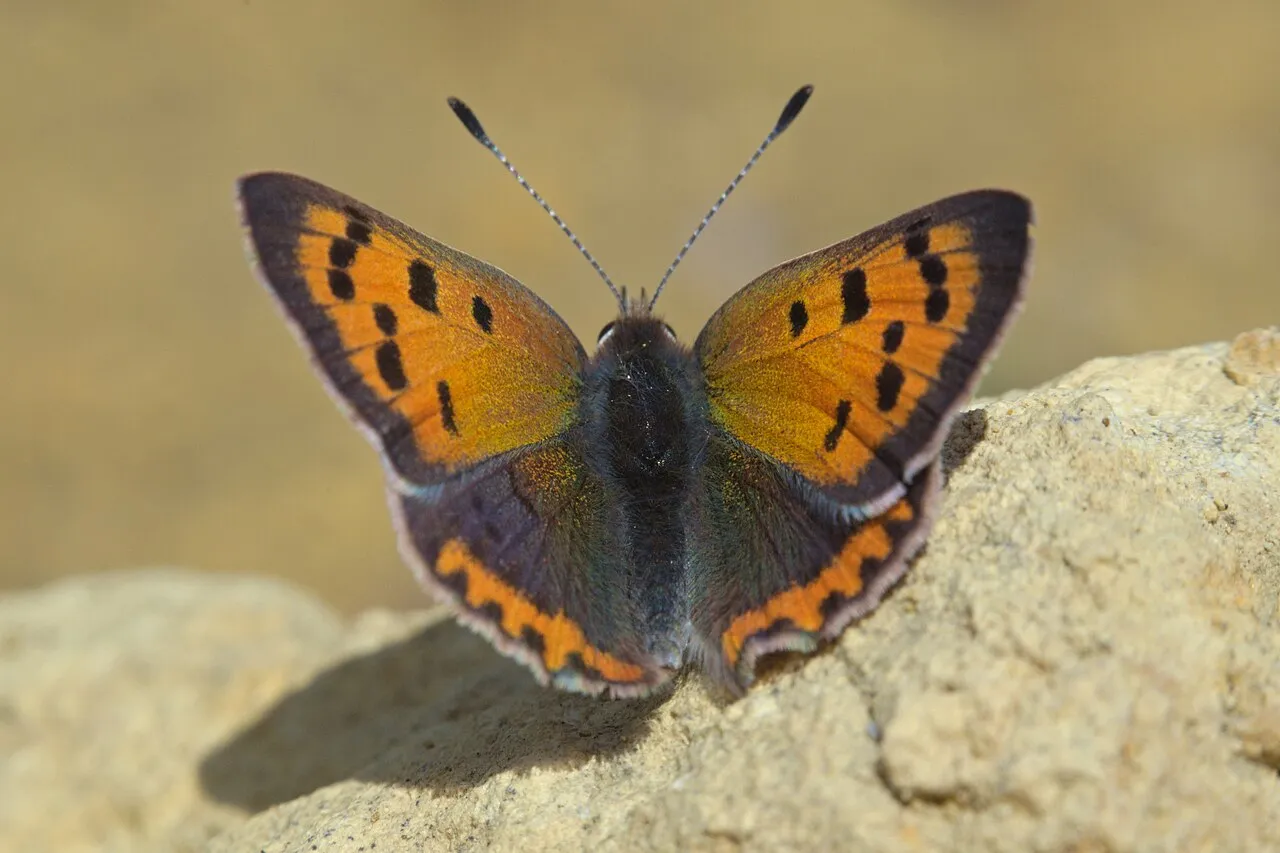
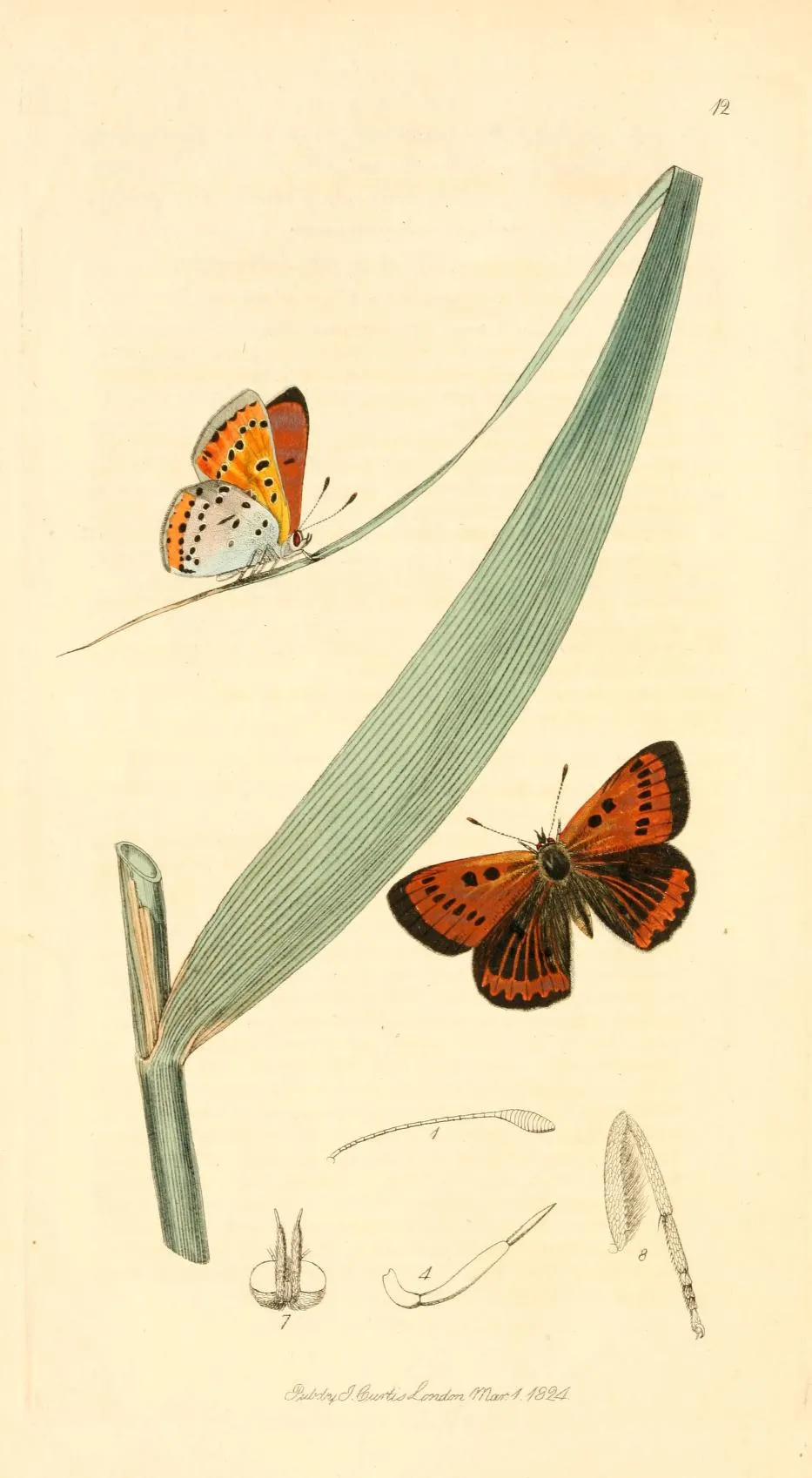
_Lycaena_virgaureae_-_Radawa_Poland_-_male_Z25L2d2.webp)
_2_XOluD.webp)
_(cropped)_ZsqovX.webp)
_%E2%99%82__Holzwarchetal_bei_M%C3%BCrringen__Ostbelgien_-_Flickr_-_Frank.Vassen_Z2eXhn5.webp)
_male_Turna_Ewa2f.webp)