_%E2%99%82__Holzwarchetal_bei_M%C3%BCrringen__Ostbelgien_-_Flickr_-_Frank.Vassen_Z2eXhn5.webp)
Contents
The violet copper, Lycaena helle, is a small butterfly of the family Lycaenidae, named for the blue-violet gloss that washes over its dark brown upperside in sunlight. The species ranges from the Pyrenees to northern Norway, and from Belgium east across the Palearctic to Central Asia, Siberia and the Amur region, though within that broad sweep it is sporadic and absent from large districts, rather than forming a continuous population across Central and Northern Europe.
Identification
The violet copper has a wingspan of 24–26 mm, among the smaller coppers found in Europe. The upperside is dark brown with a sky-blue gloss that strengthens in direct sunlight, the feature that gives the species its English name. Both sexes carry that gloss on both wings, but females of the spring brood add a reddish-yellow patch to the forewing disc, a mark the males of that brood lack. On the underside, the hindwing carries a bluish-white lunate band set just before a red submarginal band, accompanied by black dots; in females that pale band typically extends onto the forewing as well. The two broods also look different from each other: the summer form is darker above and more yellow beneath than the spring form. Populations in the far north are classed as the subspecies lapponica, and even within the wider range the exact shade of the gloss varies by district, running more blue in some areas and more violet in others.
Range and habitat
The violet copper favours damp meadows, found mainly in the lowlands in the north of its range and in mountainous terrain, up to roughly 1,800 m, further south. At night and in poor weather, adults rest on the underside of alder (Alnus) and willow (Salix) leaves, sometimes clustering together in groups, a sheltering habit that sets it apart from coppers that simply perch low in vegetation.
Life cycle and host plants
Caterpillars feed mainly on bistort (Polygonum bistorta), with Rumex also reported as a host, and are found on the plant in June and again in autumn, tracking the two broods of adults. The larva is light green with a dark line down the back and a yellow stripe along each side, and it pupates into a yellowish-brown chrysalis marked with blackish spots. The species produces two generations a year, a spring brood and a summer brood, each with a somewhat different look as described above.
Behaviour and flight period
Adults are on the wing from May to July, with a second emergence in July and August depending on location, the later dates marking the summer brood further north or at higher elevation. The spring brood visits the flowers of cuckooflower (Cardamine pratensis) for nectar, a damp-meadow plant that flowers alongside the butterfly’s own emergence. Outside flight hours the butterflies are easy to overlook: sheltering on the underside of alder and willow leaves, occasionally in loose clusters, keeps them out of sight of all but a close look.
Conservation
The species is assessed as shown in the facts box, a category drawn from its Wikidata record. Its scattered, patchy distribution across the Palearctic, with gaps even within its mapped range, leaves many of its colonies isolated from one another and dependent on the damp meadows it needs surviving undrained and unploughed.
Similar species
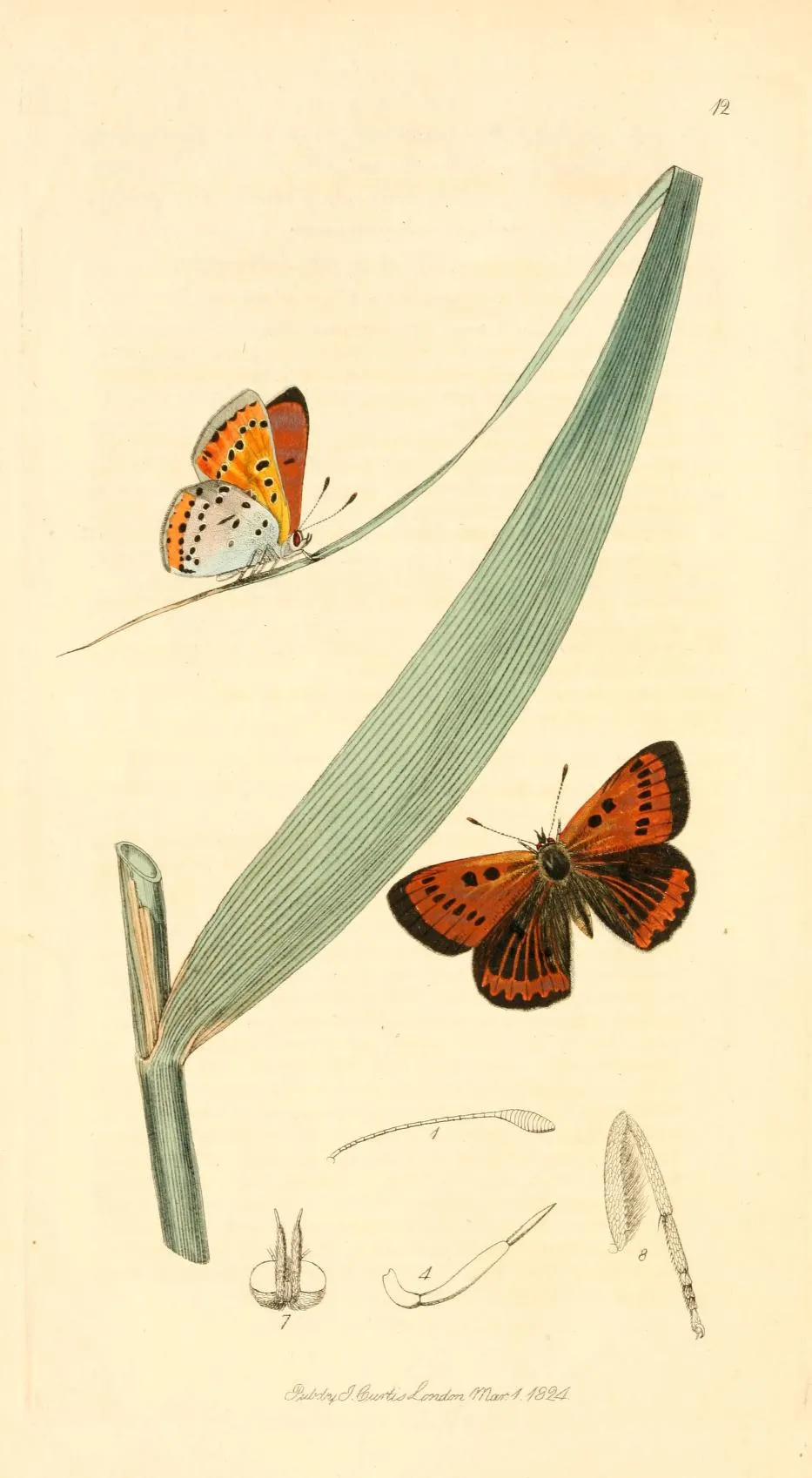
- Purple-edged copper (Lycaena hippothoe): shares the same bistort host plant and a violet-toned male upperside, but is a larger butterfly with a bright copper ground colour rather than the violet copper’s dark brown.
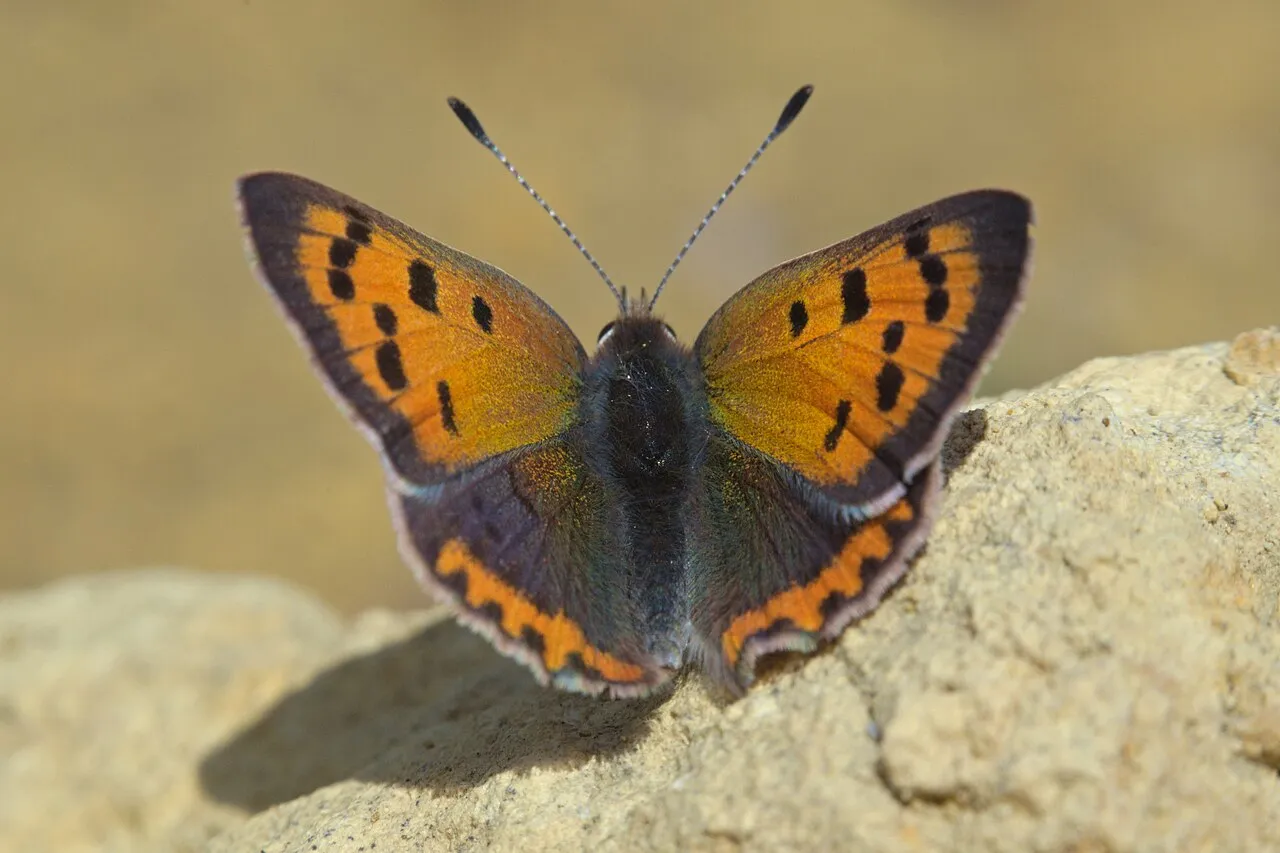
- Sooty copper (Lycaena tityrus): another small, dark-above copper of damp grassland with a dull female, but it lacks the blue-violet gloss and the pale lunate band on the hindwing underside.
_Lycaena_hippothoe_-_Ja%C5%9Bliska__Poland_-_male_Z2dknjB.webp)
_(cropped)_ZsqovX.webp)
_Lycaena_virgaureae_-_Radawa_Poland_-_male_Z25L2d2.webp)
_2_XOluD.webp)
_Z2vsEF2.webp)