Contents
The Large Copper, Lycaena dispar, is a brilliant orange butterfly of the family Lycaenidae, tied closely to wetlands across temperate Eurasia. Its species name means “unequal” or “different”, a nod to how sharply the male and female wings contrast with each other. It ranges from western Europe to the Amur region, Korea and Manchuria, roughly between latitudes 40° and 60°, but it has been extinct in Britain and Ireland since the mid-19th century. Within that range it keeps to undisturbed, often marshy ground, and it is one of the larger members of its family. Several subspecies are recognised, from the extinct English form in the west to six further extant races, including the Dutch batavus, across Europe, Siberia and Manchuria in the east.
Identification
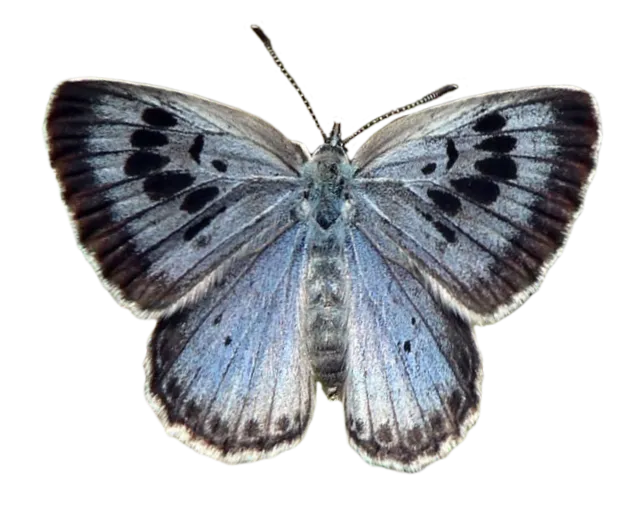
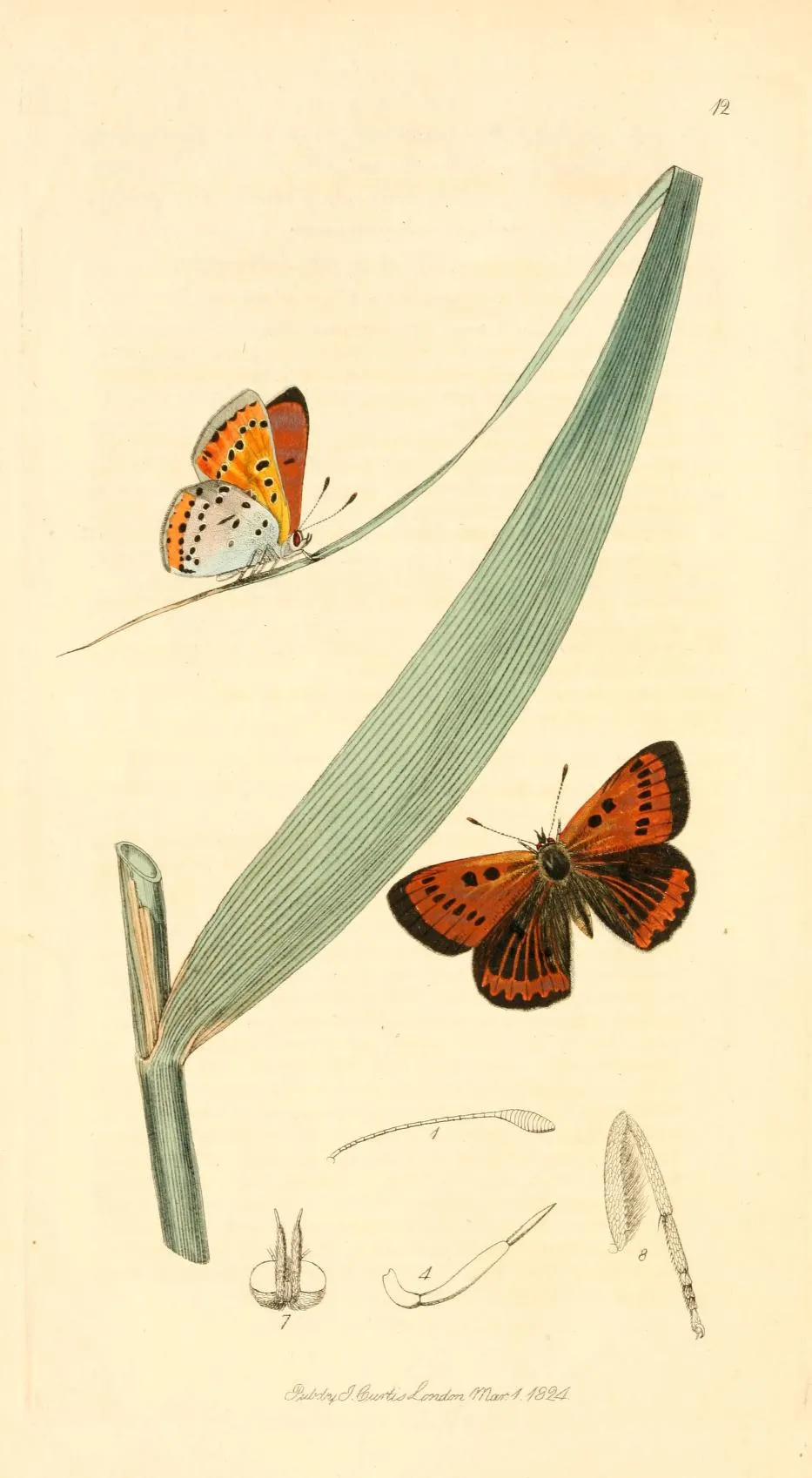
The species has a wingspan of 44–52 mm, with males running slightly smaller at 44–48 mm and females larger at 46–52 mm, noticeably larger than most other coppers. The sexes differ sharply above. The male’s upperside glows a brilliant, almost unmarked orange-copper with narrow black margins and white fringes, while the female’s forewings carry a scatter of black spots and a broader dark brown border, and her hindwings run mostly dark brown rather than copper, giving her a far more patterned look than her mate. Both sexes show a silvery-blue hindwing underside marked with black spots and an orange submarginal band, a pattern that separates the species from other coppers and helps it blend into reed and dock stands when at rest.
Range and habitat
The Large Copper is a wetland specialist. It favours undisturbed grasslands and fens along riverbanks and stream banks, where its host plants grow thickly and the ground stays damp through the flight season. Central European populations have proved more adaptable, also turning up on drier fallows and even in urban wetlands. In Britain the species was first recorded in 1749 near Spalding, Lincolnshire, where it lived in the fens of East Anglia and probably other southern English wetlands. That reliance on wet ground made the British subspecies especially vulnerable: as the fens were drained for agriculture, its habitat shrank until the butterfly died out by 1851.
Life cycle and host plants
Caterpillars feed on dock, chiefly curled dock (Rumex crispus), water dock (R. hydrolapathum) and broad-leaved dock (R. obtusifolius), though which species a population prefers varies by region; the extinct British form relied mainly on water dock. Females lay roughly 714 eggs over a lifetime, placing white eggs singly on sunlit, medium-sized plants tucked away from open water and screened by surrounding vegetation. The caterpillars eat only the underside of a leaf, leaving the upper surface intact as a pale, papery “window”, and like many lycaenids they are attended by ants of the genus Myrmica, which lick sweet secretions from their skin. The butterfly overwinters as a half-grown, third-instar caterpillar in diapause, a dormancy triggered once temperatures drop below about 15°C, and resumes feeding on fresh dock growth the following spring. A mature larva then travels up to 25 cm from its host plant and changes colour from bright green to pale yellow-brown for camouflage before pupating for 10 to 14 days.
How many broods appear each year depends on latitude. Most of the continent sees one or two generations, with a partial third generation further south, while northern populations produce only one. The extinct British subspecies was univoltine, flying as a single generation each year.
Behaviour and flight period
Flight times track that same north–south pattern. Most European populations are bivoltine, flying in May–June and again from late July to early September, with numbers peaking in July; northern populations such as those in Estonia fly in a single generation, from late June to late July. The now-vanished British form emerged in July and continued flying into August. Males hold loose territories and intercept passing insects rather than actively search for mates, and like other coppers, adults spend much of the day perched low in vegetation or basking with wings open. The species is markedly weather-dependent: mating, and so egg-laying, takes place only in sunshine, which leaves whole generations vulnerable to a run of poor summers. Mowing shortly after eggs have been laid can also wipe out a local population in a single pass.
Conservation
The species is listed as Near Threatened, the status shown in the facts box and taken from its Wikidata record. Drainage and the loss of undisturbed wetland habitat are the main pressures behind that status, the same forces that drove the British subspecies extinct, compounded by the mowing and agricultural disturbance that can destroy eggs and caterpillars outright. England has seen repeated attempts to re-establish the butterfly since its 19th-century extinction, none lasting. G. H. Verrall released continental caterpillars at Wicken Fen, Cambridgeshire, in 1909, a colony that failed for lack of suitable host plants; Edward Bagwell Purefoy ran parallel colonies in Tipperary, Ireland, from 1913, one of which survived roughly eleven or twelve years; and a colony established at Woodwalton Fen from 1927, helped along by caging caterpillars over winter, persisted in a managed form until its remaining animals were taken back into captivity in 1969. All of Britain and Ireland’s reintroductions have ultimately failed, a pattern researchers attribute to captive-bred stock being poorly adapted to wild conditions.
Similar species
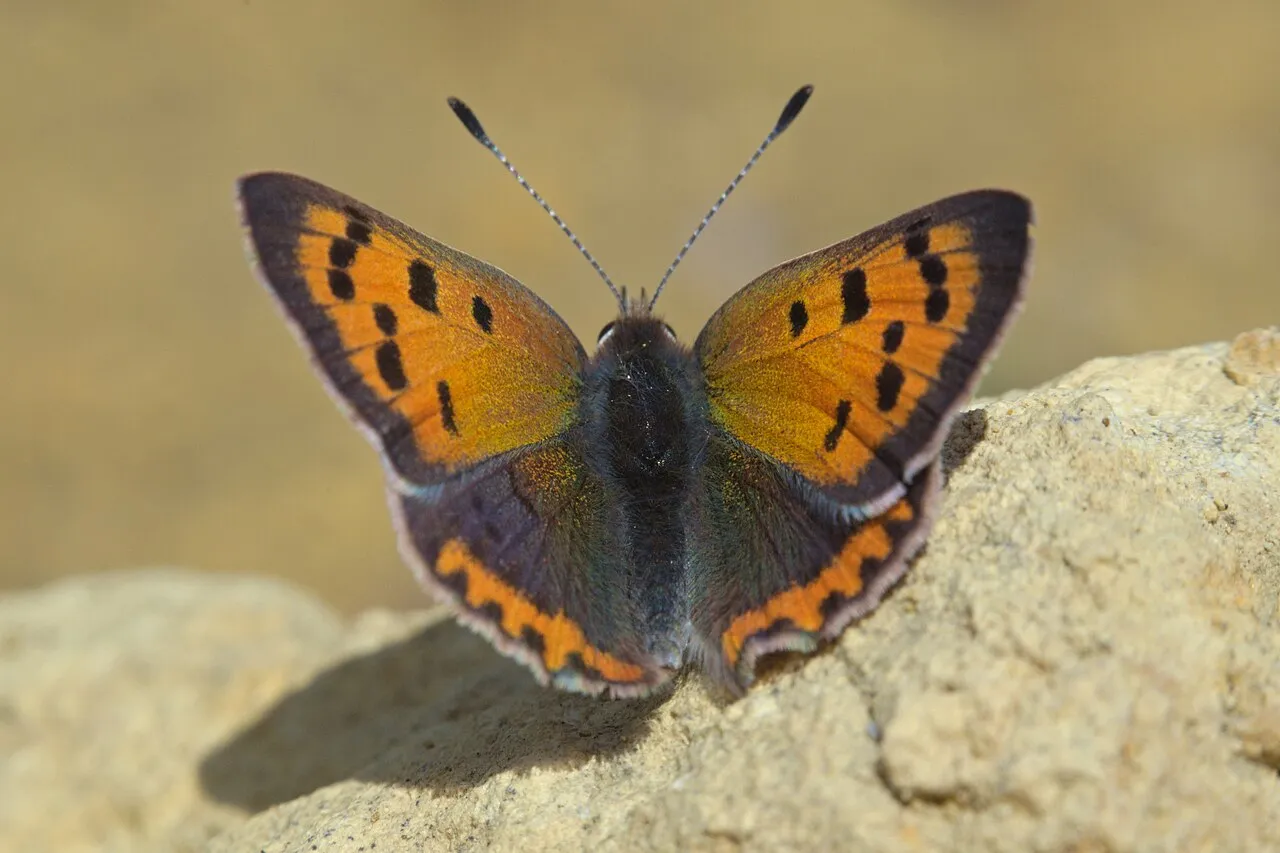
- Small Copper (Lycaena phlaeas): a much smaller, more widespread relative with a similar fiery orange upperside, but lacking the Large Copper’s wetland habit and bigger size.
- Scarce Copper (Lycaena virgaureae): another orange Eurasian copper, found in drier meadows rather than the Large Copper’s marshes and fens.
_Lycaena_virgaureae_-_Radawa_Poland_-_male_Z25L2d2.webp)
_2_XOluD.webp)
_Lycaena_hippothoe_-_Ja%C5%9Bliska__Poland_-_male_Z2dknjB.webp)
_(cropped)_ZsqovX.webp)
_%E2%99%82__Holzwarchetal_bei_M%C3%BCrringen__Ostbelgien_-_Flickr_-_Frank.Vassen_Z2eXhn5.webp)
_male_Turna_Ewa2f.webp)