Contents
The Scarce copper, Lycaena virgaureae, is a small, bright butterfly of the family Lycaenidae, with a wingspan of 34–38 mm1. It lives from Atlantic Europe to East Siberia and Mongolia2, reaching the Arctic Circle in Fennoscandia in the north and northwestern Greece in the south, but it is absent from Britain and the Netherlands.
Identification
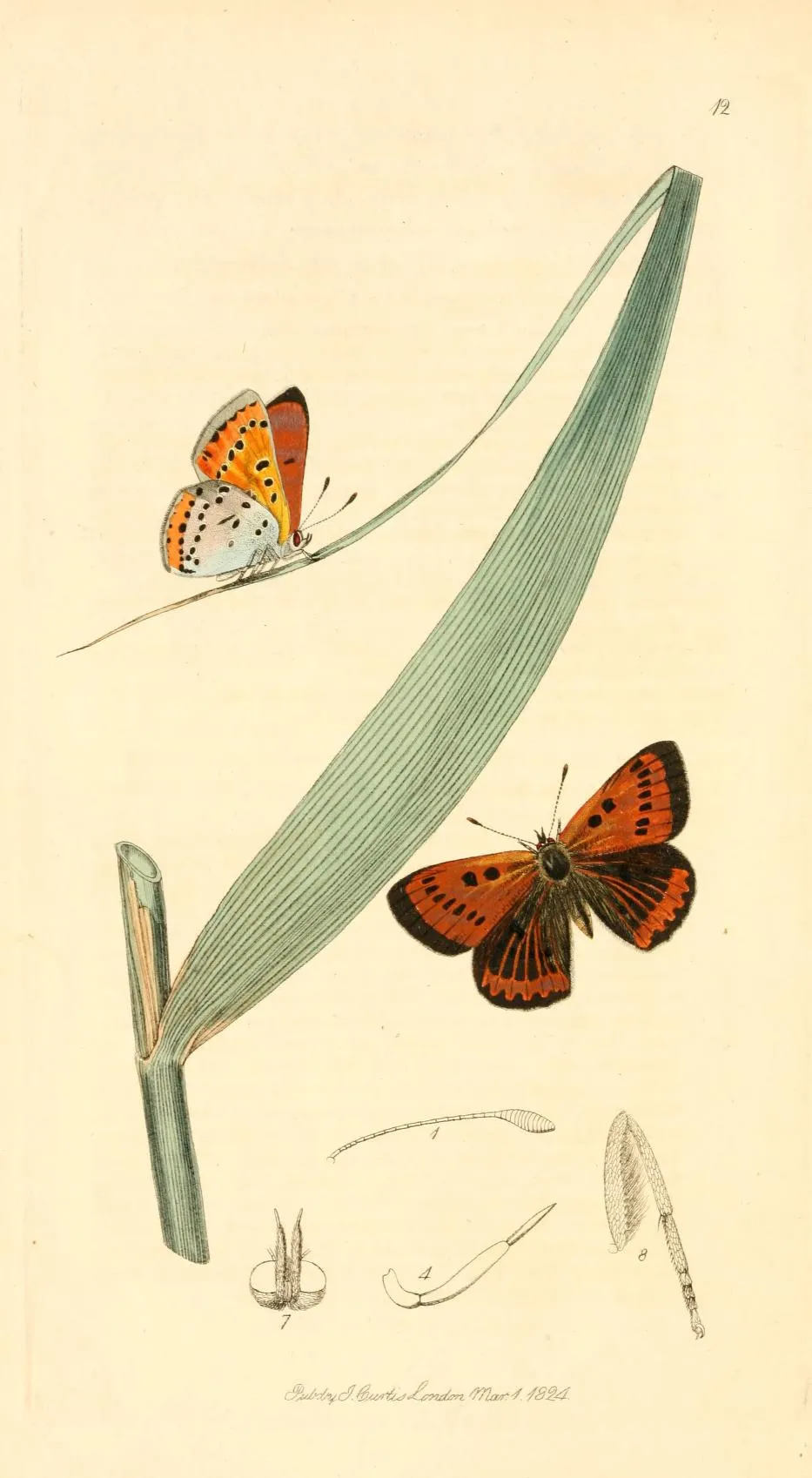
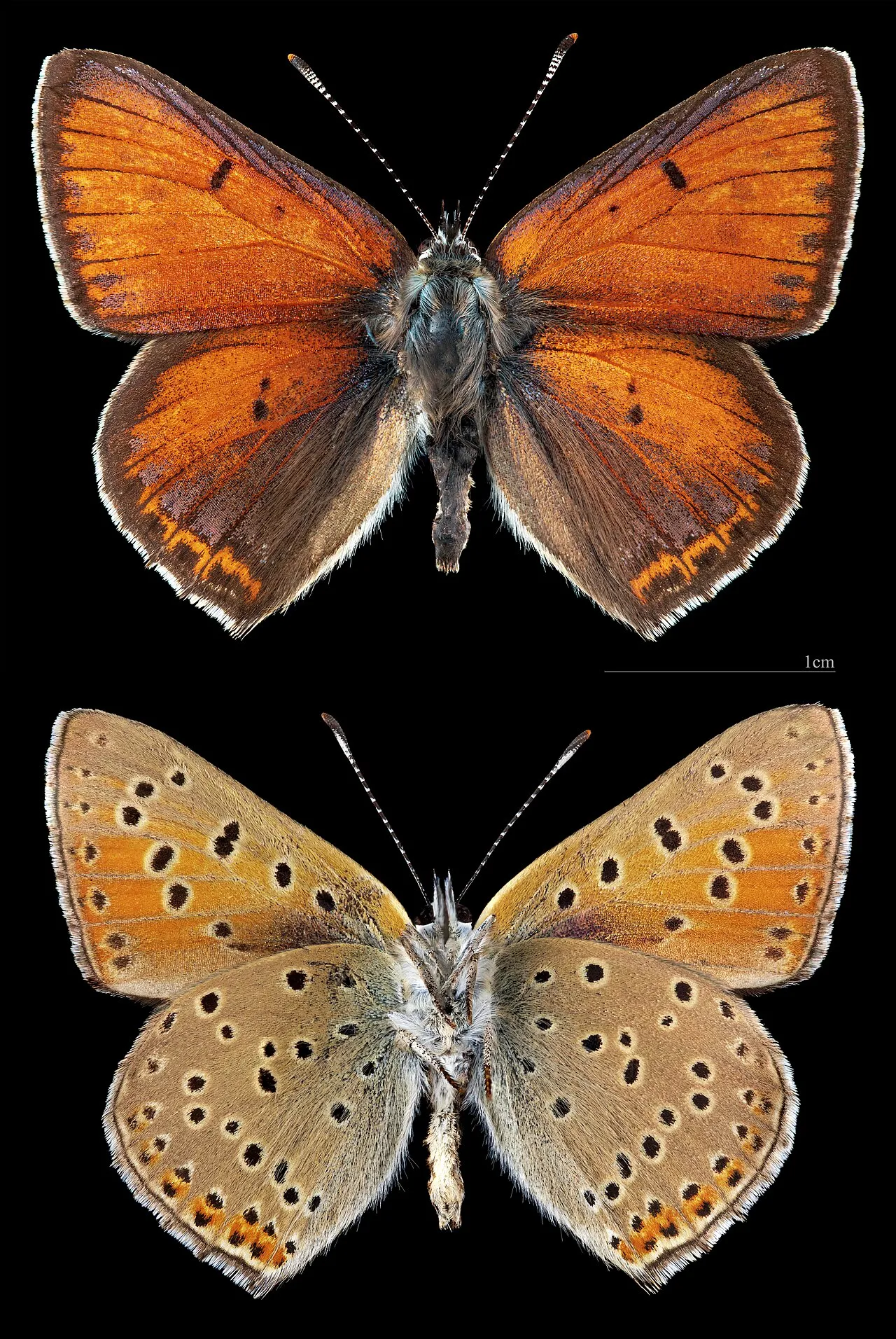
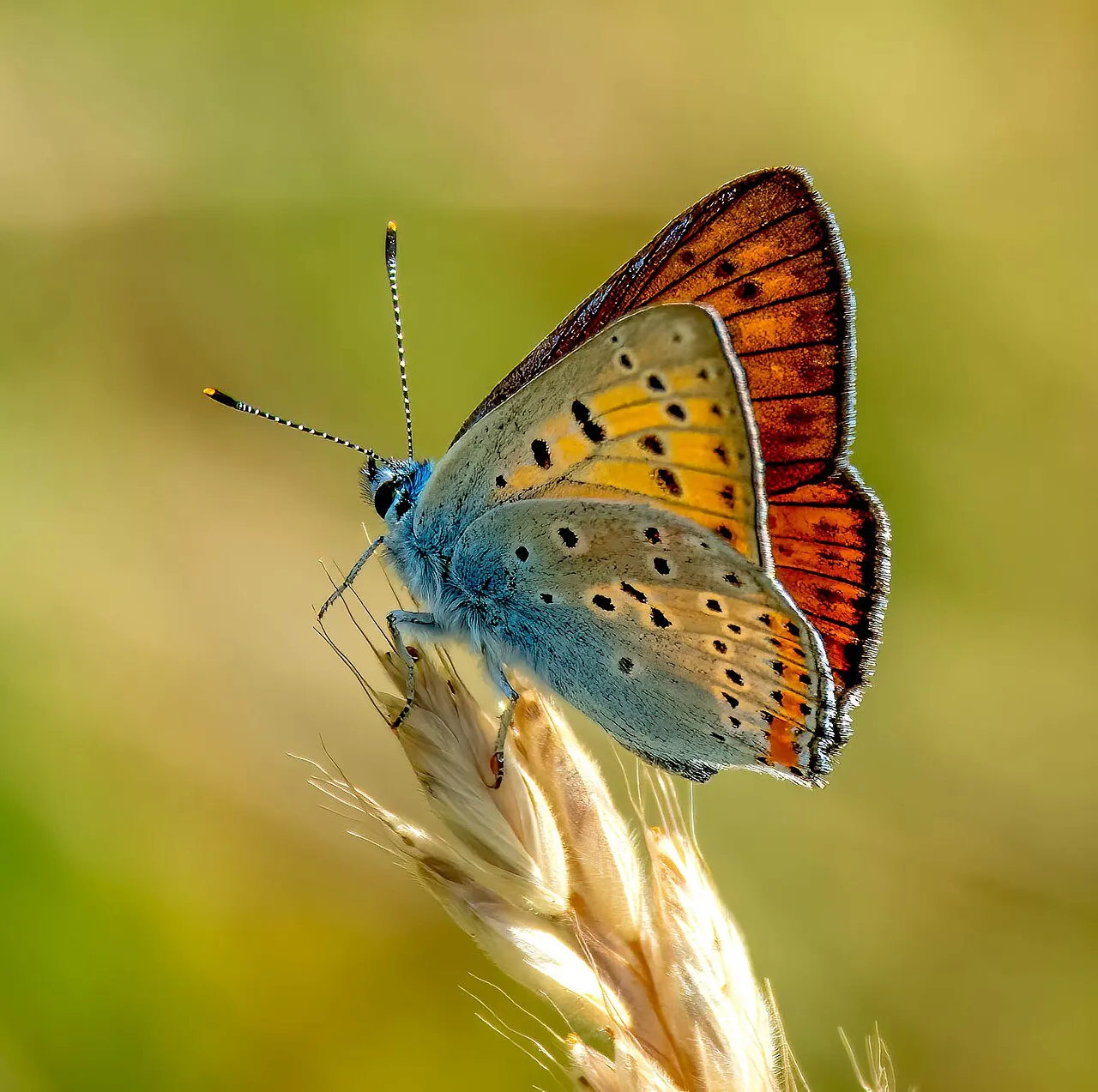
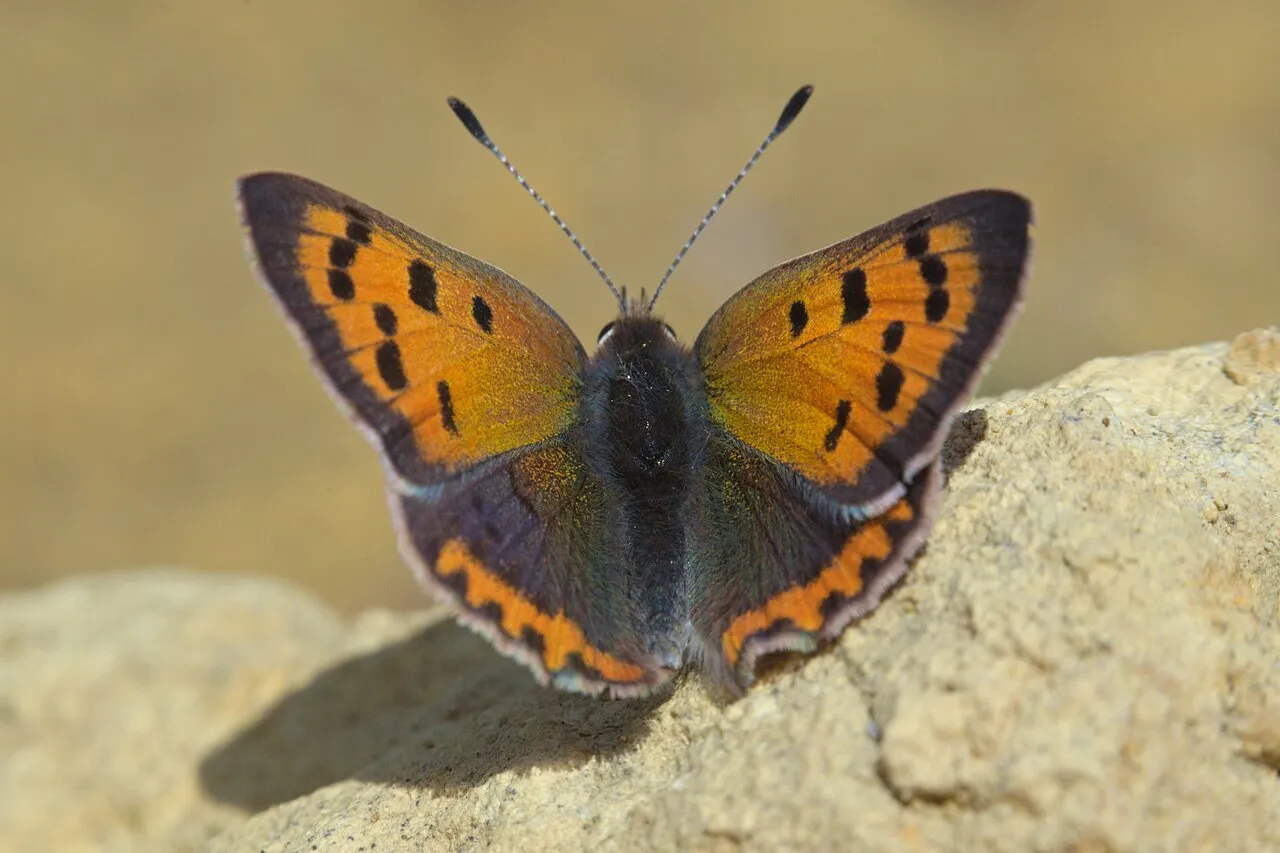
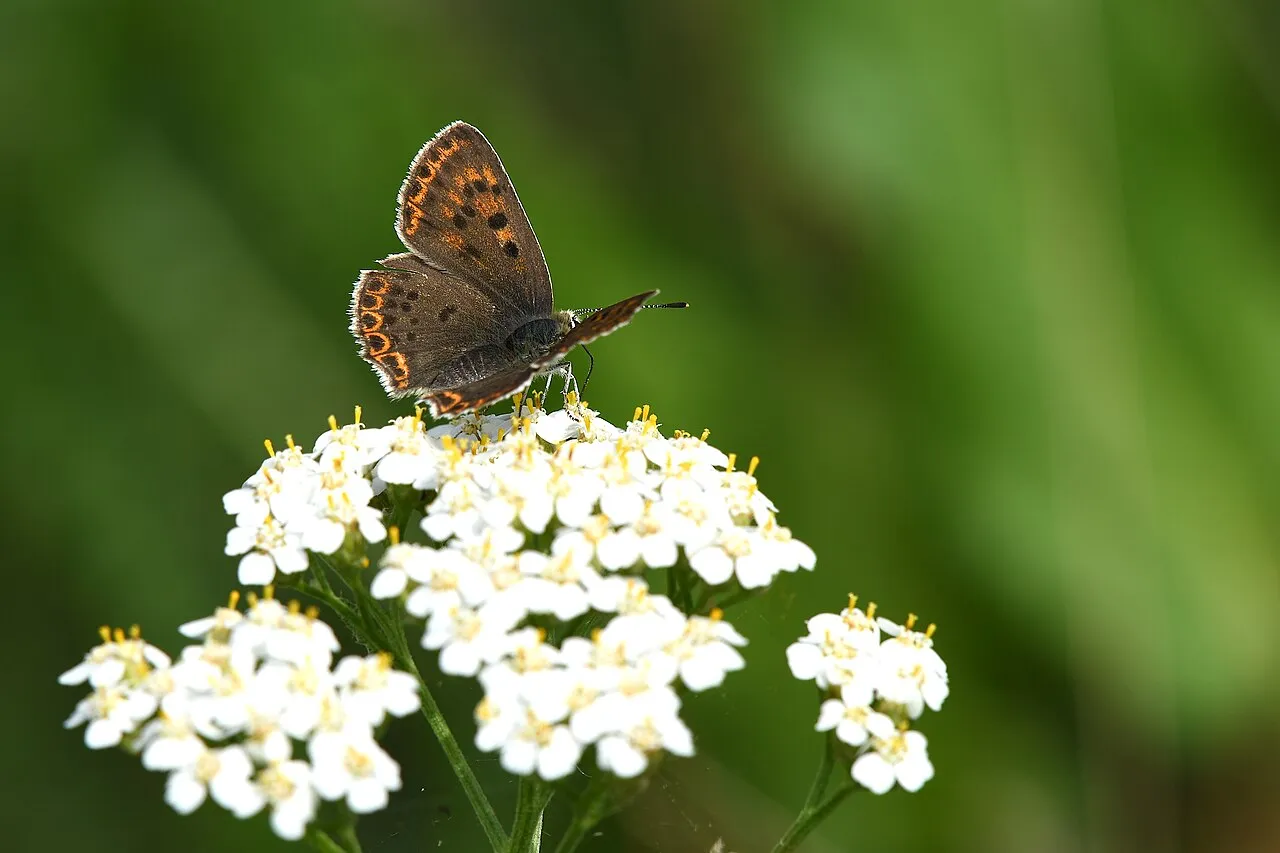
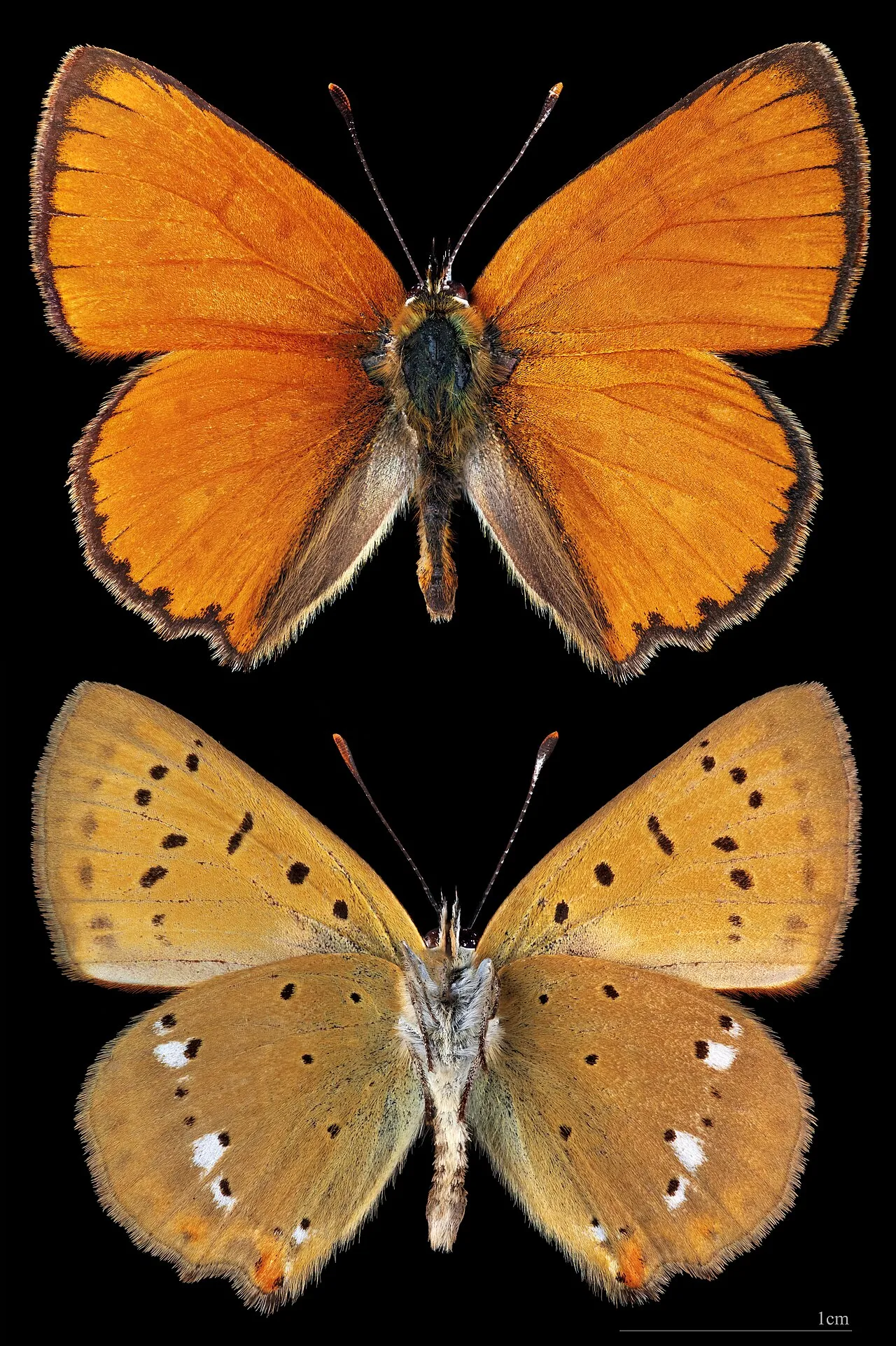
Linnaeus described the species in 1758; it now sits, within the Lycaenidae, in the subfamily Lycaeninae, tribe Lycaenini, and in some treatments has carried the synonym Heodes virgaureae. Males are colored bright gold-red above, with a narrow black margin, while females have broader orange wings marked with a dark design, the hindwing partly dusted with black. At rest, white patches on the hindwing underside3 separate it from other coppers, set against a yellowish hindwing ground colour sparsely dotted with black2. It was previously known as the Middle Copper; a claim that it flew wild in Britain goes back to 1770, but those early mentions relied on earlier published works or specimens held in collections1, not on first-hand observation of a wild butterfly in the field.
Range and habitat
In Western Europe the species survives only very locally, in the mountains; in Germany it occurs in mountain ranges such as the Black Forest and the Bavarian Forest, while in the Alps south of Germany it stays widespread and sometimes common. In the Alps south of Germany it settles on rubble fields in sparse larch forest growing Rumex scutatus, and more generally favours cool, humid coniferous forest with grassy clearings and forb communities. Elsewhere it uses mixed woodland, mesophile grassland and humid grassland, with a preference for sheltered, flower-rich grassland in or near woods3. Accounts of its elevation range vary: one gives flower-rich meadows at 1,000–2,000 m, climbing to 2,700 m in Armenia, while an older account describes it ascending into high mountains above 10,000 feet (roughly 3,050 m); a caterpillar found in the Swiss Alps at 2,100 m likewise sits above the lower figure. Three subspecies track that mountain habit: L. v. montanus in the Alps of France, Switzerland, Italy, Germany and Austria, at 1,700–2,000 m; L. v. miegii in north and central Spain, at 600–1,600 m; and L. v. armeniaca, endemic to Armenia, at 1,800–2,700 m2. Pyrgus.de attributes decline in Central Europe north of the Alps to the darkening of forests, and within the Alps to agricultural and forestal intensification4, abandonment of forest grazing and tourist development, especially at lower elevations.
Life cycle and host plants
Caterpillars feed on sorrel, including Rumex scutatus and R. acetosella. Females lay their eggs at the base of the flowering stems of sorrel, usually attached to dry parts of the plant4 close to the living host, and the eggs overwinter and hatch the following spring. Accounts of the egg itself differ: one describes it as white and somewhat larger than the eggs of other coppers, another, by the early naturalist Adalbert Seitz, as semiglobular and grey-green, with a network of polygons. The caterpillar is green and feeds at night, emerging from the egg in April and feeding until June, and the pupa is rounded, smooth and bean-shaped, brownish with dark markings2. It produces one generation a year3.
Behaviour and flight period
Adults seem to prefer white and yellow flowers of the daisy family, among them yarrow; the species name itself comes from the female’s visits to goldenrod3, and adults also nectar on ground-elder, Eupatorium, Valeriana and burnet saxifrage. Accounts of the single brood’s flight window differ slightly: one gives mid-July to mid-September, another late June or July into August, with high-altitude colonies flying into early September; the early twentieth-century naturalist Adalbert Seitz recorded it on meadows, clearings in woods, mountain-sides and flowery slopes2. At one high-altitude Alpine site, a naturalist found a young caterpillar on cushions of Rumex scutatus4 in late May at 2,100 m.
Similar species
- Small copper (Lycaena phlaeas): also feeds on sorrel as a caterpillar, but flies in two or three broods a year, with a fourth sometimes occurring in the south in exceptionally good years5, against the Scarce copper’s single brood.
- Large Copper (Lycaena dispar): a bigger butterfly, with a wingspan put at either 44–52 mm or 35–45 mm depending on the account, tied to wetlands and riverbanks instead of mountain meadows; its silvery-blue hindwing undersides6 are the feature cited to separate it from both the Scarce copper and the Purple-edged copper7, in place of the Scarce copper’s white-patched underside.
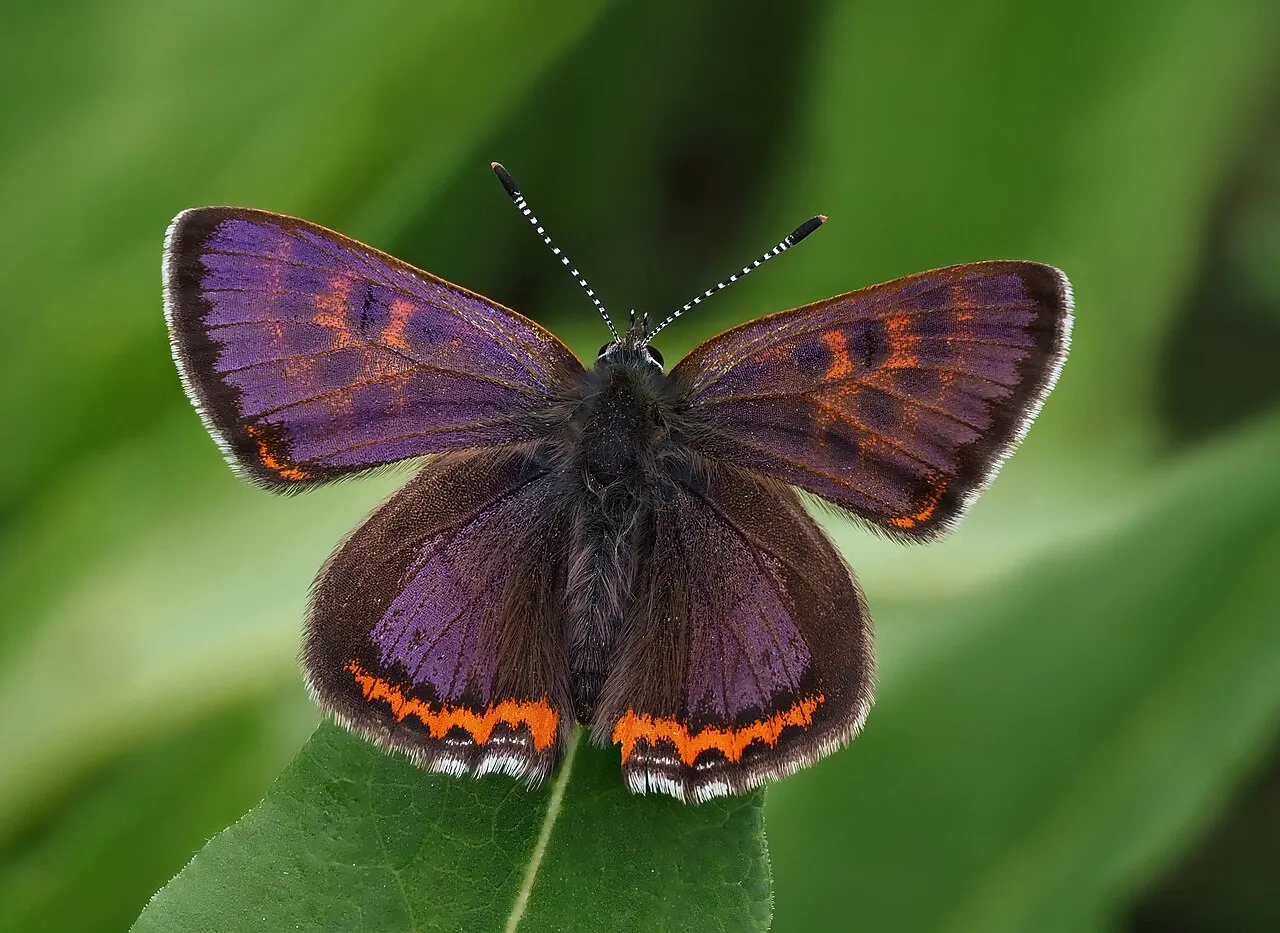
- Purple-edged copper (Lycaena hippothoe): close in size, with a wingspan of 34–38 mm; males are red above with a brown or purple edging8, described elsewhere as mostly violet-suffused9, unlike the Scarce copper’s narrow black margin.