Contents
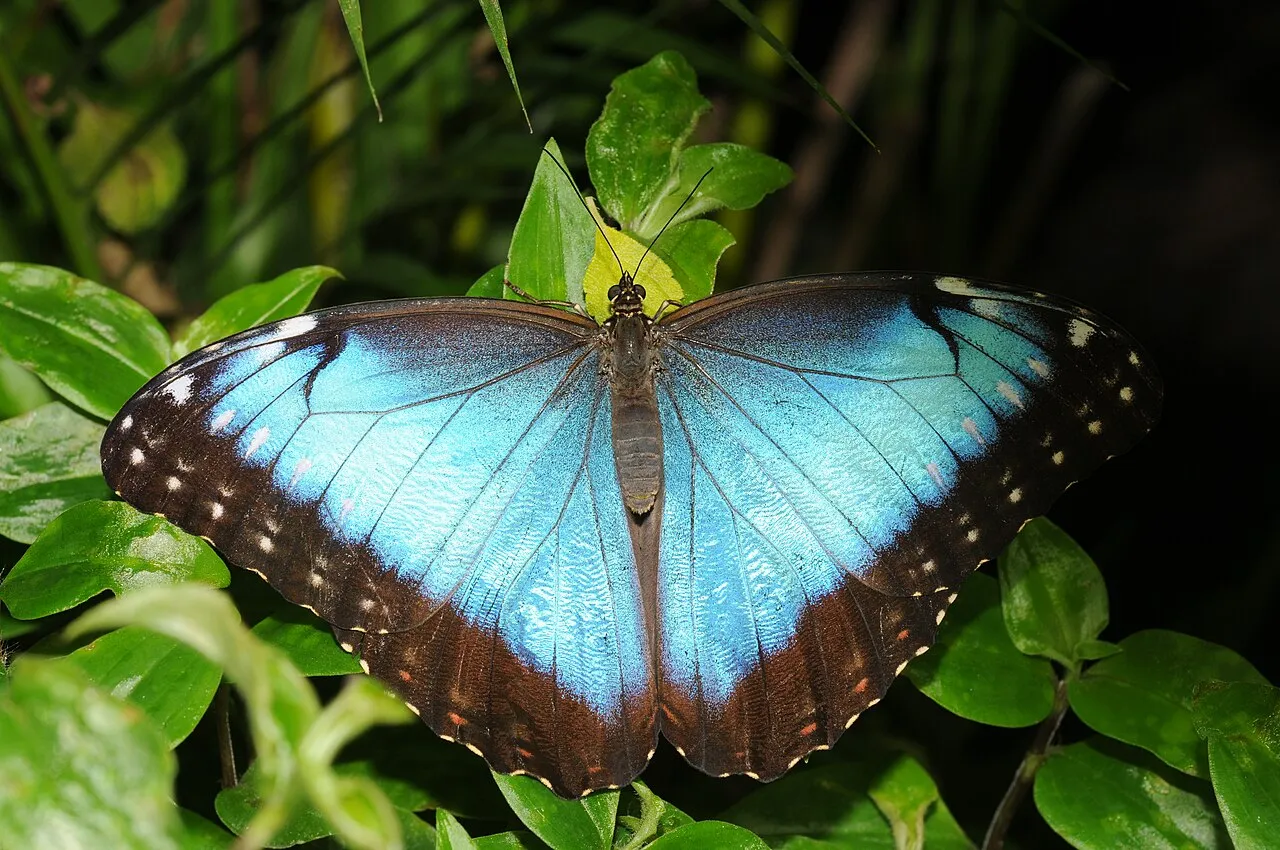
The Menelaus blue morpho, Morpho menelaus, is one of 30 species of butterfly in the subfamily Morphinae1. This neotropical butterfly is found in Central and South America, and it is one of the most familiar and recognizable neotropical insects.
Identification
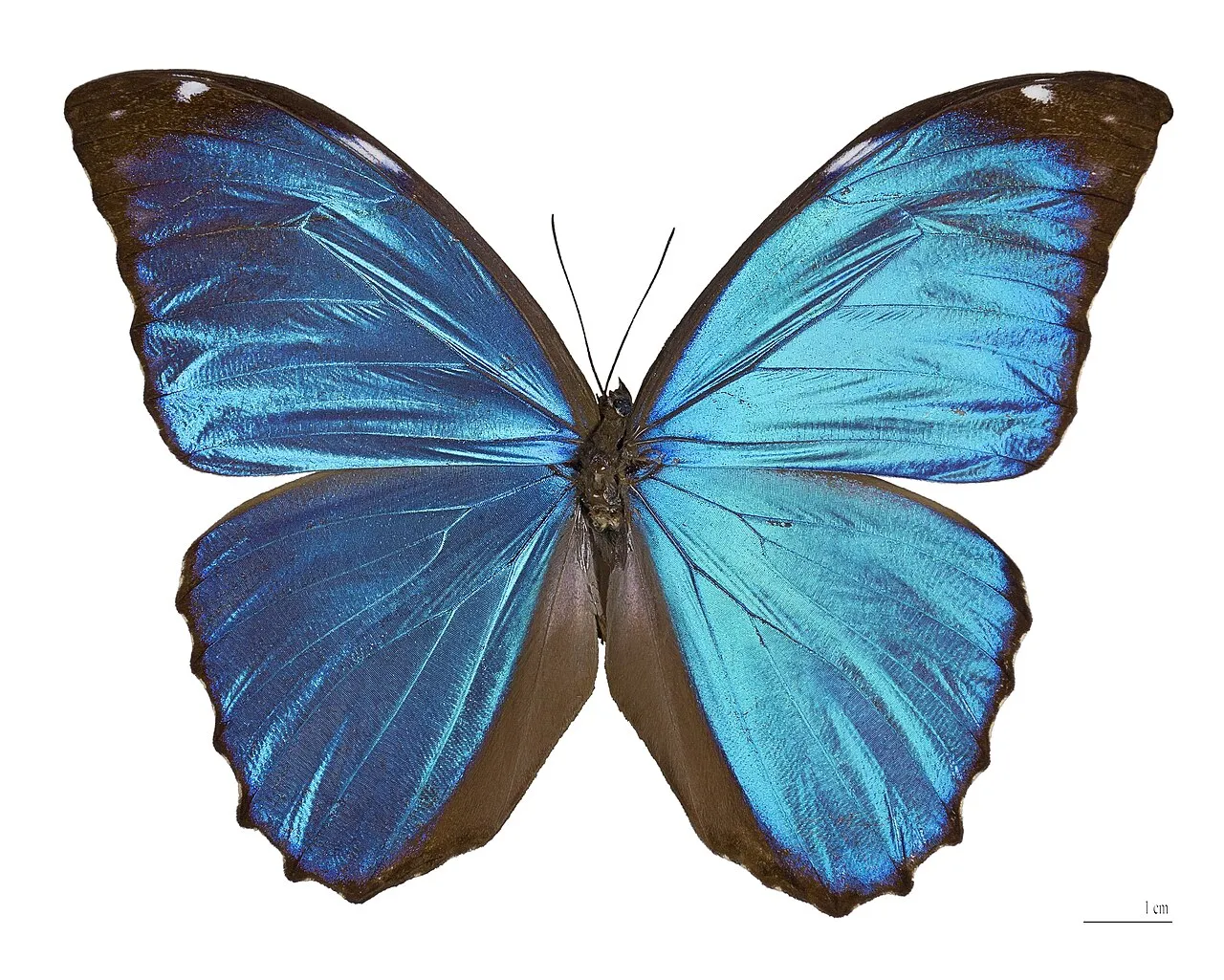
Its wingspan is about 12 cm1. Above, both wings are a bright, iridescent blue with black edges, while the undersides are brown. The sexes differ on the upperside: in the female it is more camouflaged, while the male shows a strong blue. In forewing length, aspect ratio and wing centroid, however, males and females do not differ.
The blue is a structural colour that varies with viewing angle. It comes from an inner layer of ground scales that are pigmented and iridescent and consist of alternating layers of chitin and air. On the underside, the wings carry an eyespot 6.8 mm in diameter1 that the butterfly uses to help avoid predation.
The caterpillar is red-brown with bright green spots1, and it is covered with bristles that release an irritant upon contact. The egg is small, round and somewhat flattened, usually pale green or whitish.
Range and habitat
The species occurs in Central and South America, including the Cerrado, a vast tropical savanna in Brazil, with other locations including Mexico and Venezuela1. The nominate subspecies, M. m. menelaus, carries the type locality Surinam2. In 2020 a paper in Tropical Lepidoptera Research described a new subspecies from north-eastern Venezuela, M. m. chantalae, with the Serranía de Turimiquire and the Orinoco Delta among its subjects3. The subspecies M. m. occidentalis lives in the Peruvian Amazon, where it has been studied in Loreto and San Martín4.
It is one of the six species of Morpho in Costa Rica1. There it struggles to survive in the dry northern Pacific area, and it needs old-growth forest with proper differentiation between understorey and canopy.
Life cycle and host plants
The female laid around 12 eggs in clusters of 5 or 61 on the undersides of the leaves. The caterpillars are social and feed on Erythroxylum, Dalbergia and Fabaceae, and they may prefer new leaves, which are easier and more nutritious to eat.
In a study of M. m. occidentalis in the Peruvian Amazon, wild females were placed in three butterfly houses planted with forest host plants, and they laid eggs most often on Vigna aff. candida, Platymiscium stipulare and Piper aduncum. Reared in the laboratory at 24–30 °C and 86% relative humidity on Arachis pintoi, the caterpillars passed through five larval instars, and the whole cycle took 97.6 days, with cumulative survival close to 80%. The larval stage had the highest mortality. The study found two natural enemies: an egg-parasitoid wasp of the family Scelionidae, responsible for 47% of the parasitism, and the ant Crematogaster, which preyed on 35% of the larvae4. Another account gives the whole life cycle as about 115 days, with 3 to 4 weeks as an adult1.
In the Cerrado the caterpillars peak in the dry season1, a climate unsuitable for most animal communities. They can enter diapause and delay pupation to survive this harsh period and the lack of water, and as the dry season continues, the caterpillar population declines due to predation.
Behaviour and flight period
Both sexes have a slow and floppy flight pattern1 and feed on rotting fruit that has dropped to the ground. In the Peruvian forest, adults of M. m. occidentalis drink the juice of fermented fruit of eight plant species4. Females inhabit the forest understory and perch on tree stumps, but are found near the treetops when it is time to lay eggs, while males tend to fly in open clearings or high in the canopy. Adults also fly along rivers, or anywhere that open land has been revealed.
In the Cerrado, adults emerge together at the beginning and the end of the wet season1. They do not appear in the middle of the wet season, because the heavy rain can cause physical harm to their wings, and for protection from rain they prefer small and enclosed spaces. Their emergence depends on the availability of food, which in turn depends on climate, and the ripening of zoochorous fruit is one of the best seasonal predictors of adult occurrence.
Similar species
- Achilles morpho (Morpho achilles): in its subspecies patroclus the upperside of the forewing is black with two broad vertical bands of blue5, where the Menelaus blue morpho is blue with only black edges.
- Rhetenor blue morpho (Morpho rhetenor): the male’s forewing has an apex more produced than any other Morphid species6, and the female has a dark-brown upperside with a central yellow area.