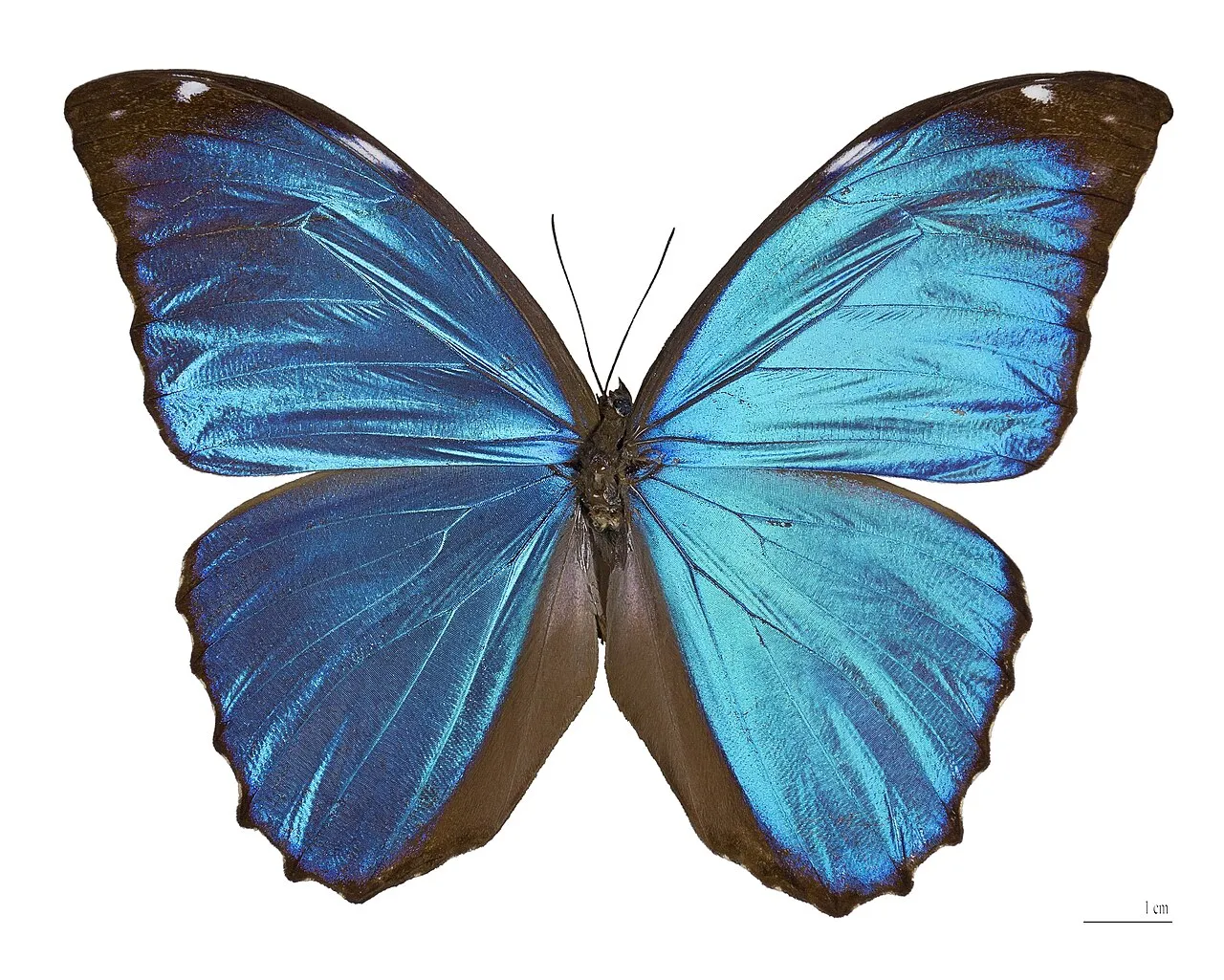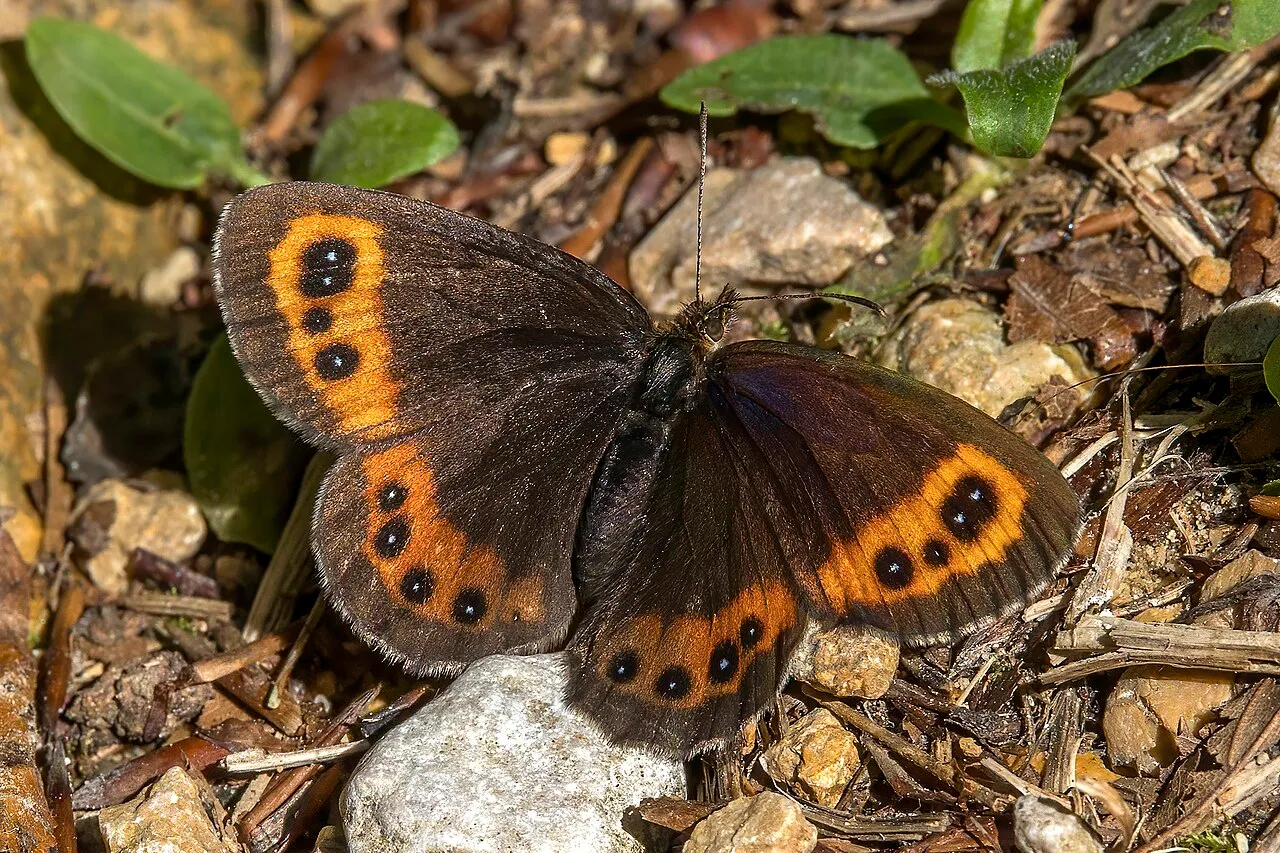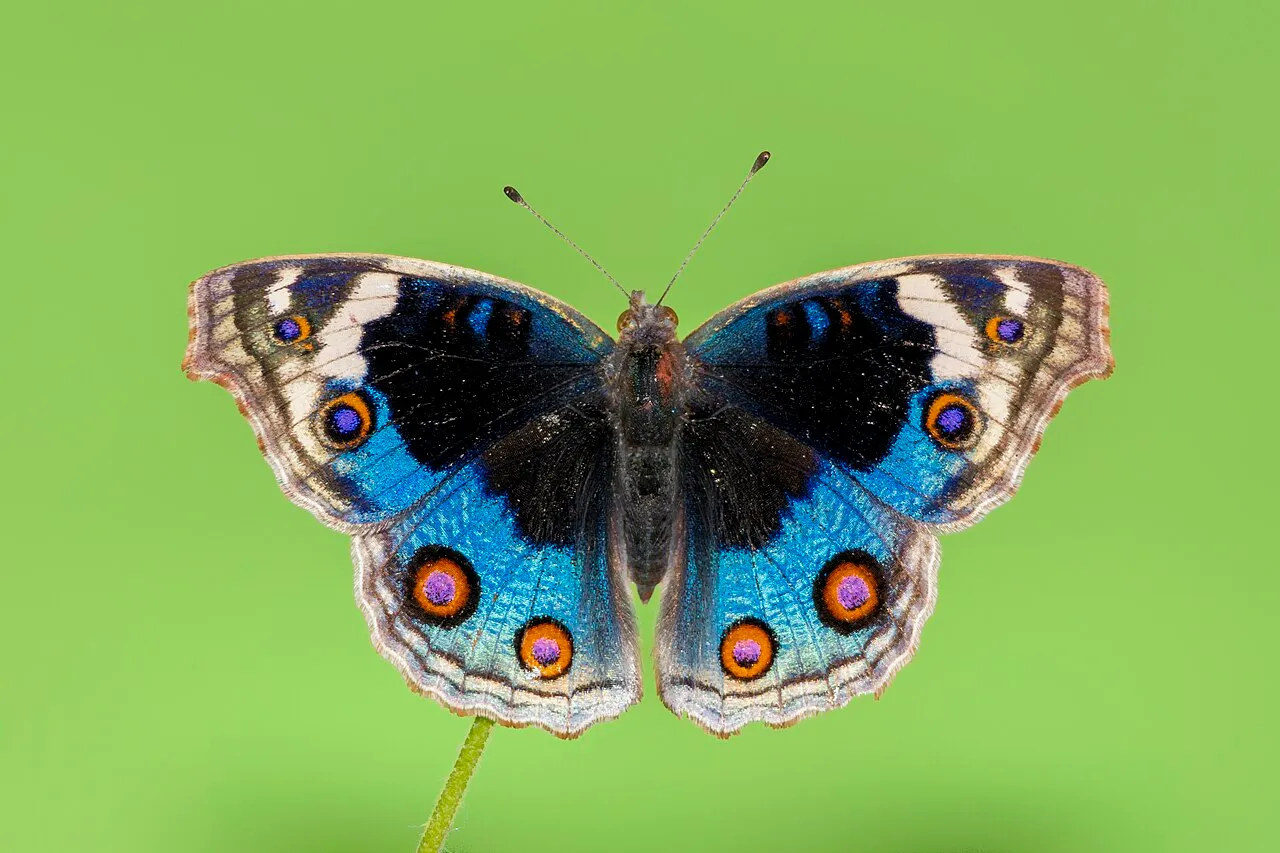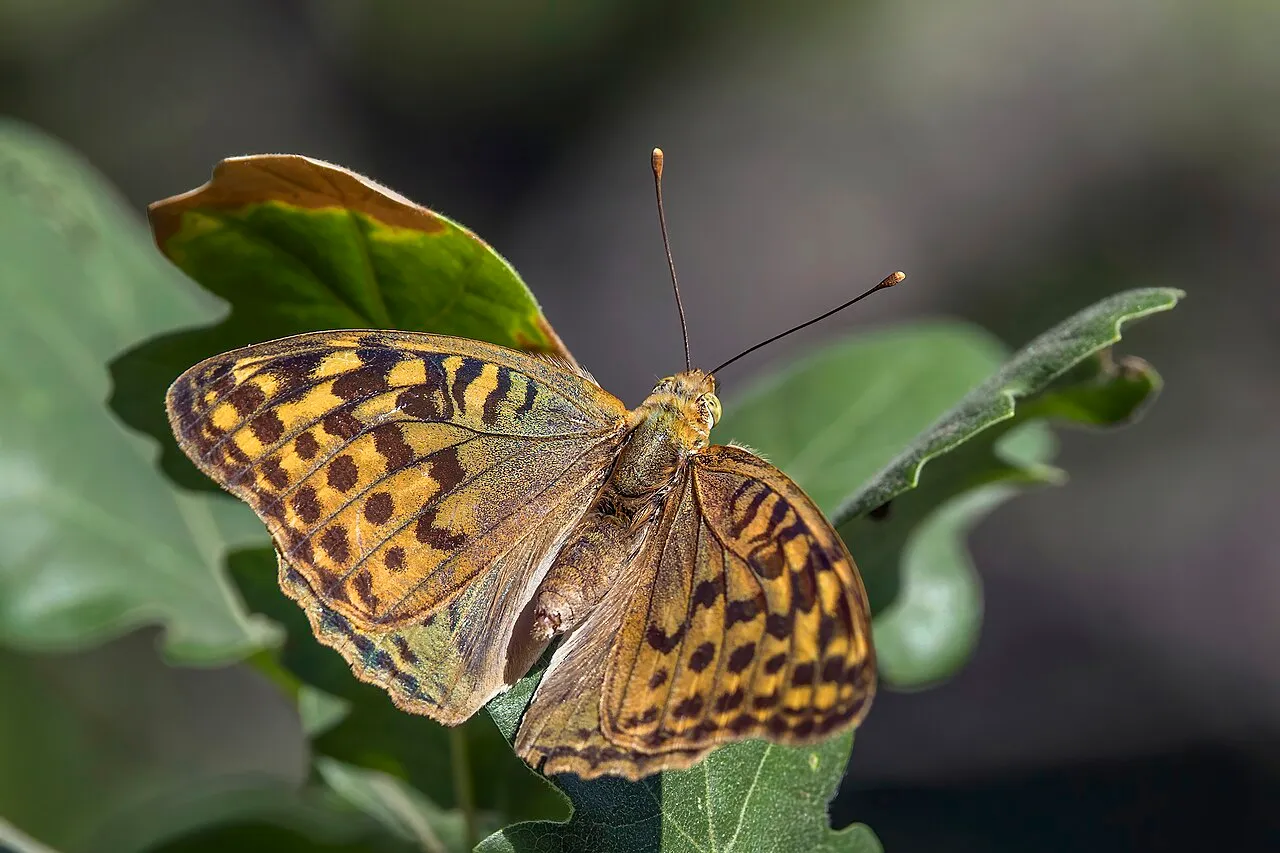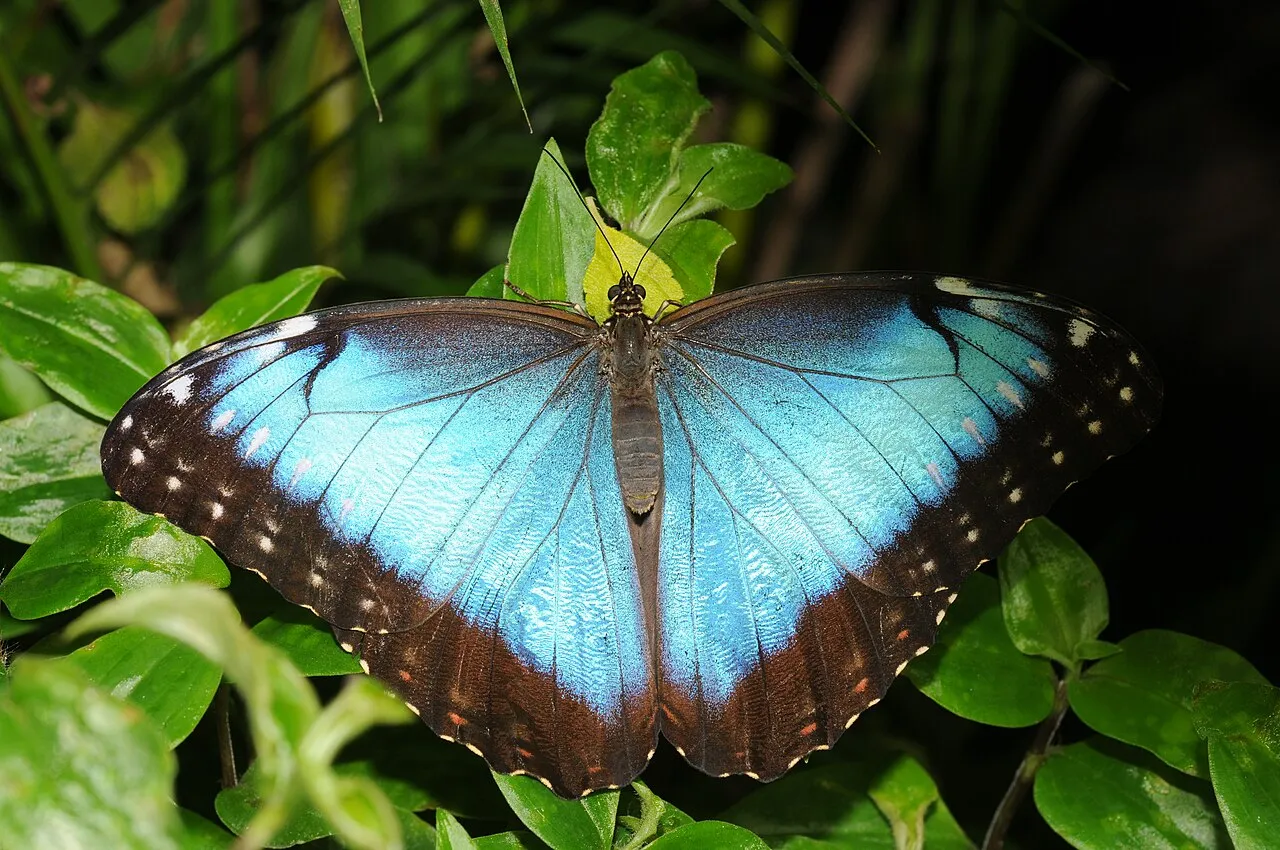
The Peleides blue morpho, Morpho peleides, also called the Common Morpho1, is a butterfly of the family Nymphalidae, subfamily Morphinae. Its place of origin is Central and South America. Most authorities treat it as a subspecies of Morpho helenor3, and the Florida Museum lists it as Morpho helenor peleides2. It is mostly known for its blue metallic shimmer4.
Identification
The wingspan is 5.0 to 6.5 inches (127–165 mm)2, and some subspecies, such as M. p. hyacinthus, are smaller than average. Only the upperside is blue, while the underside is brown. The blue comes from periodic, multilayered scales with ridged stripes, which create interference. In one study, the scales measured 157 to 216 µm long and 107 to 137 µm wide. Each carries ridged stripes approximately 0.2 µm thick and spaced about 2 µm apart, 1.71 µm high, each ending in nanotips. The underside is brown, red and white with distinct eyespots3, which can intimidate predators or act as camouflage. Brown below, the butterfly camouflages itself when it lands with closed wings4.
The sexes differ little in wing pattern and size. On the male, the blue reaches to within a centimetre of a black margin with 5–6 white spots; the female has a similar pattern, but her black margins are twice as wide3, and she is slightly larger than the male.
The wing surface repels water: in the same study, drops on it showed contact angles of about 136°. Drops slide off at 7° when the wing tilts away from the body, but only at 29° when it tilts towards it. The authors link this to survival: drops roll outwards, which shields the body, keeps their weight from hindering take-off and keeps the wings clean. Where scales are missing or the ridged stripes are damaged, a drop can no longer remain suspended4 on the surface.
Range and habitat
Morpho peleides is the most widespread Morpho species, living throughout Central America, Mexico and Paraguay. Butterflies of America gives the range of M. helenor peleides as Panama to Colombia, with its type locality in Colombia1. The species lives mainly in montane areas and tropical wetland forests3, while M. p. limpida in Costa Rica is mostly confined to primary and secondary growth forest.
Life cycle and host plants
The eggs are green with brown spots and 1–2 mm across, and the egg stage may last 7–16 days, depending on the subspecies. Eggs are prone to mould and to parasitic wasps. Newly hatched caterpillars eat their empty egg shell. The caterpillar passes through five instars, from 5.25 mm to 74–93 mm long, greenish yellow with maroon patches and tufts of red and white hair at first, brown later. The larval stage lasts approximately 40–50 days, and caterpillars of every instar are vulnerable to tachinid parasites. After a three-day prepupal stage, the pupa stage lasts 14 days3; in the prepupa the whole body turns green except the hair tufts.
Host plants are limited to eight species3, among them Machaerium seemannii, Mucuna urens and species of Inga and Lonchocarpus. Caterpillars feed only at dawn and dusk and are fully inactive in between, resting on silken mats to which they always return after feeding. Resting and feeding sites are rarely on the same leaf. Depending on the subspecies, caterpillars also feed on Patagonia pyramidata and Paullinia pinnata.
Behaviour
Unlike most butterflies, adults do not feed from flower nectar3. They feed on decayed or rotting fruit, and when no fruit is available they have been known to take sap from Samanea trees. In flight, a morpho appears as a sporadic presence on an unpredictable path4.
In courtship the male chases the female in a circular pattern, and mating can last from eight hours to three days3. Females lay their eggs singly on the upper surfaces of older leaves, especially heavily shaded ones.
Adults hear through a Vogel organ on the underside of the forewing3, with an inner and an outer membrane that vibrate differently. These are thought to widen the range of frequencies the butterfly can detect, and the organ is thought to be adapted to detecting bird predators. The species can tell sounds apart by both amplitude and frequency.
Similar species
- Menelaus blue morpho (Morpho menelaus): also blue above with black edges, but with a wingspan of about 12 cm5, and its female is more camouflaged on the upperside than the vivid blue male.
- White morpho (Morpho polyphemus): found from western Mexico to north-western Costa Rica6, its wings are bright white above and below7 instead of blue.