Contents
The great purple emperor, Sasakia charonda, is a large forest butterfly of the family Nymphalidae, subfamily Apaturinae, and the national butterfly of Japan. William Hewitson first described it in 1863 as Diadema charonda, with Japan as the type locality. It ranges across Japan from Hokkaidō to Kyūshū, the Korean Peninsula, China, northern Taiwan and northern Vietnam, and spends most of its life high above the ground.
Identification
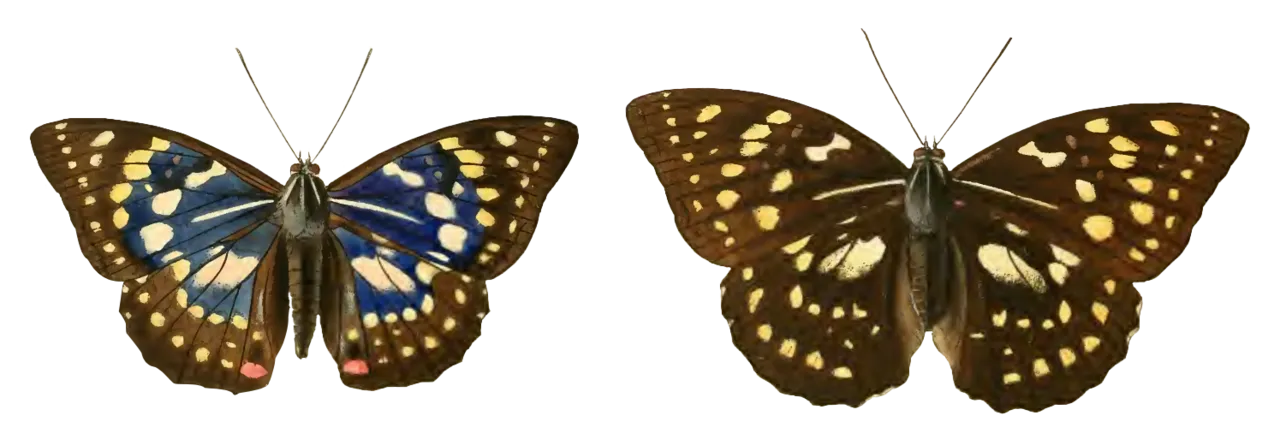
The species shows marked sexual size dimorphism. Its wingspan averages 50 mm in males and 65 mm in females, so a female on the wing looks noticeably larger than a male. The historical Hewitson illustration above shows a male and a female side by side, the kind of plate the species was first described from.
Range and habitat
Within this East Asian range the great purple emperor is common in the upper canopies of forests, only coming down to feed or to find salt sources. That canopy habit, shared with the related purple emperors of Europe and continental Asia, keeps the adults largely out of sight except when they descend to drink. On the Korean Peninsula the species is found across the country except for the mountainous northeast, including Jeju Island and islands off Incheon and Gyeonggi-do, where the population is treated as the subspecies coreanus.
Life cycle and host plants
The caterpillars feed on hackberries, including Celtis jessoensis, Celtis japonica and Celtis sinensis, and also on Aphananthe, a related tree in the elm family. These trees grow in the same forests the adults inhabit, so the butterfly’s whole life cycle plays out within a single wooded landscape rather than across open country. The caterpillar overwinters in its fourth or fifth instar, sheltering beneath fallen leaves on the ground near its food plant until growth resumes.
Behaviour and flight period
Adults are on the wing from mid-June to late August, in a single brood. Most of the day they spend in the canopy, but males are often seen sitting on the ground or sucking up water, and both sexes feed on decomposing matter or the fermenting sap that oozes from oak trees. In the afternoon, males move to mountain peaks or ridges and perch in trees there, a behaviour known as hilltopping. The habit of coming down only to feed or to find salt, and otherwise living high in the forest canopy, is one it shares with the related purple emperors of the Palearctic.
Similar species
- Purple emperor (Apatura iris): a European and Palearctic relative in the same subfamily, also a canopy-dwelling woodland butterfly whose males descend to the ground to feed.
- Lesser purple emperor (Apatura ilia): another continental relative, smaller than the purple emperor and, like the great purple emperor, a forest species of the Palearctic.
_kkJaX.webp)
_2r3CXC.webp)
_2_rmr34.webp)