Contents
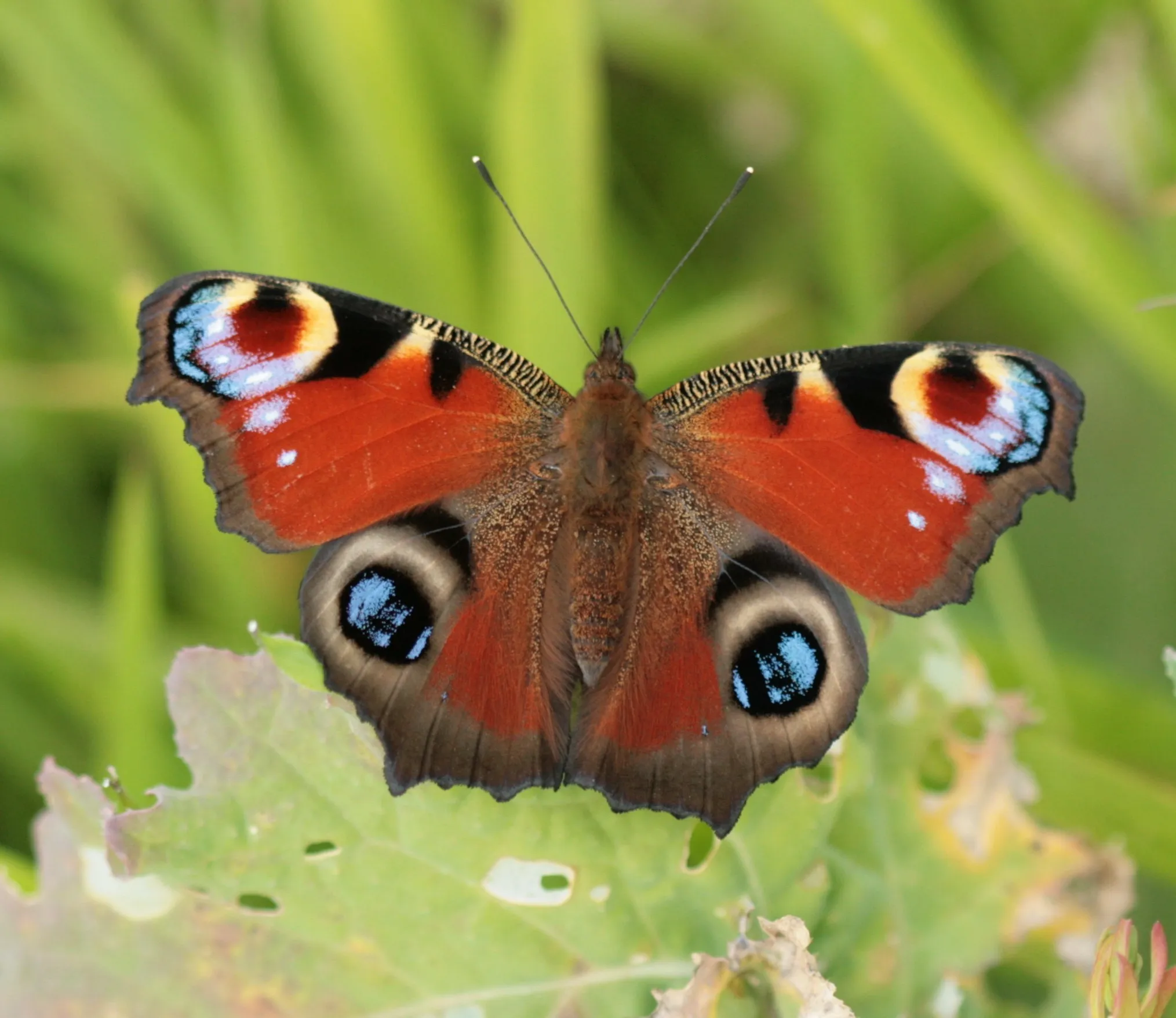
The peacock, Aglais io, is a butterfly of the family Nymphalidae that carries four large eyespots on its wings. It is found in Europe and temperate Asia as far east as Japan. In Britain and Ireland it is a familiar sight in gardens1, and a 2026 poll by Butterfly Conservation2 named it Britain’s favourite butterfly.
Identification
Males have a wingspan of 63 to 68 mm, females 67 to 75 mm. The base colour of the wings is a rusty red2, with a black, blue and yellow eyespot at each wingtip. UK Butterflies credits the eyes on the upperside of the hindwings with giving the butterfly its name. The underside is almost black1, a camouflage that works when the butterfly rests on a tree trunk or hibernates. Butterfly Conservation describes the undersides as very dark, looking like dead leaves3.
The two sexes are very difficult to tell apart, being almost identical in appearance. One way to sex them is behaviour: males will fly up at any dark object1.
Mature caterpillars are jet black for the most part, with six rows of barbed spikes and white dots on each segment2. The pupa has two colour forms, yellow and dark grey1, depending on where it pupates.
Range and habitat
The peacock lives in woods, fields, meadows, pastures, parks and gardens, from lowlands up to 2,500 metres. Two subspecies2 are recognised: A. io caucasica in Azerbaijan and A. io geisha in Japan and the Russian Far East.
In the British Isles it occurs throughout, including Orkney and Shetland, although it is not found in parts of northern Scotland, and its range there does seem to be increasing. Butterfly Conservation notes that its strong flight and nomadic instincts lead it to range widely through the countryside, often to woodland clearings, rides and edges. The species holds Least Concern on the GB Red List (2022)3, and UK Butterflies calls it not a species of conservation concern1.
Life cycle and host plants
The primary caterpillar food plant is common nettle (Urtica dioica); hop (Humulus lupulus) and small nettle (Urtica urens) are also used. Females lay egg clusters of up to 400 eggs on the underside of a nettle leaf, and the eggs hatch in 1 to 3 weeks1.
The young caterpillars build a communal web near the top of the plant, moving to new plants and building new webs as they grow. When disturbed, a group will often jerk their bodies from side to side in unison; they will also regurgitate green fluid and, if necessary, curl up and drop to the ground. There are 5 instars. The pupa is formed head down, and this stage lasts 2 to 4 weeks, depending on temperature1.
The adult is the stage that hibernates, often in outbuildings such as a garage, shed or barn, frequently with other peacocks; hollow trees and wood piles1 are also used.
In the UK the butterfly is generally single-brooded1, with a small second brood that may appear in good years. In most climates the butterflies emerge from hibernation near the end of March or the beginning of April, with a second generation near the end of July. Studies in Belgium2 found the species reproducing in early spring and early summer, with a possible third period in autumn.
Behaviour and flight period
In the UK most adults emerge from hibernation at the end of March and beginning of April, and the next generation emerges at the end of July. Adults may be seen at any time of the year1, with warm weather waking them from hibernation.
Adults spend most of the morning nectaring. Males set up territories around midday, often on the sunny side of a wood, and wait there for a passing female. Adults emerging in summer nectar on a variety of flowers1, building up essential body fats before overwintering; buddleja, brambles, thistles, dandelions and wild marjoram are among the flowers UK Butterflies lists.
The avian predators of the peacock include blue tits, pied flycatchers and other small passerine birds. When attacked, the butterfly will open its wings and expose its eyespots in a threat display. It can also make a hissing sound by rubbing its wings together1 that is audible to human ears. In dark wintering sites the eyespots are ineffective against rodents such as small mice2, which react much more strongly to the hiss.
Similar species
- Red admiral (Vanessa atalanta): its velvety black wings are crossed by striking red bands4.
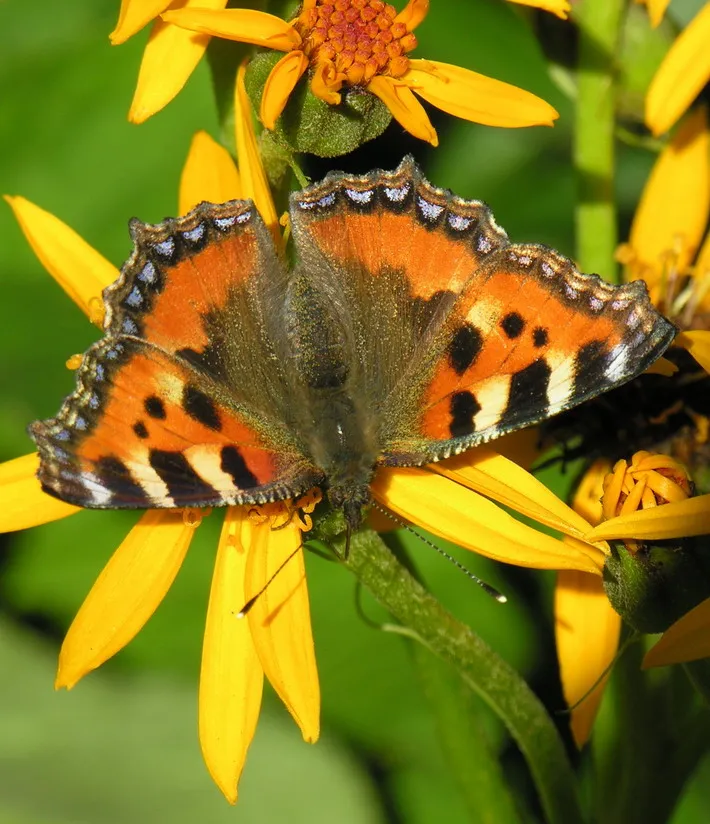
- Small tortoiseshell (Aglais urticae): a smaller wingspan, 45 to 55 mm in males, 52 to 62 mm in females5; its mature caterpillars are typically dark green with a pair of yellow stripes1, where the peacock’s are jet black.
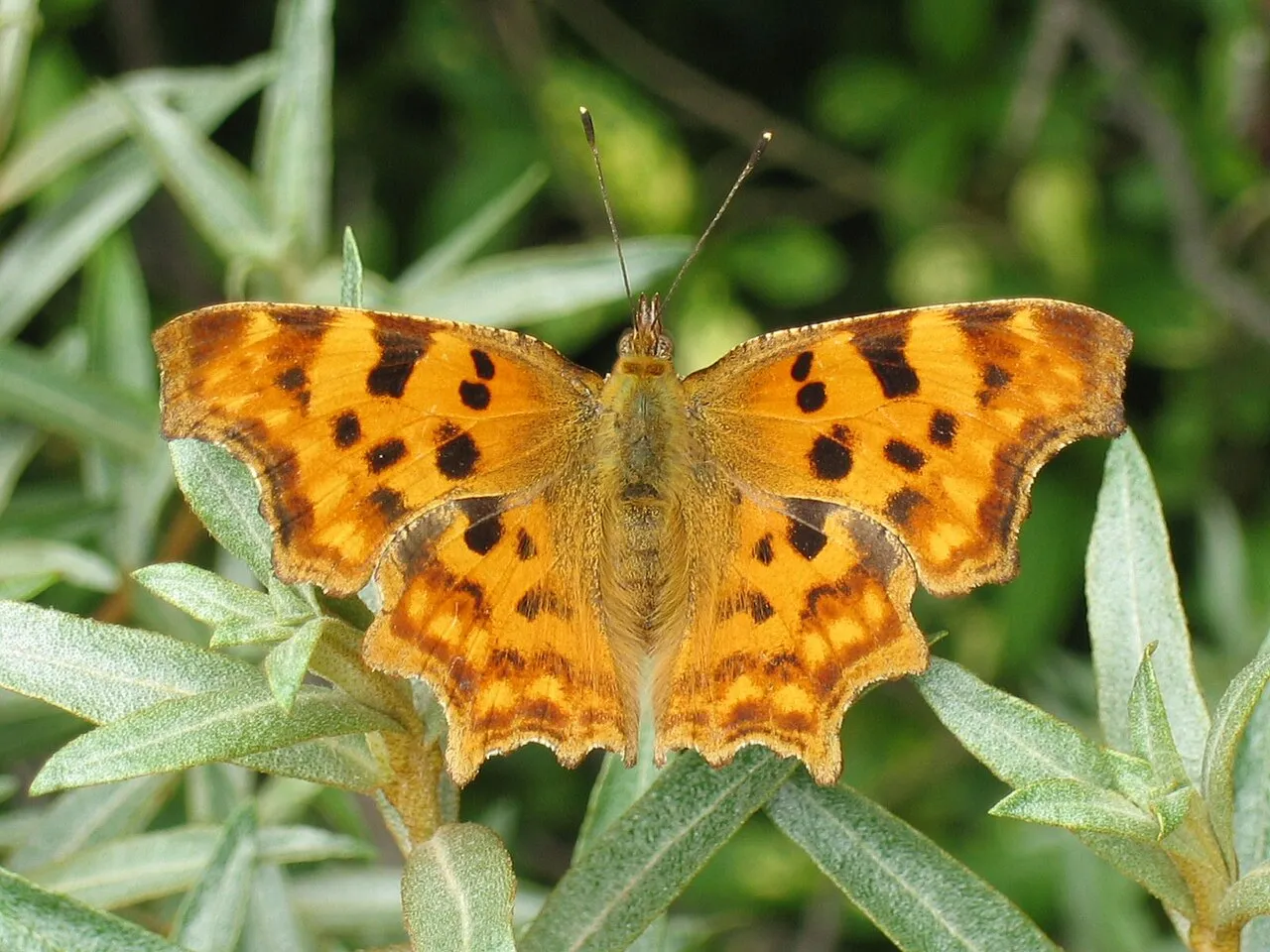
- Comma (Polygonia c-album): the jagged outline of the wings looks like a withered leaf, and its only white marking on the underside resembles a comma6.
_-_Blue_Pansy_(Female_DSF)_(5)_WLB_1XtyjN.webp)
_female_Dobruja_26TKKb.webp)
_female_Macedonia_Z3684v.webp)