Contents
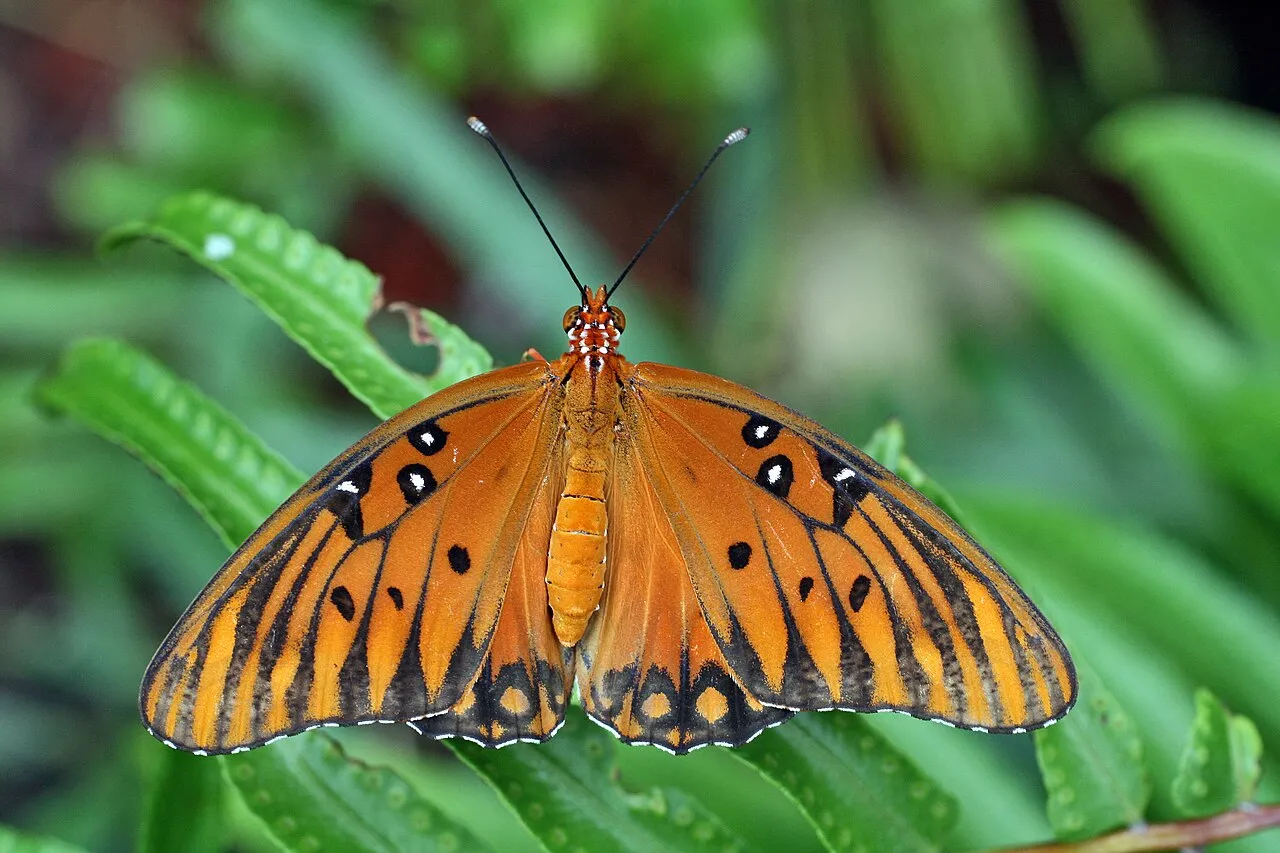
The Gulf fritillary, Agraulis vanillae, is a bright orange butterfly in the subfamily Heliconiinae1 of the family Nymphalidae. It is a resident throughout the southern United States down into Mexico, Central America, the West Indies and South America, and passion flower is its larval foodplant2.
Carl Linnaeus named it in 1758, from a 1705 painting by Maria Sibylla Merian that shows the adult and caterpillar on a vanilla orchid, but the caterpillar does not use the vanilla plant. Some taxonomies call it Dione vanillae, and a 2019 phylogenetic analysis1 placed Agraulis as a sub-genus of Dione.
Identification
The Gulf fritillary has pointed forewings2 and a wingspan of 2.5 to 3.75 inches (6.3 to 9.5 cm). The upperside is bright orange with black markings, with three black-encircled white dots on the leading edge of the forewing. The underside is brown, with orange at the base of the forewing, and both wings carry elongated, iridescent silver spots3.
Females are darker with heavier markings2, and they are typically distinctively larger than males. Males have specific structures on their dorsal wings1 that produce and release chemical pheromones.
The egg is yellow, oblong and ribbed, and it turns brownish red over the next 24 hours. The mature caterpillar is dark brown or black with red-orange stripes2 and rows of complex black spines, yet it is not a stinging caterpillar. The pupae vary in both coloring and physical size1.
Range and habitat
Butterflies and Moths of North America3 gives its range as South America north through Central America, Mexico and the West Indies to the southern United States; it wanders north to the central United States and is rare further north. It migrates northward to the Central U.S.2, and can turn up in the Great Basin, the Rockies, the Midwest and the mid-Atlantic states. To the south it reaches as far as Argentina, and it has also been introduced to Hawaii1.
It prefers subtropical second growth, woodland edges, brushy fields and city gardens2. Pastures and open fields are also listed among its habitats3.
Life cycle and host plants
Caterpillars feed on various species of passion-vine, including maypops (Passiflora incarnata) and running pop (P. foetida). In some Texan counties where the butterfly is common, they use Passiflora lutea and Passiflora affinis1. The eggs are laid singly on passion-vines2, and caterpillars feed on most parts of the host3.
The egg stage lasts on average roughly three to five days, depending on temperature. Newly hatched larvae eat the egg casings, then pass through five instars over an average 11 to 16 days. The pupal stage takes on average roughly 7 to 12 days, and the adult lives roughly 14 to 27 days1.
Butterflies and Moths of North America3 states that adults overwinter in the south. A 2009 note by Andrei Sourakov, citing earlier work, calls the species migratory, moving southward in the fall and northward in the spring, and reports that in north-central Florida it can apparently diapause as both pupae and larvae. There, some pupae stayed dormant until spring, and mature larvae apparently survived without food for four months after a freeze killed the passion-vine. Of 20 last-instar larvae he collected in late November, 90% were parasitized4 by tachinid flies.
Behaviour and flight period
Adults fly throughout the year in south Florida and South Texas, and from January to November further north; the number of broods has not been determined3. In Florida there are two major flights a year1, northward in spring and southward in fall.
Males patrol for females. In courtship, a male lands beside a perching female and performs a wing clap display; copulation, display included, lasts on average approximately 11 seconds. When disturbed, both sexes release a distinct odor from glands on the abdomen, and birds then avoid them in favour of other prey. The odour contains chemicals such as 6-methyl-5-hepten-2-one and hexadecyl acetate1. Adults take nectar from lantana, shepherd’s needle, cordias and composites3.
Conservation
The IUCN Red List rates the Gulf fritillary Least Concern, in its 2022.2 edition5. Butterflies and Moths of North America calls it not usually of concern, and the management need it lists is to cultivate host plants3.
Similar species
- Julia butterfly (Dryas iulia): another passion-vine feeder, but the male is bright orange above and below6, lacking the Gulf fritillary’s silver-spotted brown underside3.
- Variegated fritillary (Euptoieta claudia): also orange above, but the hindwing underside has a mottled pattern and no silver spots7.