Contents
The purple emperor, Apatura iris, is a Palearctic butterfly of the family Nymphalidae. It is widely distributed in dense, broadleaved woodlands throughout Europe, and its range runs across the Palearctic to central and western China1. UK Butterflies calls it elusive, spending most of its time in the woodland canopy2, where it feeds on aphid honeydew. First Nature says it is not a common sight3, partly because of its shyness and scarcity and partly because it spends most of the day in trees, particularly oaks, well above head height.
Identification
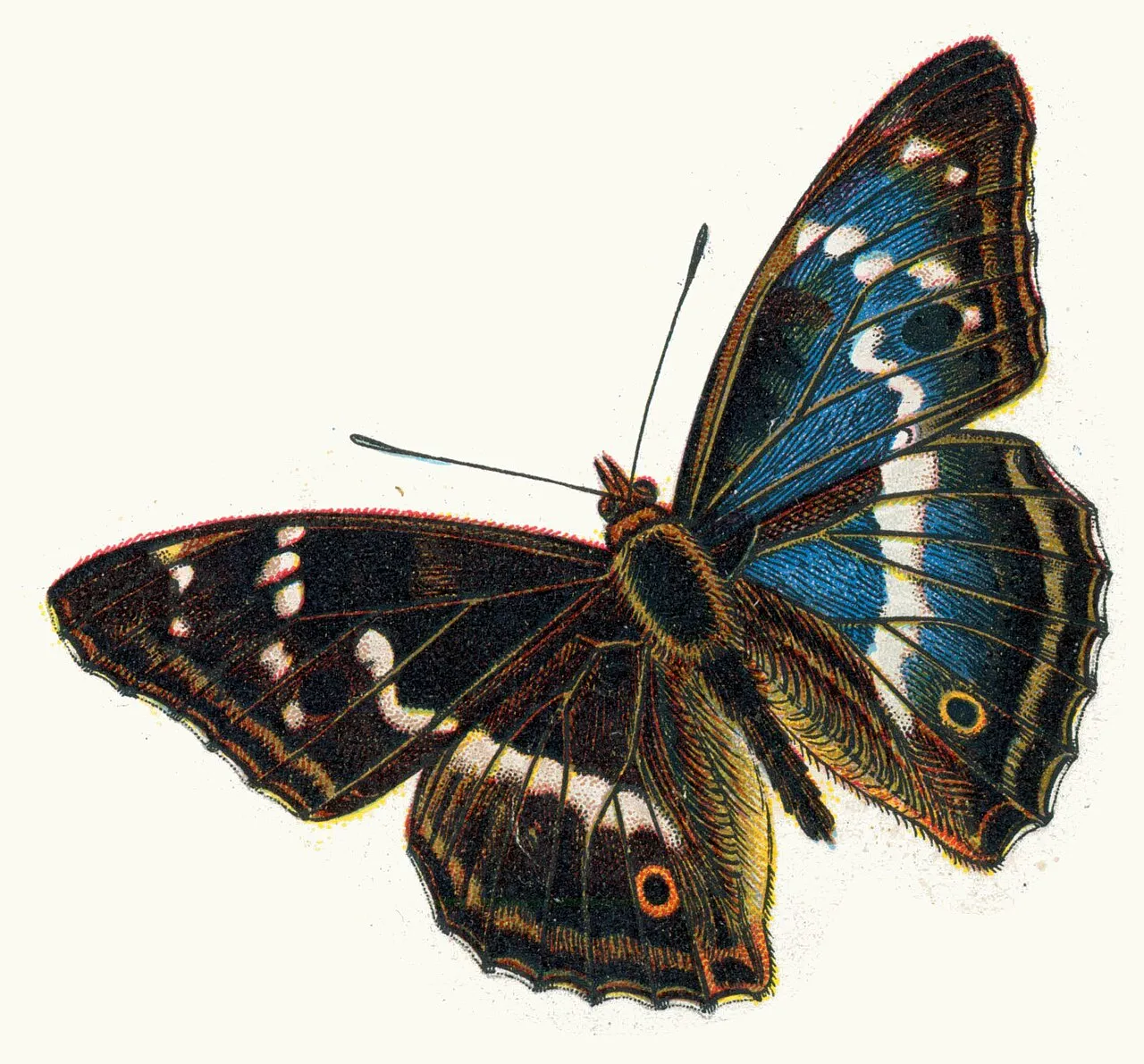
The wingspan is 70–92 mm. First Nature gives 7 to 8 cm for the male and 8 to 9.2 cm for the slightly larger female. The upperside has a dark-brown background with white bands and spots and a small orange ring on each hindwing. From certain angles the male appears to have black wings intersected with white bands; with the wings at a certain angle to the sun it shows a purple sheen, the result of light refracted from the structures of the wing scales. The female is deep brown, without the male’s purple sheen2. On the brown underside, each forewing carries a large orange-ringed eyespot, and the hindwing, more deeply scalloped than the forewing, has a long white band across its middle3.
Range and habitat
In mainland Europe the species occurs at a few locations in northern Portugal and northern Spain and is more plentiful across most of central and northern Europe except Scandinavia; it is absent from southern Italy and the Mediterranean islands3. In Britain it is confined to deciduous woodland in central southern England2, between South Wiltshire and South Hampshire in the west, Surrey and West Sussex in the east, and Oxfordshire and Hertfordshire in the north, with scattered colonies elsewhere.
UK Butterflies describes a butterfly of large expanses of deciduous woodland, usually with oaks2, less often beech and other species. Butterfly Conservation finds it in large blocks of broadleaved woodland or clusters of smaller woods4, or in dense scrub, wherever there is a good supply of willow. Females favour dense and mature oak woodlands1 and come down only to lay eggs on the small willow bushes that grow in clearings and bridleways.
In Victorian times the species was regarded as common in southern England, as far north as the river Humber, but it then went through a sharp decline in both range and numbers. Butterfly Conservation gives an abundance trend of 110% for 1979–2019 and a distribution trend of 58% for 1994–20194. The butterfly has returned in large numbers to the Knepp estate in Sussex1 following re-wilding.
Life cycle and host plants
The primary larval foodplant is goat willow2 (Salix caprea); crack-willow (Salix × fragilis) and grey willow (Salix cinerea) are also used. Poplar is a more common food plant in continental Europe1 than in the British Isles.
The female enters a sallow to lay a single egg on the upperside of a leaf in half-shade, usually toward the crown of the tree. Eggs are blue-green when first laid, and after a few days their base turns purple; they hatch in 9 or 10 days2, depending on the weather. The caterpillar is green with white and yellow markings, with two large “horns” at the front end and a smaller one at the rear. After hatching it lies along the midrib of the leaf1, where it is well camouflaged, and feeds only at night.
The larva has 5 instars in total. After the second moult it turns light brown and moves to the fork of a twig or next to a sallow bud, where it overwinters on a silk pad. Over the winter it changes colour from green to brown to match its surroundings, and it leaves hibernation around the middle of April2, just as the sallow buds start to expand. The following June it forms a pale green chrysalis, 30–35 mm long and 12–15 mm wide1, resembling a leaf shoot.
Behaviour and flight period
There is a single generation each year. In Britain the adult emerges in early July2, sometimes at the end of June in good years, with a peak in the second and third weeks of July. Adults usually emerge in July, flying well into August1.
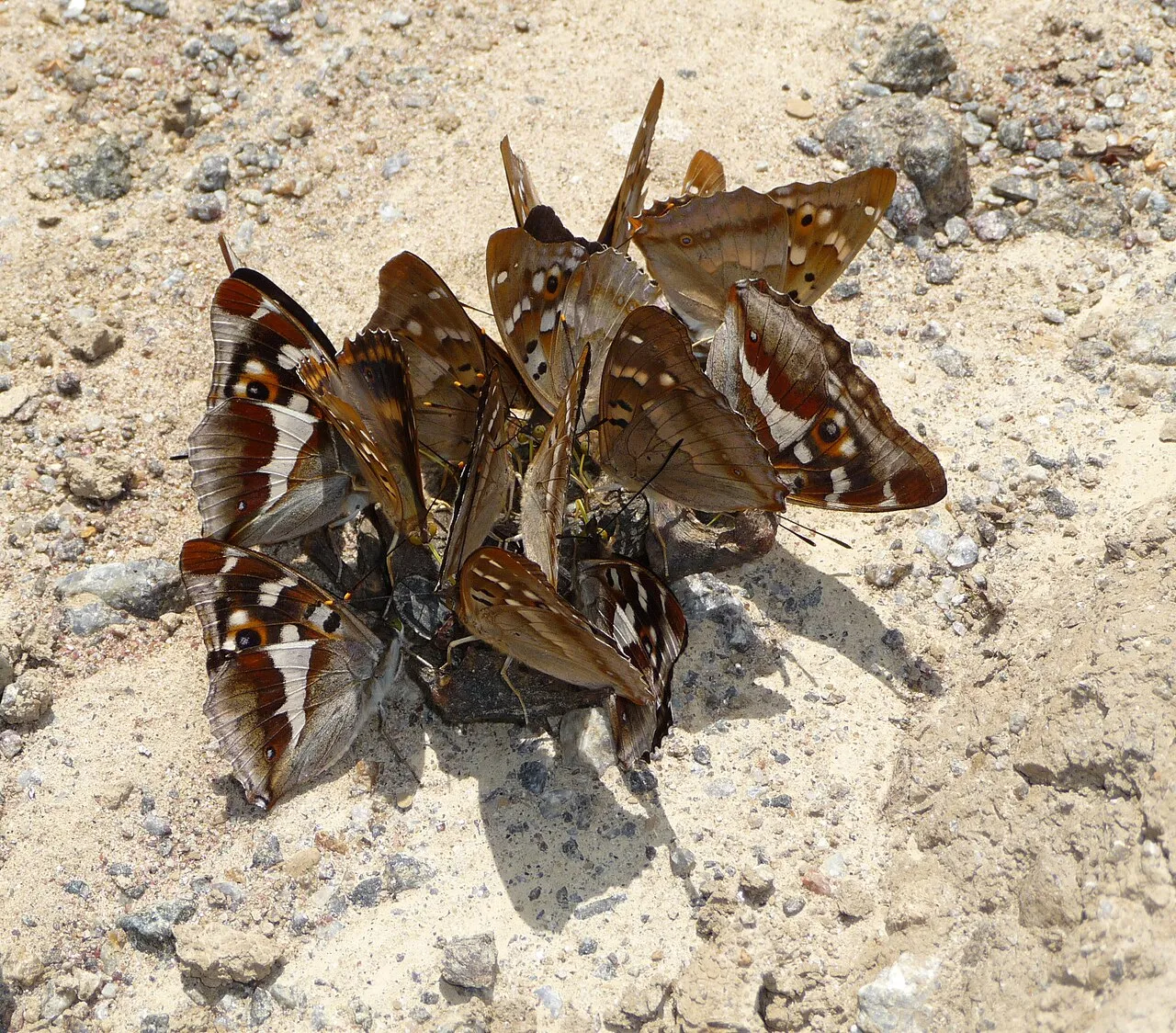
Unlike most butterflies, the purple emperor does not feed from flowers1, but on honeydew secreted by aphids, sap oozing from oak trees, and on dung, urine and animal carcasses. Male and female both spend the majority of their time resting high in the tree canopy. Males come down to the ground in early morning and again in late afternoon to feed on moisture from damp earth and animal droppings, and they sometimes spend over an hour feeding in the same place2. First Nature adds that the males are attracted towards human perspiration3.
In late morning the males congregate at so-called “master trees”, which give them a vantage point for intercepting passing females. When a virgin female is found, the pair fly off and settle in the canopy, where mating takes place. A female that has already mated descends straight to the ground2, where the male loses interest and returns to his perch.
Similar species
- Lesser purple emperor (Apatura ilia): its forewing carries an orange eyespot that differentiates it from Apatura iris, and it is absent from the United Kingdom5.
- White admiral (Limenitis camilla): female purple emperors resemble the white admiral4 but have an orange-ringed eyespot under the forewing.
_-_Blue_Pansy_(Female_DSF)_(5)_WLB_1XtyjN.webp)
_female_Dobruja_26TKKb.webp)
_female_Macedonia_Z3684v.webp)