Contents
The Hermit, Chazara briseis, is a grey-brown butterfly of the family Nymphalidae that blends into its surroundings once it settles on bare rock or stony ground, living in steppe-like grasslands in dry, warm places1 from North Africa across southern Europe to Central Asia.
Identification
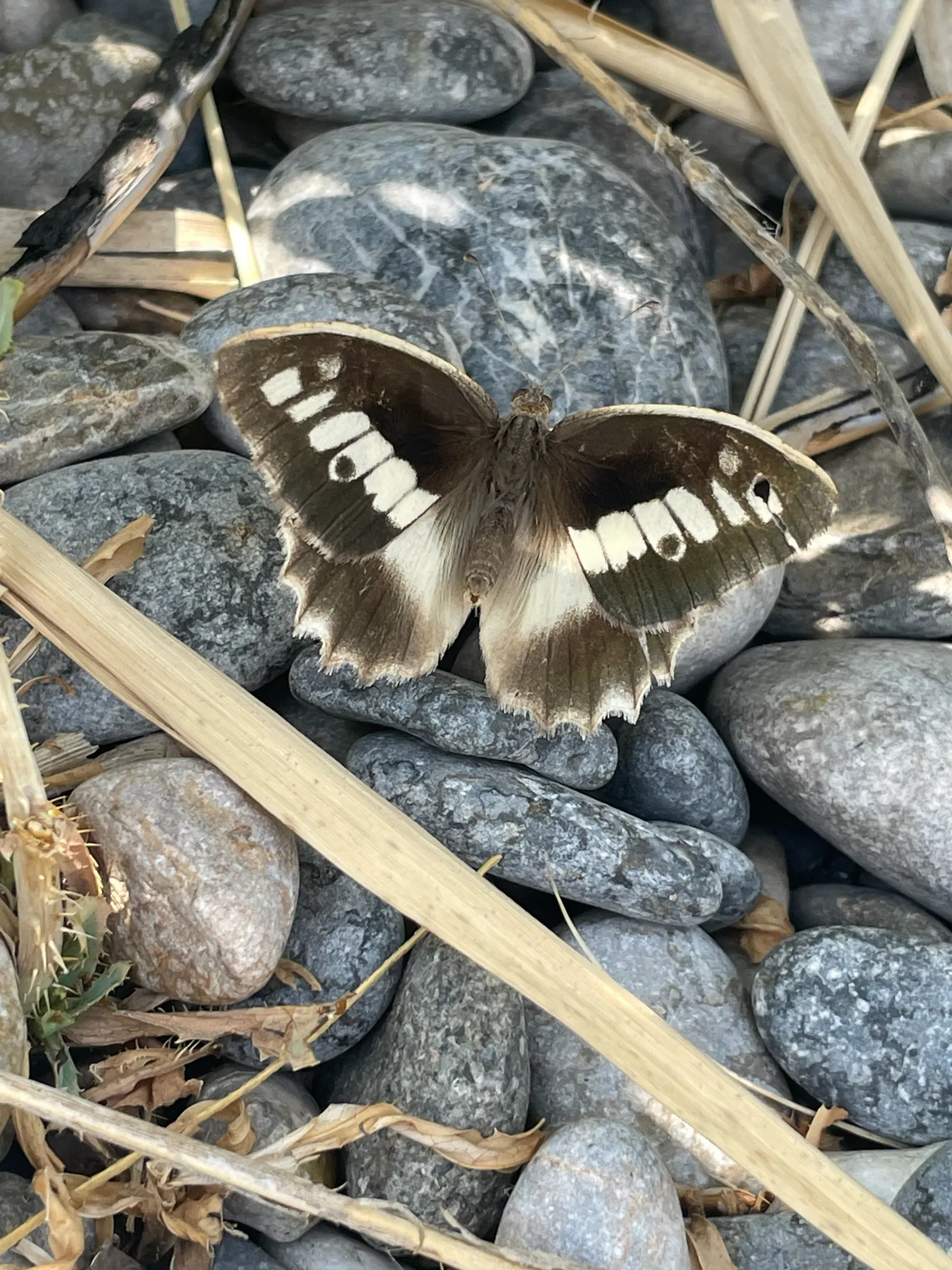
The Naturalis Butterflies of Europe database calls it a very large butterfly1 for the group; the wingspan runs 45 to 60 mm, one source giving a slightly narrower 45 to 58 mm3. The dark upperside of both wings is crossed by a pale band of narrow transverse spots, carrying a distinct eyespot near the forewing tip and a second, similar spot nearer the middle of the outer margin, on the hindwing sometimes shaded. At rest, two further distinguishing marks stand out: the flat triangular club of the antenna, and a pale leading edge to the forewing. The sexes differ mainly beneath: males show large dark angular spots at the base of both wings, while the female’s hindwing underside is more uniformly brownish or grey throughout. At rest the Hermit keeps its wings tightly closed2, the cryptic underside turning it into a patch of bare ground.
The caterpillar is yellowish grey, with a dark stripe down the back, dark lines beside it, and two paler lines above the breathing pores on each flank; the chrysalis is brownish yellow2, with a darker stripe down the back.
Range and habitat
One account extends the Hermit’s range beyond North Africa and southern Europe to Asia Minor and the Caucasus, and further east through Kazakhstan, Central Asia, Afghanistan and north-western China to Tuva, while in the northern parts of its European range it is confined to dry chalk hills. The Naturalis Butterflies of Europe database lists its habitat as dry siliceous and calcareous grassland, inland cliffs and exposed rock, and locally deciduous forest1 too, while another account narrows the altitude to steppe and other dry grassy places between 500 and 2,500 m on chalky soil. Lepidoptera Mundi adds that it also turns up on limestone rocks, in disused quarries and in warm meadows3 across its European range, and the Pyrgus.de account adds grazed calcareous grassland4 to that list of places it is found. Adults love to settle on bare ground and on boulders2, where the pale, mottled underside all but disappears against the rock they are resting on.
Life cycle and host plants
Caterpillars feed on a range of grasses, named in one account as Festuca, Stipa, Poa, Brachypodium, Sesleria and Lolium, and Lepidoptera Mundi names Bromopsis erecta and Festuca pallens3 among the grasses used. The Pyrgus.de account singles out sheep’s fescue, Festuca ovina, as the main food plant at most sites, with Festuca guestfalica used locally in the Swabian Alb, and adds that the caterpillar feeds at nutrient-poor grassland sites4 generally, not only on those two fescues. The female lays her eggs singly on withered grass blades, including those of false-brome, brome and fescue grasses. There is one generation a year, and the species overwinters as a small first-instar caterpillar, resuming feeding on grasses until June2 the following year. Pupation happens in a loose cocoon1, in a small hollow in the ground, or occasionally low down on the food plant itself.
Behaviour and flight period
One account puts adults on the wing from July to September, while the Pyrgus.de account gives a flight period from late July until well into September, with a few individuals flying on into early October. Flight style varies noticeably across that wide range: it is low and hopping in the small northern form, but stately and floating2, and rather fast, in the larger forms from Africa and Asia Minor. After hibernation the caterpillar feeds mainly at night, and can be found with a flashlight sitting exposed on the tips of grass blades after dark; it is grown up by late June4.
Conservation
The species is listed Least Concern on the IUCN Red List, version 2022-2, but regional status varies sharply: the Czech Republic’s own red list rates it critically endangered5, and the Pyrgus.de account warns that, driven by the decline of migratory sheep grazing and by air pollution, the Hermit is strongly endangered especially in Central Europe4 and may disappear there within decades.
Similar species
- Grayling (Hipparchia semele): another cryptic, ground-settling butterfly of dry, sunny habitat, closed-winged at rest; the female grayling’s upperside carries a yellow-orange submarginal band6, distinct from the Hermit’s own pale band of narrow transverse spots2.
- Chazara prieuri: on the hindwing underside, C. prieuri shows spotting that is less conspicuous than the Hermit’s7.
_female_Dobruja_26TKKb.webp)
_female_Macedonia_Z3684v.webp)