Contents
The grayling, Hipparchia semele, is a butterfly of the family Nymphalidae best known for vanishing the instant it lands: closed wings and a mottled brown underside turn it into a patch of bare ground. It is found almost all over Europe and parts of western Russia, from sea level up to about 2,000 m, though it is absent from western France, much of Greece, Albania, North Macedonia and most areas south of Bulgaria.
Identification
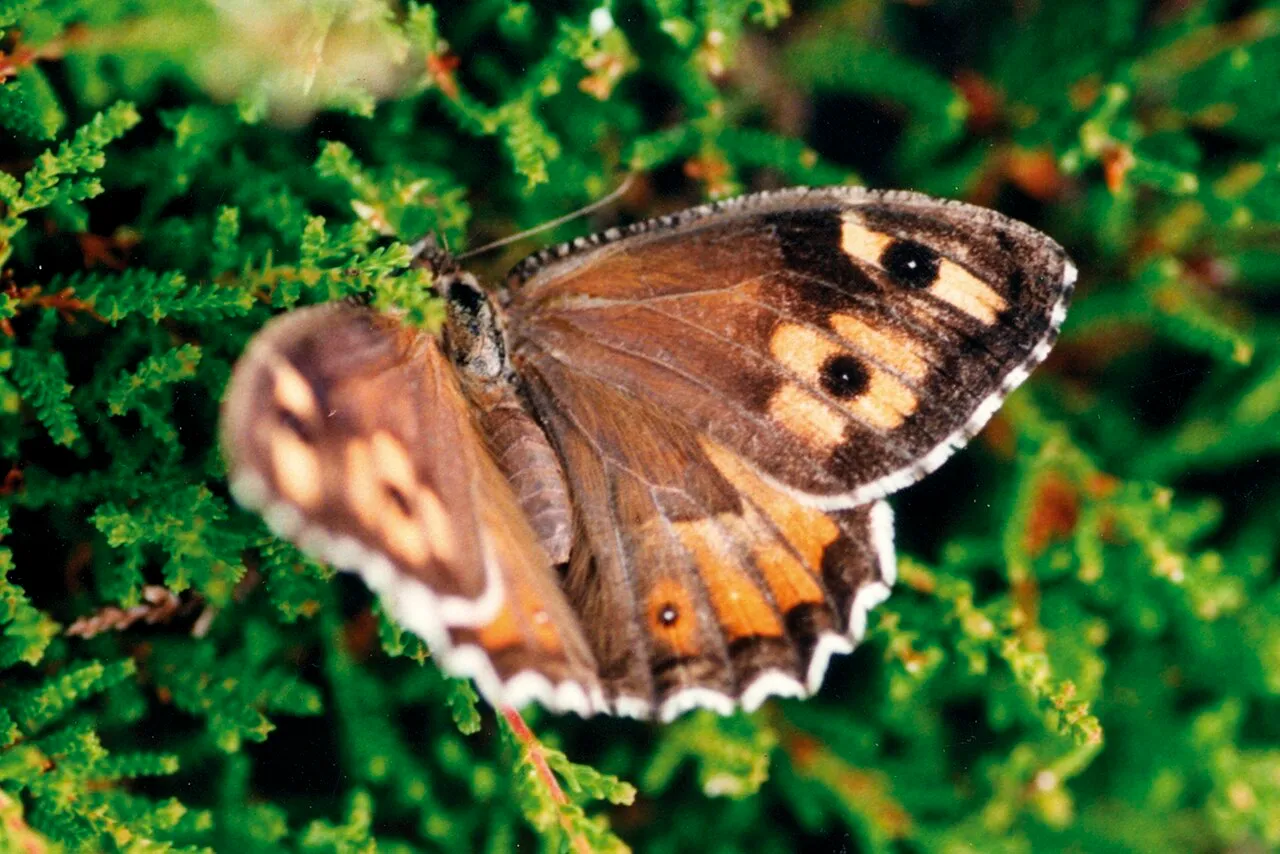
Wingspan runs from about 51 to 62 mm, with females (54–62 mm) running larger than males (51–56 mm). The upperside is mostly dark, but the sexes differ: the male is almost entirely dark, while the female shows a dark brown ground colour crossed by a yellow-orange submarginal band, a band that is more conspicuous in the female and more subdued in the male. Both sexes carry eyespots on the forewing, but these rarely show: at rest the grayling keeps its wings closed, tucking the forewings behind the hindwings to hide the eyespots and expose only the cryptic hindwing underside. The forewing underside, briefly visible on landing, is yellow-orange ringed by a marbled band of brown and white around two black eyespots, while the hindwing underside is marbled brown and white, a pattern UK Butterflies calls “a beautiful spectrum of browns” that disappears against bare earth and stone.
Range and habitat
The grayling keeps to sheltered, sunny, dry sites with sparse vegetation and bare ground, including heathland, sand dunes, coastal grassland, clifftops, limestone pavement and disused quarries. In Britain and Ireland it forms discrete colonies, mainly along coasts in England, Wales, the Isle of Man and the Channel Islands, and is absent from Orkney and Shetland; colony size varies from a few dozen to several thousand adults. Two British races mark the extremes of its variation: the Welsh subspecies thyone, confined to Great Ormes Head in Denbighshire, is considerably smaller and flies several weeks earlier than other races, while subspecies atlantica, found on the western Scottish isles and adjacent mainland, is brighter, with more contrast and more orange on a blacker underside.
Life cycle and host plants
Caterpillars feed on fine grasses, including sheep’s-fescue, red fescue, bristle bent, marram grass and early hair-grass. The species overwinters as a caterpillar, an early-instar larva that hibernates at the base of a grass tussock, resuming feeding on its host grasses the following spring. There is one generation a year. Both sexes feed as adults on nectar, visiting brambles, heathers, thistles and other flowering plants.
Behaviour and flight period
Adults are on the wing from July to August in Britain and Ireland, from June in the Welsh subspecies thyone, while across the wider European range most adults emerge in August. Males are territorial and far more often seen than females, perching on bare ground or occasionally on tree trunks and boulders and flying out to investigate any passing object; females are seen mainly while egg-laying. The grayling regulates its body temperature by leaning its wings at different angles to the sun: it leans to expose its side to the sunlight when cold and stands straight up on its wing edges when it needs to cool down. Courtship is an elaborate display: the male flicks his forewings upward, opens and closes them rapidly and bows before an unreceptive female, releasing scent from scales on the forewing, raising and lowering them rhythmically to win her over.
Conservation
The species is listed as shown in the facts box, a category drawn from its Wikidata record. In Britain, where it is tracked closely, the trend is stark: the grayling has suffered severe declines and is now a priority conservation species, with its occurrence down 92% and its abundance down 72% between 1976 and 2019.
Similar species
- Wall (Lasiommata megera): another small, fast-flying satyrine that rests on bare ground and basks with wings held open rather than closed; its cryptic underside and preference for sun-warmed, open patches of soil overlap with the grayling’s dry grassland habitat.
- Large wall brown (Lasiommata maera): absent from Britain but widespread across continental Europe, it shares the grayling’s taste for stony, sun-exposed ground and a marbled, camouflaged underside, though its upperside keeps more orange than the largely dark grayling.
_kkJaX.webp)
_2r3CXC.webp)
_2_rmr34.webp)