_1Ylt3R.webp)
Contents
The large tortoiseshell, Nymphalis polychloros, is a butterfly of the family Nymphalidae, a close relative of the Camberwell beauty despite its superficial resemblance to the much smaller small tortoiseshell. It ranges across North Africa, southern and central Europe, Turkey, southern Russia and the Urals east to Kazakhstan and the Himalayas. It was once a British resident, died out there in the mid-20th century, and has been recolonising southern England as a migrant since the 2000s.
Identification
This is a large, robust nymphalid, with a wingspan of 68–75 mm: males run 68–72 mm and females 72–75 mm. The upperside is orange-brown, with three black blotches along the leading edge of the forewing, three large black spots further back on the disc, and a narrow blackish band along the outer margin. The underside is smoky brown with darker shading and fine black cross-hatching, giving the closed wings a bark-like camouflage. Wikipedia notes there is no obvious difference in pattern between the sexes; females are simply the larger of the two.
The surest way to tell it apart from the similar yellow-legged tortoiseshell is the legs: the large tortoiseshell has dark-haired tarsi, while the yellow-legged tortoiseshell’s leg hairs are pale. Against the small tortoiseshell, size is the giveaway: the large tortoiseshell is considerably bigger and carries more orange at the base of the hindwing.
Range and habitat
The species favours open woodland, woodland edges and clearings, orchards, hedgerows and areas of scattered trees, the kind of broken, sunny-but-sheltered ground where its host trees grow. Adults rarely bother with flowers: they feed instead on tree sap, fermenting fruit and honeydew, and are often found basking on tree trunks or feeding at sap runs and overripe fruit.
Life cycle and host plants
Caterpillars feed on elms, sallows and willows, aspen and poplars, plus pear, apple, whitebeam and rowan (Sorbus), hawthorn and species of Prunus. Females lay their pale green eggs in a continuous band around a twig near the top of a host tree, and the caterpillars that hatch are gregarious, feeding together and systematically stripping the topmost twigs bare. When fully grown, a caterpillar moves further down the tree and spins a silk girdle around a twig to pupate, forming a greyish-brown chrysalis with a faint silvery sheen.
The species is univoltine, producing a single generation a year. Adults emerging in high summer feed up before going into hibernation for the rest of the year.
Behaviour and flight period
New adults emerge in July and August, feed to build reserves, and then go into hibernation for the winter. They over-winter as adults in dry, dark places such as hollow trees or outbuildings. The butterflies reappear with the first mild spells, emerging from hibernation and mating in late February or early March.
Similar species
- Camberwell beauty (Nymphalis antiopa): its closest relative despite looking quite different, sharing the genus Nymphalis rather than the small tortoiseshell’s genus Aglais.
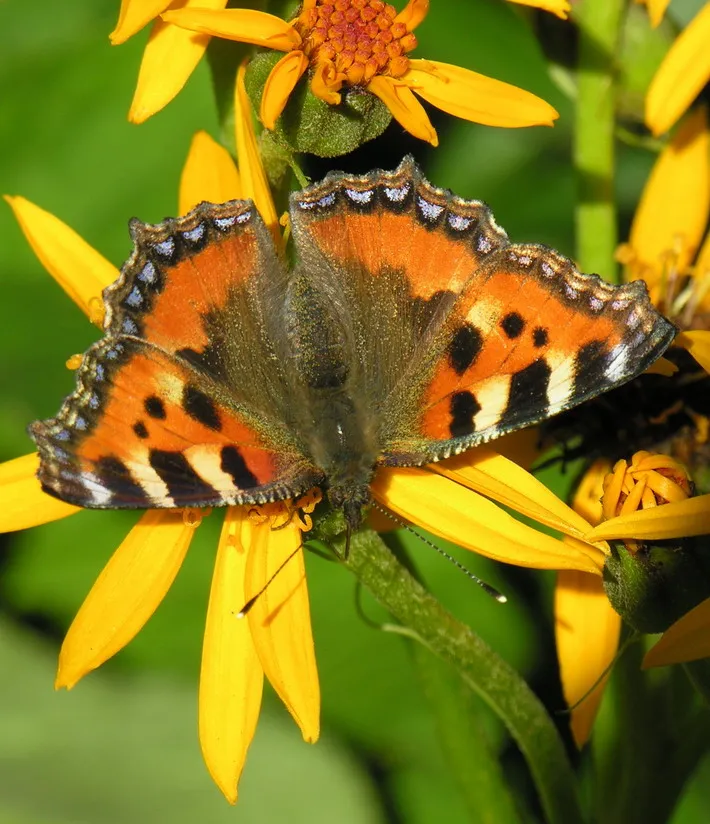
- Small tortoiseshell (Aglais urticae): smaller and superficially similar in colour, but the large tortoiseshell is noticeably bigger and carries more orange at the hindwing base.
- Yellow-legged tortoiseshell (Nymphalis xanthomelas): very close in size and pattern; told apart mainly by its pale leg hairs, against the large tortoiseshell’s dark ones.
_Nymphalis_xanthomelas_anna_-_Pologne_-_male_X5gMY.webp)
_kkJaX.webp)
_2r3CXC.webp)