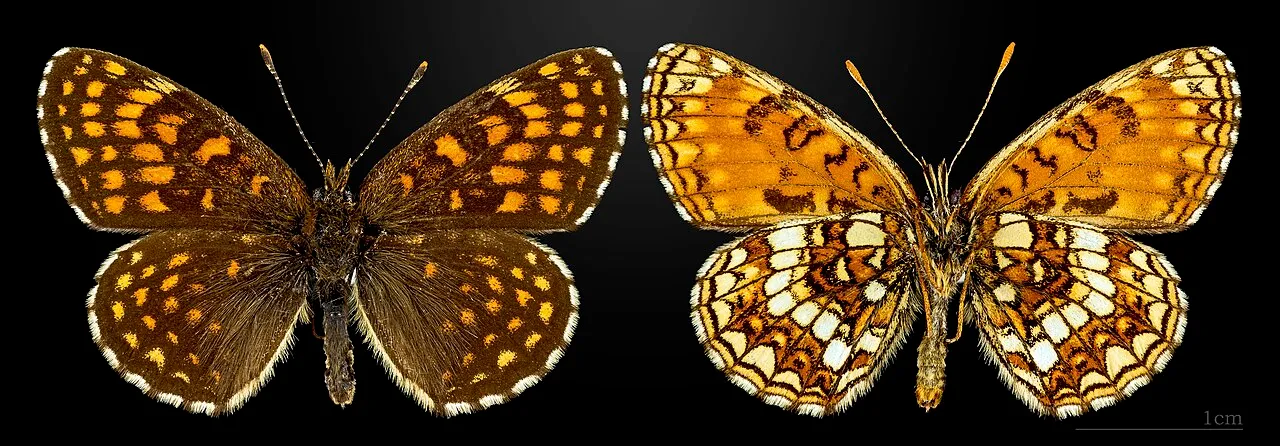
_Nymphalis_xanthomelas_anna_-_Pologne_-_male_X5gMY.webp)
Contents
The scarce tortoiseshell, Nymphalis xanthomelas, is a mid-sized orange butterfly of the family Nymphalidae, closely related to the small and large tortoiseshells. It was first described, as Papilio xanthomelas, by Denis & Schiffermüller in 1775. It ranges across Eastern Europe, the Himalayas from Kashmir to Mussoorie, China and Japan, and has turned up as a rare migrant as far west as south-east England. Across most of that range it is a lowland species of river valleys and damp woodland, tracking the willows and poplars its caterpillars depend on.
Identification
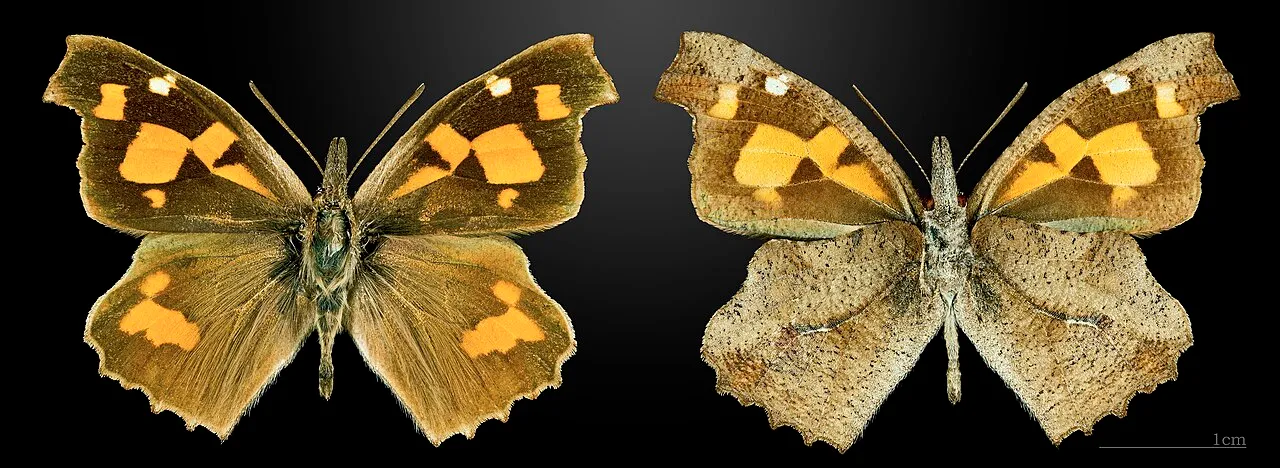
The butterfly has a wingspan of about 63–68 mm. The upperside is a rich orange-yellow, with the forewing’s leading edge dusky black on the inner half and flecked with brown, two black spots in the cell, and a sinuous black band crossing both wings before the border, which itself is a dusky band flecked with golden brown. The underside is a duller ochreous brown, finely streaked with slender dark brown lines, with a row of dark blue crescents forming a band near the edge of both wings. Away from the wings, the antennae, head and thorax are a very dark brown, while the abdomen is fulvous, a tawny orange-brown. The sexes are similar, though the female carries an extra, incomplete row of yellow crescents bordering the black band on the upperside.
The caterpillar is distinctive in its own right: cylindrical and slightly hairy, with a dorsal row of short spines on the third to last segments and a pair of slender yellowish lines running down its back.
Range and habitat
Within its range the species keeps to damp deciduous woodland on flood plains and along wooded stream and river banks, including mixed and alluvial forest, and more broadly to lowland woodland growing on flood plains or on the wooded banks of streams and rivers. It is normally a lowland butterfly, and the handful of records from much further west, such as a specimen recorded by the British entomologist Christine Foord at Shipbourne in Kent, south-east England, in 1953, reflect occasional long-distance wandering rather than an established population. That pattern — a core range centred on Eastern Europe and temperate Asia, with rare strays turning up far outside it — is typical of several tortoiseshells and marks the species as a periodic, rather than a resident, visitor to Western Europe.
Life cycle and host plants
Caterpillars feed on willows (Salix spp.), poplars (Populus spp.), elms (Ulmus spp.) and nettle tree (Celtis australis); further east, recorded food plants also include Pistacia integerrima. While young, the caterpillars live together in large communal nests spun among branches that overhang water, before dispersing as they near maturity. That choice of nest site, suspended over running water, mirrors the adult’s own preference for flood-plain woodland, and may help keep the colony away from ground-based predators during the vulnerable early instars. The species is single-brooded, producing one generation a year.
Behaviour and flight period
The scarce tortoiseshell overwinters as an adult, hibernating in sheltered spots such as hollow trees or wood piles. With a single generation a year and adults carrying the species through winter, individuals that emerge in summer must survive for several months before breeding the following spring, a strategy shared with its close relatives the large and small tortoiseshells. Choosing flood-plain woodland near water also fits the caterpillars’ habit of nesting communally over streams and rivers before dispersing to feed alone, so that the generation’s habitat needs run from wooded riverbank as a caterpillar to sheltered hollow as a hibernating adult.
Similar species
- Large tortoiseshell (Nymphalis polychloros): closely related and similarly patterned above, but a separate species with its own, more westerly range in Europe.
- Small tortoiseshell (Aglais urticae): smaller and more brightly marked, a familiar look-alike across the same part of the scarce tortoiseshell’s range.
- Nymphalis vaualbum: another close Nymphalis relative with a similar orange upperside, found further east and north across Asia.
_1Ylt3R.webp)
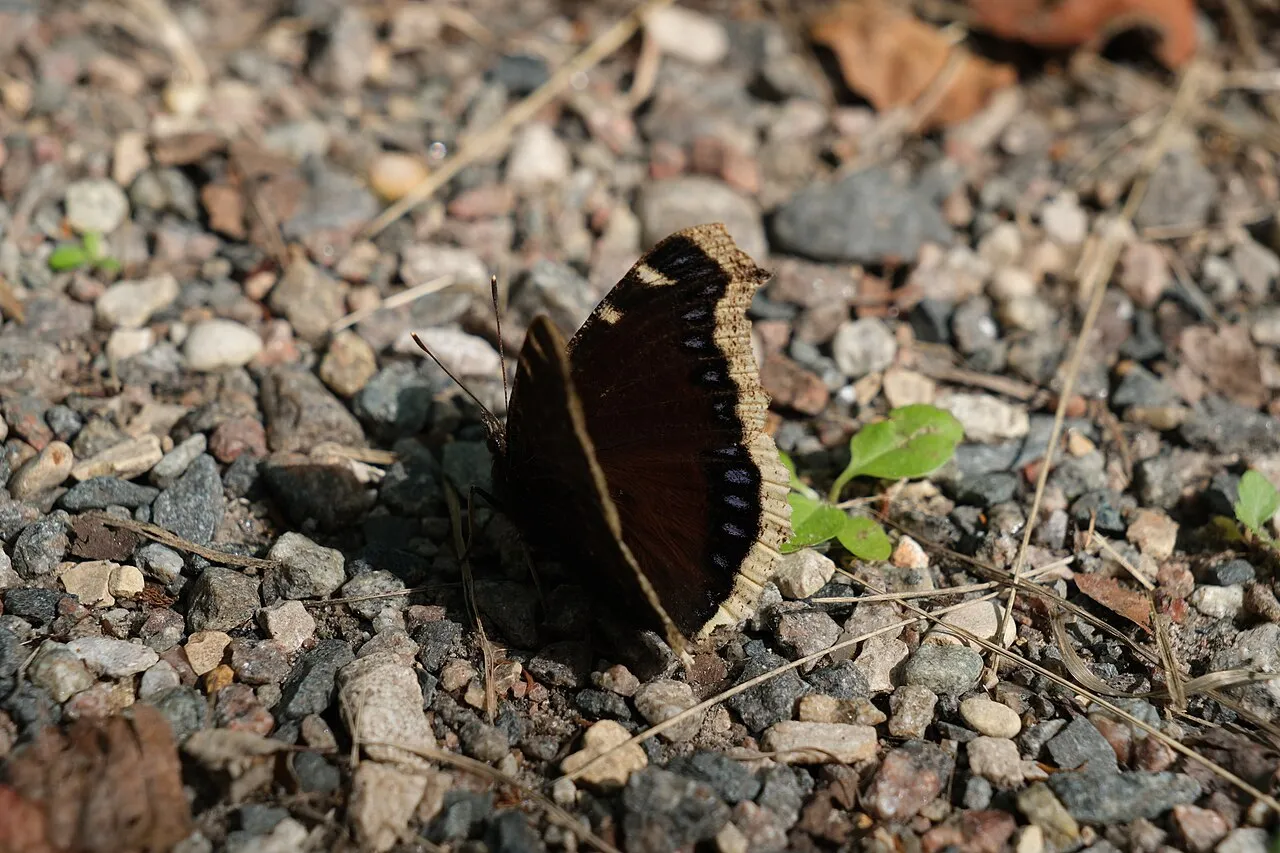
_female_Dobruja_26TKKb.webp)