_Anthocharis_cardamines_-_Foret_de_Bouconne__France_-_male_2lyp2N.webp)
Contents
The orange tip, Anthocharis cardamines, is a white butterfly of the family Pieridae, named for the bright orange patches on the male’s forewing tips. It is one of the first butterflies to appear each spring, and is found throughout Europe and temperate Asia, including Britain and Ireland. Linnaeus named the species in 1758, and several subspecies are recognised across its range, from the nominate A. c. cardamines of Europe to A. c. alexandra of the Tian Shan mountains and A. c. isshikii of Japan; Britain and Ireland have their own, britannica and hibernica. Its caterpillars feed on cuckooflower and garlic mustard, and the species is a familiar sight along hedgerows and lanes.
Identification
The orange tip has a wingspan of 40 to 52 mm. The sexes are easy to tell apart from above: the male’s forewings are white with a large, unmistakable orange tip bordered in black, while the female’s forewings are white with the same black tip but no orange, so that she can be mistaken for a small white or green-veined white at a glance. The underside of the hindwing in both sexes carries a mottled green-and-yellow pattern, made up of fine yellow and black scales over a white ground, which breaks up the butterfly’s outline when it settles on a flowerhead and closes its wings. The orange tips themselves are thought to work as a warning, advertising the mustard-oil compounds the caterpillars take up from their cruciferous foodplants and carry through to the adult. Adult size is not fixed: a caterpillar raised on garlic mustard tends to produce a larger butterfly than one raised on cuckooflower.
Range and habitat
The species ranges throughout Europe and temperate Asia, including Britain and Ireland, and further east across the Palearctic as far as China. In Britain it is found through England, Wales and Ireland, more locally in the north and in Scotland. It favours country lanes, hedgerows, riverbanks, woodland margins and rides, damp meadows and gardens. Within these habitats the sexes part company: males favour forest edges and clearings, while females keep to open meadows and dry hillocks, reflecting the male’s habit of patrolling for mates and the female’s need to find host plants in sunny, open ground. Unlike many British butterflies, the orange tip has been doing well: both its distribution and its population have grown in recent decades, with abundance up by around a quarter between 1976 and 2019, and warmer spring and summer temperatures have pushed its first appearance in Britain more than two weeks earlier than in the 1970s, while lengthening the flight period.
Life cycle and host plants
Caterpillars feed mainly on cuckooflower (Cardamine pratensis) and garlic mustard (Alliaria petiolata), and will also take charlock, dame’s-violet, hairy rock-cress, hedge mustard, honesty, large bitter-cress, turnip and winter-cress. A female lays her eggs singly on the flower stalks of a young inflorescence, and marks each one with a pheromone that discourages other females from using the same flowerhead. The egg is greenish-white when laid and slowly turns orange and then brown over the following days, hatching after one to two weeks.
On hatching, a caterpillar eats its own eggshell before moving on to the seed pods of its foodplant, and a hatchling that meets another caterpillar on the same plant will usually eat it too, a habit that keeps the species spread thinly across its host plants rather than crowded onto a few. The caterpillar passes through five instars over three to four weeks, changing from yellow-ochre when newly hatched to pale and then deep green, with a pale stripe along each side, by the final instar; resting lengthwise along a developing seed pod, it is superbly camouflaged at every stage.
The species passes the winter as a chrysalis, for around eleven months in Britain, fixed by a silk girdle to a plant stem away from the foodplant itself. The chrysalis is green at first and turns light brown as winter approaches, its elongated, concave shape mimicking a seed pod and making it very hard to find in the field. The species completes a single generation each year, though a small partial second brood has occasionally been recorded in early years.
Behaviour and flight period
In Britain and Ireland the orange tip flies in a single brood, from early April through May and into June. Males spend much of the day on the move, patrolling hedgerows and lane edges in bright sunshine in search of females rather than holding a fixed territory, which makes the species conspicuous even where it is not abundant; a virgin female found in flight is pursued at once and mating nearly always follows. A perched female signals her status with her abdomen, raising it to detain a male if she is still a virgin, and swinging it away from an approaching male if she has already mated, since a mated female also carries a pheromone that discourages further mating attempts. Both sexes visit flowers for nectar, including bluebell, bramble, dandelion, garlic mustard, red campion and vetches, and the caterpillar’s camouflage and the chrysalis’s resemblance to a dry seed pod make the early stages far harder to find than the adult. Spiders take a steady toll of caterpillars, and grazing muntjac deer destroy a further share of eggs and young caterpillars by browsing the flowerheads they sit on.
Similar species
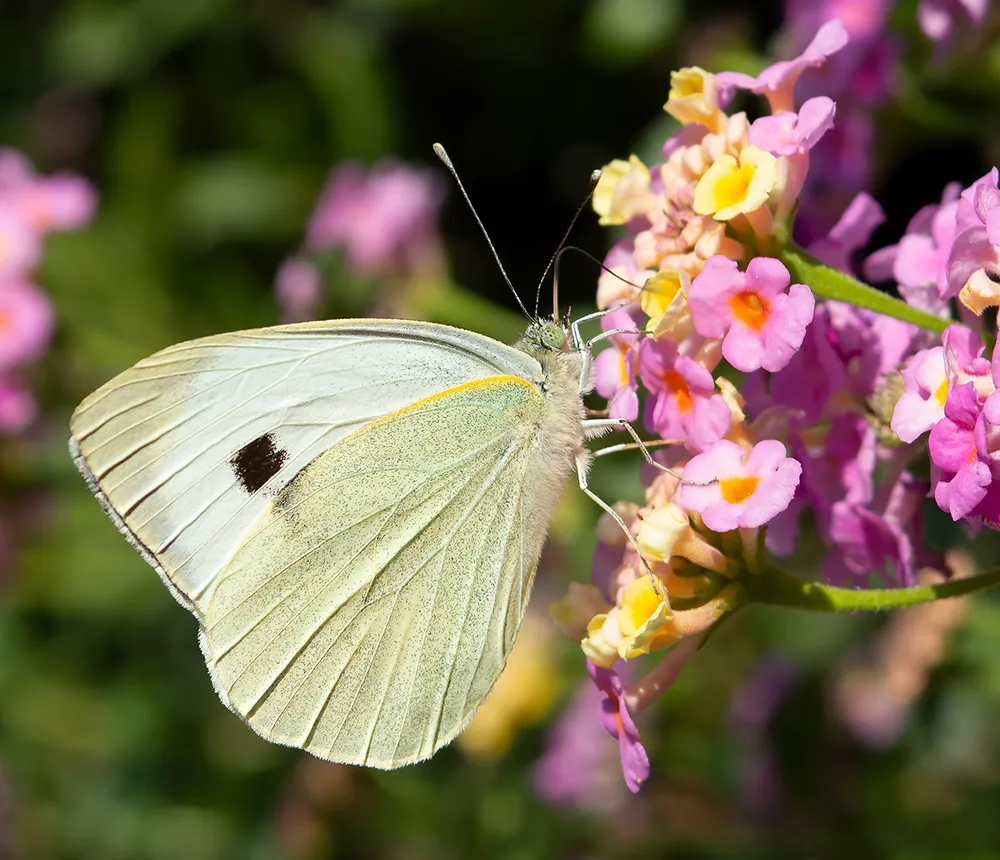
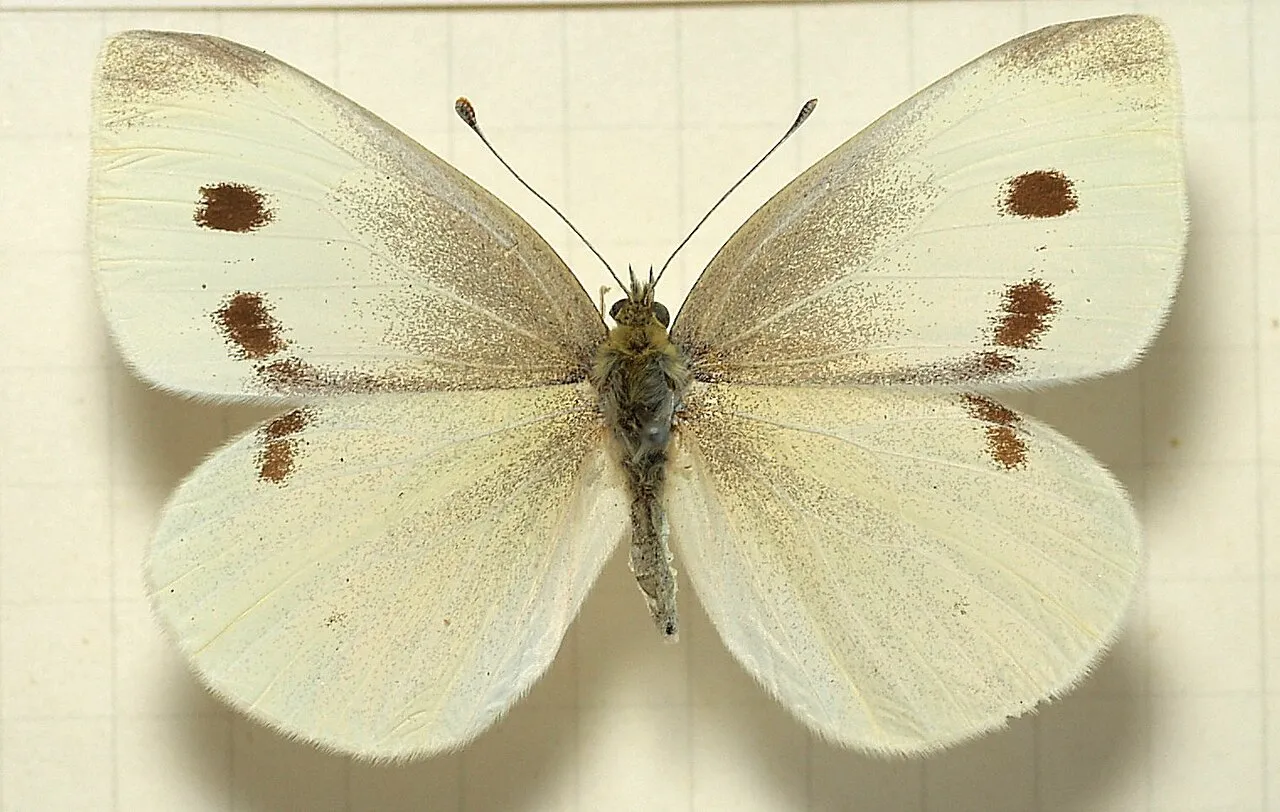
- Large white (Pieris brassicae): another white butterfly on the wing at the same time of year, but larger and lacking any orange, with plain black wingtips rather than the orange tip’s bold orange-and-black patch.
- Green-veined white (Pieris napi): close to the female orange tip in general colouring and often confused with her in flight, but it lacks the black-tipped forewing and the mottled green underside of the orange tip.
_Aporia_crataegi-_Foret_de_Soreze_Tarn_France_-_male_25HPdB.webp)
_Gonepteryx_rhamni_-_Pr%C3%A9serville_France_-_male_KFu9N.webp)
_Pieris_napi_napi_-_Foret_de_Bouconne__France_-_male_Z19U1qT.webp)
_Colias_croceus_-_Durfort_Tarn_France_-_male_ZvAIWE.webp)