Contents
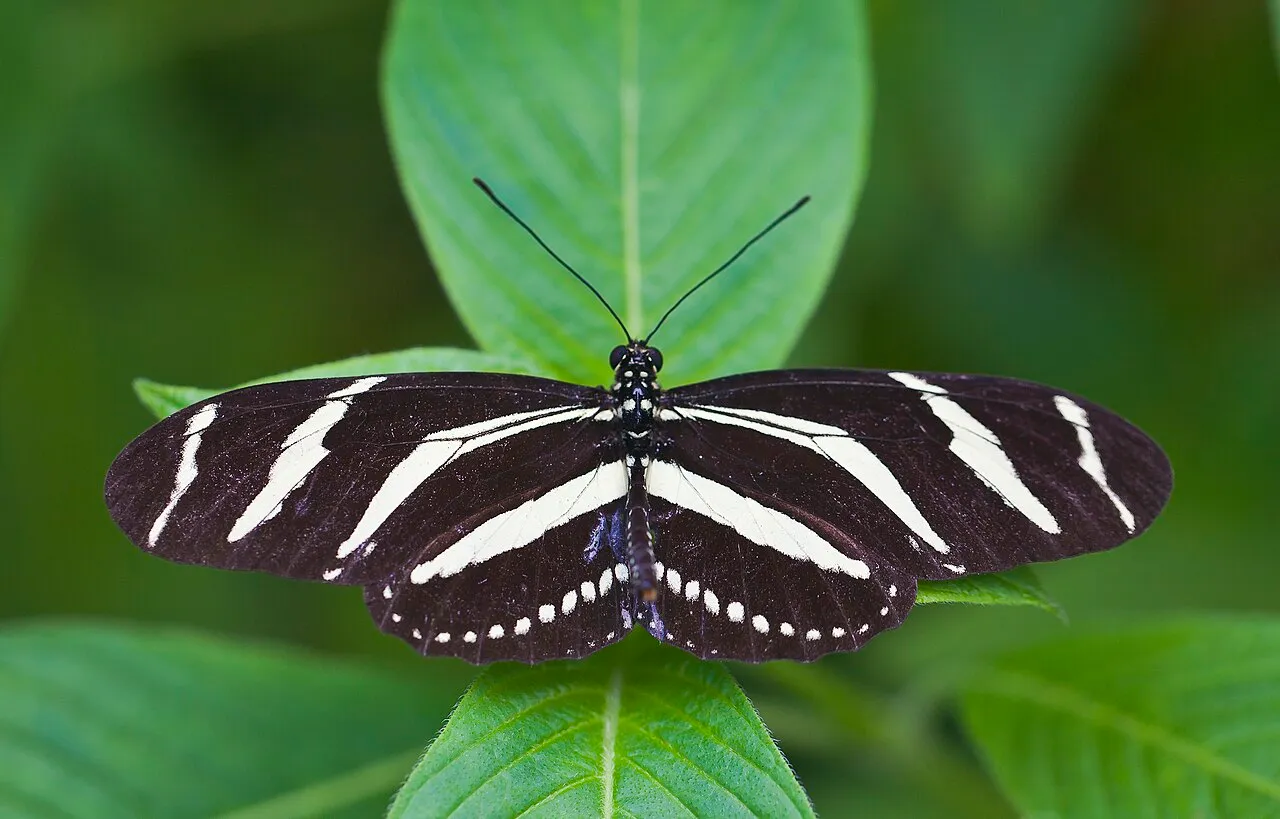
The zebra longwing, Heliconius charithonia, is a butterfly of the family Nymphalidae, subfamily Heliconiinae and tribe Heliconiini1, found across South and Central America and as far north as southern Texas and peninsular Florida. Its wings are long and narrow, black with narrow yellow stripes. Carl Linnaeus first described it in 1767, and it was designated the state butterfly of Florida in 19962. Butterflies and Moths of North America3 lists it as the zebra heliconian.
Identification
The wingspan is 72 to 100 mm. Adults are monomorphic, of medium size with long wings. On the upperside the wings are black with narrow white and yellow stripes2; the underside carries a similar pattern, but paler and with red spots.
The caterpillar is white with black spots2 and has numerous black spikes along its body.
Range and habitat
Butterflies and Moths of North America gives the range as South America north through Central America, the West Indies and Mexico to South Texas and peninsular Florida, with occasional immigrants north to New Mexico, Nebraska and South Carolina3. The Florida Museum gives its place of origin as Florida, Central and South America1.
Its subspecies include H. c. tuckeri in the southeastern United States and the Bahamas2, H. c. vazquezae from Mexico to Panama, H. c. ramsdeni in Cuba and the Bahamas and H. c. bassleri in South America.
It lives in tropical hammocks, moist forests, edges and fields. Butterflies and Moths of North America considers conservation measures not usually required, though habitat for permanent populations is limited in South Texas, and names the management need as maintaining habitat and host plant colonies. It lists the NatureServe global rank as G5, demonstrably secure globally3, noting it may be quite rare in parts of its range, especially at the periphery. Butterflies of Mexican origin migrate north into Texas2, following the retracting temperature gradient, and the longer the distance travelled, the shorter the stay.
Life cycle and host plants
Caterpillars feed on passion-vines including Passiflora suberosa, P. lutea and P. affinis. Eggs are laid in groups of 5–15 on leaf buds or leaves of the host plant, and the caterpillars feed at night on leaves3.
Passionflower plants carry trichomes, structures that reduce herbivore attack. The larvae deal with them by pulling their legs free of the trichome hooks2, laying silk mats over the trichomes and biting off their tips, and they often try to avoid the densest areas by staying on the under surface of the leaves.
Adults take flower nectar and pollen, gathered on a set foraging route or “trap-line”, and their favourite plants include lantana and shepherd’s needle3. Eating pollen is unusual among butterflies. Amino acids from pollen are used to synthesize cyanogenic glycosides, which are stored in larval and adult tissues. Without pollen in the diet, oviposition rates decrease and lifetime fecundity drops. Adults can live up to 3 months in the wild2 and 4–5 months in the lab.
Males patrol for females, and are also attracted to female chrysalids. A male waits on the chrysalis and mates with the female as she is about to emerge, then deposits on her abdomen a chemical that repels other males3. This pupal mating is observed quite frequently in insectaries but rarely seen in nature. Females of pupal-mating species such as this one are thought to be monandrous2, rarely mating more than once in a lifetime.
Behaviour and flight period
Adults are on the wing all year in South Texas and southern Florida3, and wander north during warmer months. The species is to some extent static, maintaining a home range2, though adults do move between territories.
Adults roost communally in groups of 25–30 individuals3, returning to the same roost every night. Roosting begins as early as three hours before sunset and usually ends within two hours after sunrise. The roosts give adults protection, the large groups deterring predators and retaining warmth, and by gathering the butterflies display collective aposematism2, advertising their unpalatable taste.
Except at eclosion, the sex ratio is male biased, at 68% males2, because males typically stay near their natal sites while females move around to find egg-laying or feeding sites on Passiflora.
Similar species
- Julia butterfly (Dryas iulia): another heliconian with elongate forewings, resident in peninsular Florida and South Texas among other places. The male is bright orange above and below4, where the zebra longwing is black with yellow stripes.
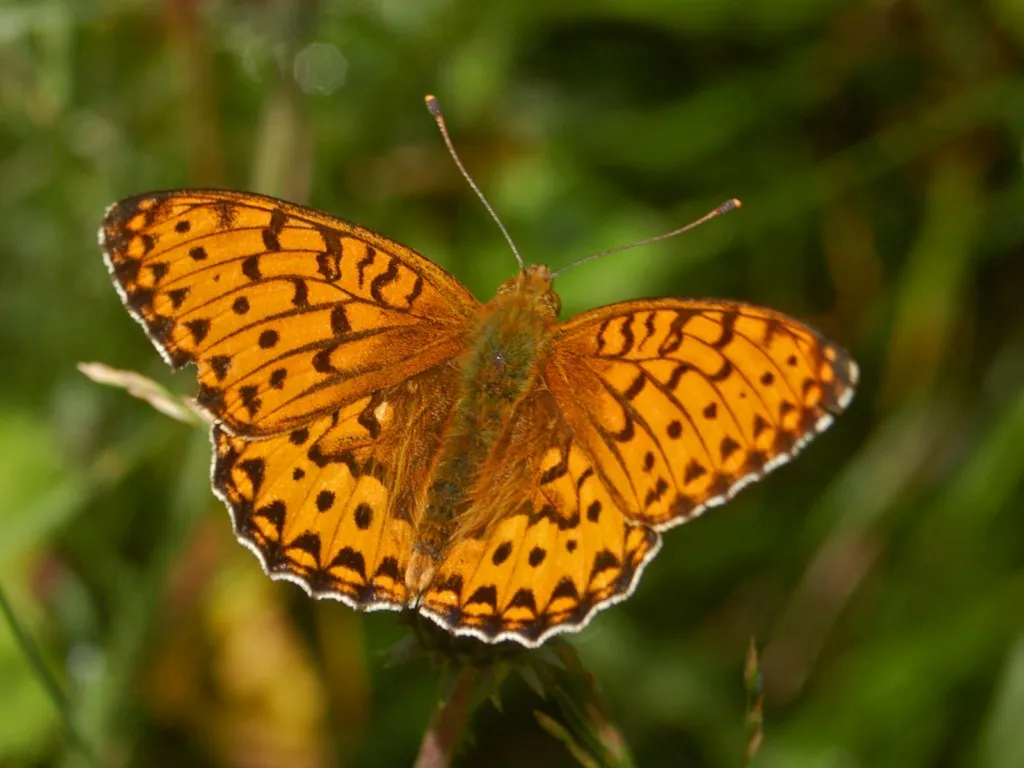
- Gulf fritillary (Agraulis vanillae): the two ranges overlap, and gulf fritillaries can sometimes be subjected to competition and fighting2 from H. c. vazquezae. Its upperside is bright orange with black markings, and the underside has elongated, iridescent silver spots5.