Contents
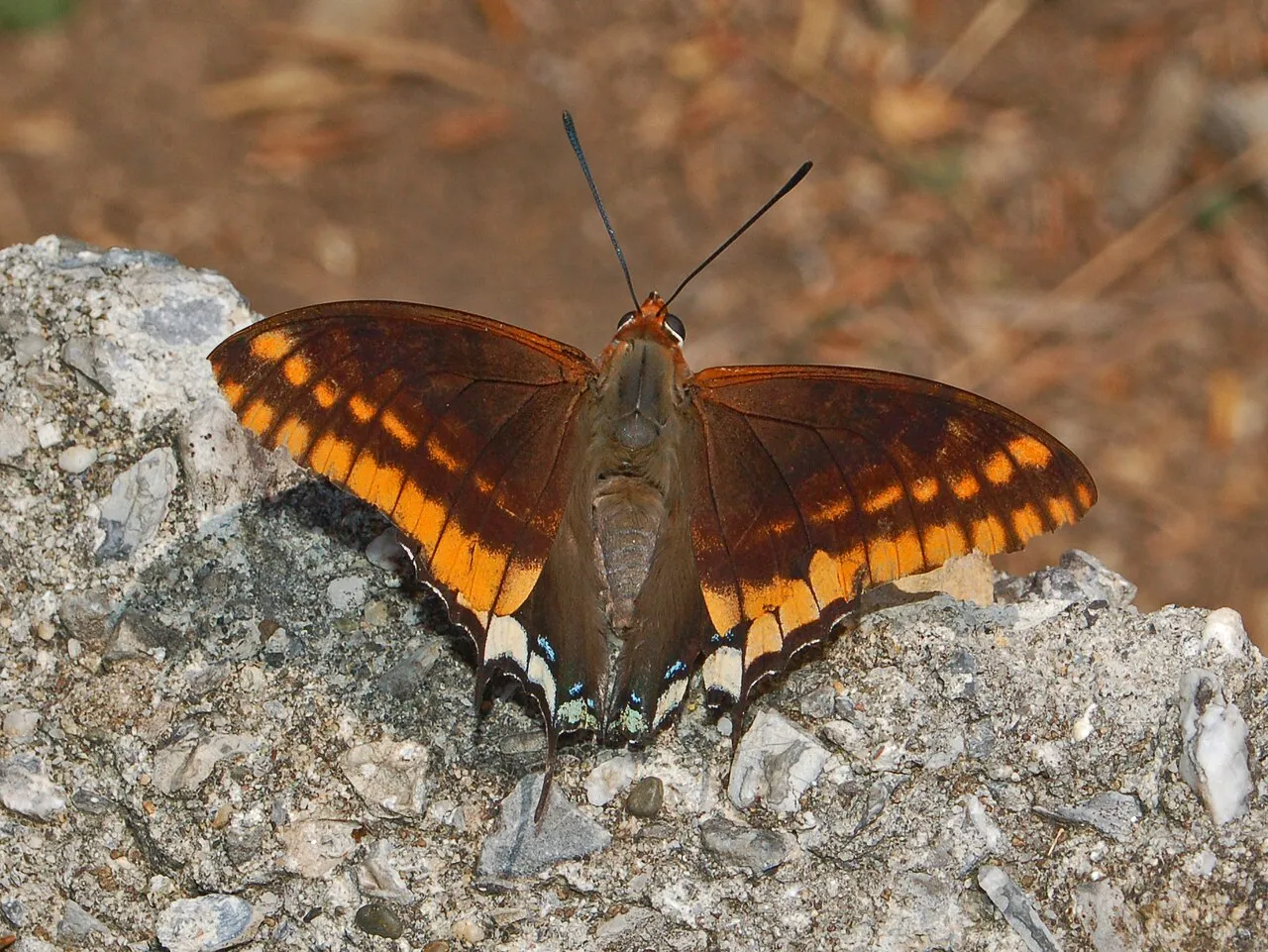
The two-tailed pasha, Charaxes jasius, is a large, powerful butterfly of Mediterranean scrub, named for the pair of tails on each hindwing. It belongs to the family Nymphalidae, in the mostly African genus Charaxes, of which it is the only species established in Europe, and its range, biology and striking underside pattern make it one of the continent’s most distinctive butterflies. The species ranges around the Mediterranean Basin: coastal Portugal, Spain and France (inland to Provence, Lozère, Ardèche and Aveyron), Italy, the Balkans and Greece, including the Balearic Islands, Corsica, Sardinia, Corfu and Crete, Turkey, Lebanon and Israel, and along the North African coast to the Atlantic Moroccan coast near Tiznit, with a few inland Moroccan sites up to 2,400 m. Despite this broad spread, its presence anywhere depends closely on the availability of a single caterpillar food plant, which keeps it tied to the coast.
Identification
This is one of the largest European butterflies, with a wingspan of 76–100 mm; males typically measure 76–83 mm and females run larger, while Moroccan specimens can reach 80–100 mm. The upperside is dark brownish-black with a changeable purplish sheen seen at varying angles, the forewing marked with darker discal bars and orange postdiscal spots, and the hindwing carrying a whitish patch near the costal border, dusted with brownish scales. Both wings show an outer border of deep orange-ochreous divided by black-scaled veins, and the hindwing has small submarginal blue spots, often vestigial but more developed in the female.
The underside is the more striking surface, with a very characteristic mosaic appearance of bands and patches in brown, reddish, grey and black, all edged with a filigree of white; a white band crosses completely from forewing to hindwing, and the orange marginal colour of the upperside reappears here too. Each hindwing carries two tails, characteristic of most species in the genus Charaxes; in the spring brood these curve toward each other like a pincer, while later broods show slightly longer, straighter tails. Females are noticeably larger than males.
Range and habitat
The two-tailed pasha keeps to maquis and mixed evergreen scrub in hot, dry coastal regions, from sea level up to about 700–800 m, wherever its larval host plant grows. Because its caterpillars depend on a single shrub, its distribution across the Mediterranean closely tracks that plant’s own range along the coast.
Life cycle and host plants
Caterpillars feed mainly on the strawberry tree, Arbutus unedo, with species of Osyris used as a secondary host. The larva is green and cylindrical, growing up to 50 mm long, with rings of yellow-white raised spots on the body, yellow lines along the sides, two yellow eyespots on the back, and four backward-facing horns on the head. It spins a tent of silk from leaves and returns to it after feeding on the surrounding foliage. The chrysalis resembles a ripening fruit, green at first and turning brown as the adult develops inside, with the adult emerging after two weeks to a month.
Behaviour and flight period
The butterfly flies in two to three broods a year depending on latitude and altitude, with the first eggs laid from May to June and a second batch from mid-August to mid-October; the number of generations, two or three, likewise varies with latitude, altitude and climate. Adults are fast-flying and territorial, and males are noted for hill-topping, gathering on high ground to seek mates. Rather than visiting flowers, adults of both sexes are drawn to fermenting fruit, attracted by its ethanol content, and can be baited with wine and other alcoholic drinks.
Similar species
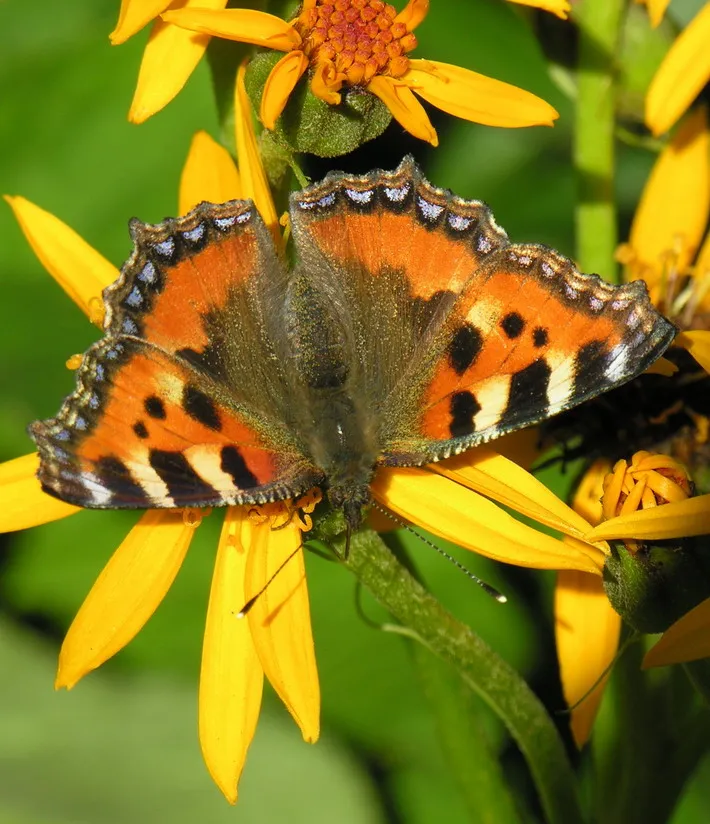
- Large tortoiseshell (Nymphalis polychloros)
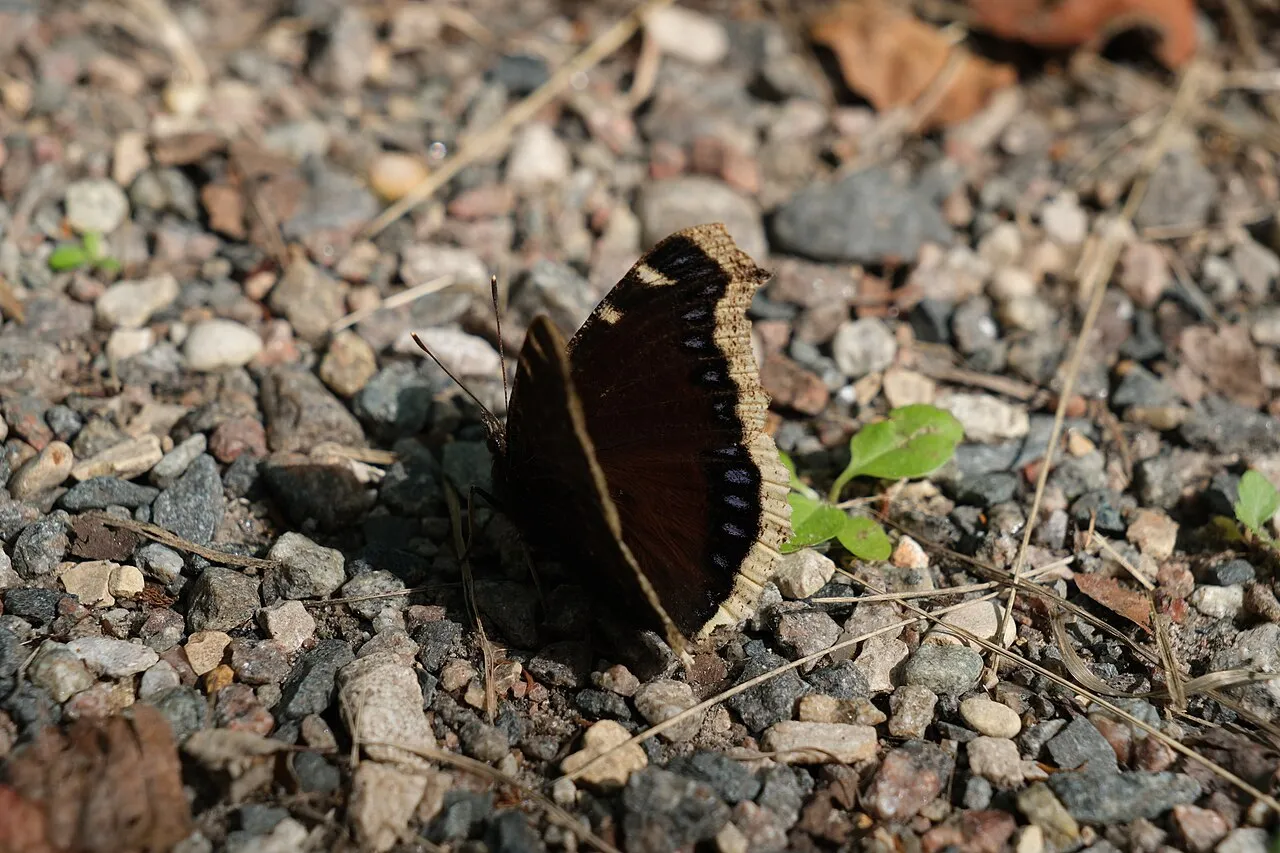
- Camberwell beauty (Nymphalis antiopa)
_kkJaX.webp)
_2r3CXC.webp)
_2_rmr34.webp)